Welcome to the Back Matter Break Down! I am so excited today to bring an interview with one of my writing friends about her debut picture book! Marie Chan was actually one of the first people I met when I joined SCBWI a few years ago, and it’s amazing to get to see her reach this milestone. She put so much work into the back matter of her book, so this will be a treat. And don’t forget to read all the way to the end so you can enter the giveaway for a free copy of her book! Let’s dive in!
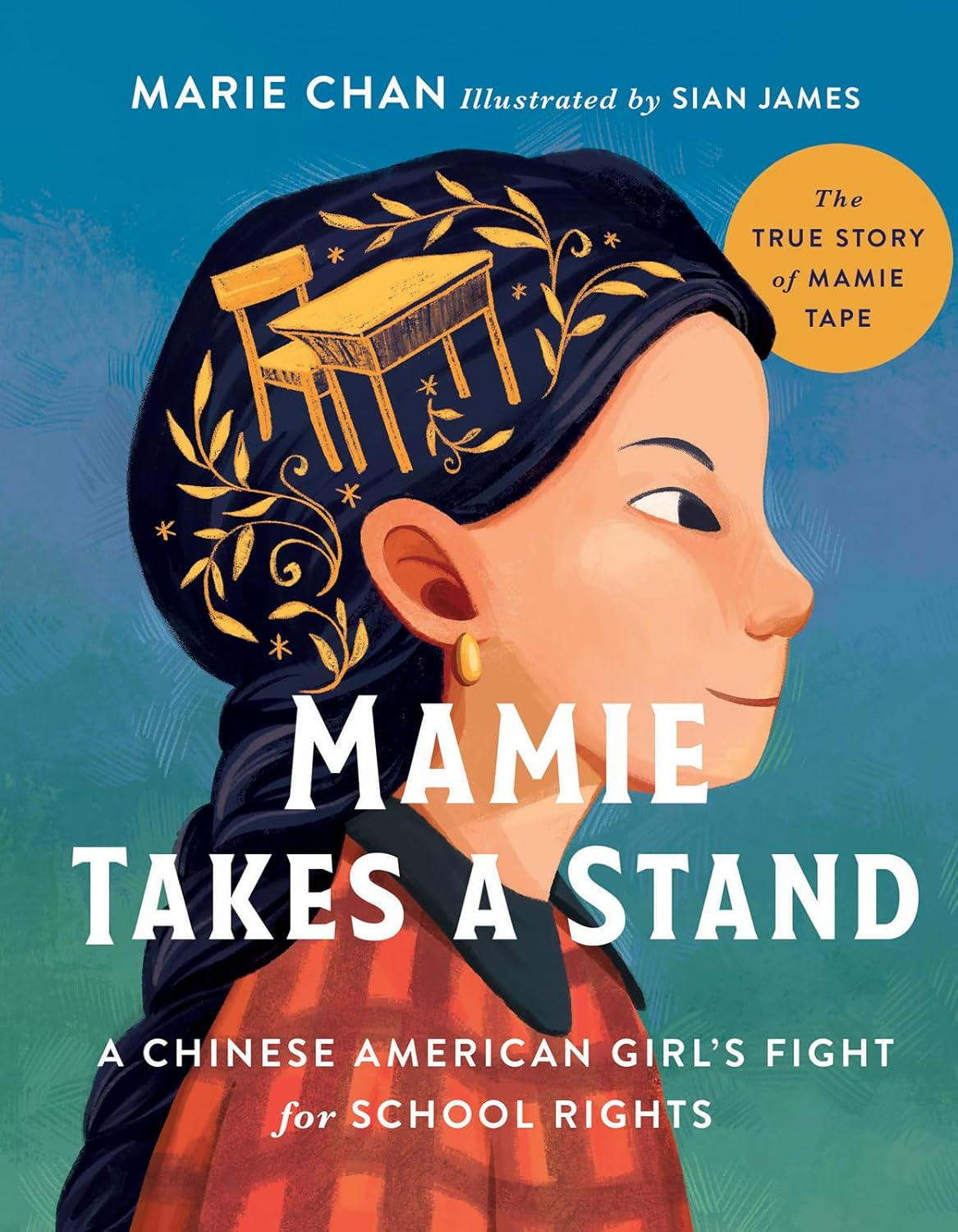
Book: Mamie Takes a Stand: The True Story of Mamie Tape, a Chinese American Girl’s Fight for School Rights
Author: Marie Chan
Illustrator: Sian James
Publisher / Year: Ten Peaks Press, 2024
Topics: Biography, US History, Civil Rights, Chinese American History
Blurb: In the fall of 1884 in San Francisco, California, Mamie excitedly arrived for her first day at an American public school, only to find the principal blocking her way. Why? Because Mamie was Chinese.
Thus began the Tape family’s yearlong struggle to secure Mamie’s right to attend public school. In the spring of 1885, Mamie’s case reached the California Supreme Court, who reaffirmed a lower court’s ruling that public schools should be open to children of all races.
What is your manuscript word count? What is your back matter word count?
Manuscript word count: 1,700 words; plus 182 words for excerpts from Mrs. Mary Tape’s letter; total 1,882 words.
Back matter word count: 1,072 words (not including quotation source notes in the bibliography); 578 words for the timeline; total 1,650 words.
My manuscript word count is higher than a usual picture book, but that is because my acquisitions editor envisioned my biography to be geared more toward middle grade readers, ages 8-12. Having an Asian American editor, who understood my intention behind why I included certain cultural details, such as Chinese words (and decided not to omit them), positively impacted the authenticity of Mamie Takes a Stand. I am grateful that my editor understood the nuances of Chinese culture, the bicultural aspects of being Chinese and American, and also could differentiate between the various dialects of Chinese because of his own lived experience.
At what phase of the drafting/revising/publishing process did you decide your book needed back matter?
From the beginning, I knew I would need a significant amount of back matter to explain this very complex court case and explain how difficult it was to research this hidden figure. I wanted to include additional facts to explain US and California laws, the Tape v. Hurley court case and other school rights’ cases; provide more background about different key leaders in the case; and share interesting family facts, quotation sources, additional resources, archival photographs, discussion questions, a glossary, and a timeline.
What did the first draft of the back matter look like? Can you show us snippets?
I originally formulated my back matter as “Did you know?” sidebars that were to appear on each page. Later, I took the content and incorporated the information into the timeline, main text, and allowed the illustrations to show the information. I also included some of the sidebar information in my 45-page digital Parent & Educator Guide that I wrote to accompany Mamie Takes a Stand.


Tell us about the back matter revision process. Why did changes occur? What changes and revisions came about after working with the editor/agent?
My publisher preferred to put everything in the back matter, so it would look more like a narrative picture book than a reference or educational book that reads more like an encyclopedia entry.
Unfortunately, there was only enough space to put my source notes for my quotes and not my full bibliography. My back matter pages were really full, and my editor and I didn’t want the font to be any smaller, which would make the text difficult to read. My actual bibliography is much longer; I probably have enough sources to write a doctoral dissertation! I may post my full bibliography on my website in the future.
I wanted to include more photographs, but there wasn’t enough space for more photos and all my historic notes to fit in 48 pages. I had suggested inserting additional photographs on the end papers, but the art director and designer decided otherwise. Instead, I included some historic Tape family photographs in the Parent & Educator Guide for Mamie Takes a Stand.
I am grateful for the designer, who created a beautiful layout for the interior, and took my comments into consideration when I shared ways to format the text to improve readability and to make the text more accessible to students with dyslexia. I liked how she added spot illustrations to the timeline, which really help students comprehend the content better when they have visuals next to the text. I also liked how the designer framed the archival photographs like they were in a scrapbook and kept some of the original borders on the photos to reflect the time period.
How did you choose the photos that appear in the back matter? Were you involved in getting permission to include the photos?
I chose the photos that were rarer and showed the span of Mamie’s life. I wanted to cite and include at least one photo from the National Archives to encourage students to utilize their library of primary sources. It was important to show the photo of the Chinese Primary School.
I had to obtain photo permission release forms from the Tape family descendants. I also asked UC Berkeley for the correct citations. The National Archives provided a guide to help me evaluate whether a primary source was within copyright or public domain and how they would like me to write the citation.
I wrote to a California historian and a professor who specializes in Asian American history to gather more information and ask questions about different historic photographs.
What was the most challenging part of the back matter publishing process?
Fact checking everything again after the designer created the layout for each page. Sometimes there were typos and other times the mistakes were mine.
I thought I was done researching, but then I would uncover new evidence that made me question whether another source I had used was completely accurate. Discrepancies abound! It was important to dig deep and look at multiple primary sources before deciding on what to print.
I spent weeks researching the difference in one letter in the transliteration of a single Chinese character (word). This involved contacting a professor who specialized in the research of Chinese dialects and asking an elderly friend who spoke Toisanese to gather more insights. Thankfully, my father had an antique Chinese dictionary that confirmed my research that listed the word with an alternative pronunciation.
Also, there was so much propaganda written against the Chinese during the era of the 1882 Chinese Exclusion Act, that even newspaper articles sometimes were biased in their reporting, so I had to search for other reliable primary sources to make sure the facts were accurate.
Is your back matter aimed for kid readers or adults? What do you hope readers will take away after reading your back matter content?
I wrote the back matter more for adults, but I encourage kids to read the afterword, author’s note, and historic note, analyze the archival photos, and evaluate the primary and secondary sources. I intentionally wrote this biography to read like a story with a narrative arc, but still have robust historical facts so that a child could use my book as a resource for research when writing a biography report for class.
I hope the timeline can be used as a springboard for researching other hidden figures and significant civil rights court cases in US history that involve Asian Americans. Furthermore, I wanted to broaden readers’ perspectives of historic school rights’ cases and show solidarity between different minority groups (e.g., African Americans, Chinese Americans, and Mexican Americans) and how these cases were interconnected and built on one another.
Reflecting on this process, what tips can you offer picture book writers for writing back matter?
If you’re writing a biography, make your own family tree of the person while you are conducting research. Write notes to show how family members are related to each other and where they lived.
Use Google maps to pin key locations in the setting of your story. Take natural disasters into consideration when you do your research. The 1906 San Francisco earthquake resulted in many structures being rebuilt, so I had to check that my reference images of school buildings and other locations pre-dated this earthquake. Some schools moved, were remodeled, or were renamed as well.
Use Zotero to keep track of your sources and to create one version of your manuscript with footnotes for every sentence in your text; this way you will know where the evidence comes from for each fact you write.
Although binders may be cumbersome, one time I needed to fact check something for my manuscript, and the online archive was down for maintenance or inaccessible. I am glad that I had printed out the articles and was able to refer to the hard copy when the electronic version was unavailable. Over the years of research, there have been cases where webpages were no longer existent.
Keep good records of your photo permissions. Copyright can be complicated. Publishers want images that are 300dpi or higher, so make sure photos are scanned at a high resolution for printing.
Also, download the digital educator guides that accompany mentor texts to use as samples when you write a resource guide for your book. Lee & Low Books makes very thorough educator guides that are good examples.
Are there resources or comp titles you can share that would be helpful for writers wanting to learn more about back matter?
I referred to historic Bloomingdale’s, Sears Roebuck, and Montgomery Ward catalogues when I needed images of historic artifacts from the late 1800s-early 1900s. These catalogues gave me a better glimpse of Mamie’s daily life and what clothing, toys, books, and materials may have been in her classroom and home.
I also utilized city directories and Sanborn Fire Insurance Maps to approximate the locations of different places to describe the setting for Mamie Takes a Stand.
A good reference book and general guide to writing children’s nonfiction books is:
Facklam, Margery, and Peggy Thomas. Anatomy of Nonfiction: Writing True Stories for Children. Writer’s Institute Publications, 2011.
Next, on my “want to read” list is, Nonfiction Writers Dig Deep: 50 Award-Winning Children’s Book Authors Share the Secret of Engaging Writing, edited by Melissa Stewart, National Council of Teachers of English, 2020.
The websites of these authors are helpful as well. When I first began writing Mamie Takes a Stand, I had the opportunity to converse with a few of the authors on this list, who were very generous in sharing their experiences in writing nonfiction for children.
Children’s Picture Book Biographies Back Matter Examples
Anderson, Beth. Lizzie Demands a Seat!: Elizabeth Jennings Fights for Streetcar Rights. Illus. E.B Lewis. New York: Calkins Creek, an imprint of Boyds Mills & Kane, 2020.
Brockenbrough, Martha, with Grace Lin. I Am an American: The Wong Kim Ark Story. Illus. Julia Kuo. New York: Little, Brown, and Company, 2021.
Hale, Christy. All Equal: The Ballad of Lemon Grove. New York: Children’s Book Press, an imprint of Lee & Low Books Inc., 2019.
Maclear, Kyo. It Began with a Page: How Gyo Fujikawa Drew the Way. Illus. Julie Morstad. New York: HarperCollins, 2019.
Tonatiuh, Duncan. Separate is Never Equal: Sylvia Mendez and Her Family’s Fight for Desegregation. New York: Abrams Books for Young Readers, an imprint of Abrams, 2014.

Thank you, Marie! You’ve given all of us some great tips and resources for working on our nonfiction picture books and back matter!
Please support Marie!
To order Mamie Takes a Stand: mariechan.com/books
To access digital download of Parent & Educator Guide for Mamie Takes a Stand: mariechan.com/books. This extensive 45-page guide includes engaging, multi-sensory, cross-curricular activities with analysis of archival photographs and primary sources. (I felt like I was writing a second book!)
For upcoming events and to get signed books: mariechan.com/upcoming-events/
I will be teaching Chinese calligraphy and sharing some of the Chinese words in Mamie Takes a Stand at some of my book events. Bring your whole family for art and story time!
Follow Marie on Instagram: @mariechanbooks
Follow Marie on Facebook: @mariechanbooks

Now for a giveaway! Marie and her publisher, Ten Peaks Press, have generously offered to give one lucky person copy of Mamie Takes a Stand! To enter: leave one comment on this blog post by September 17 2024 at 11:59pm Pacific Time. You may earn 1 bonus entry if you leave a comment on the Twitter/X and Instagram posts about this blog to let me know you commented here. (Please remember to check back on this blog post and Twitter/X to see if you are selected as a winner!)
UPDATE: The giveaway is now closed. Congrats to Jamie on winning a copy of Mamie Takes A Stand!
Thank you for reading!
Don’t miss future posts! Subscribe to my blog:

 Judy Campbell-Smith
I know I’m late to the Mamie Takes a Stand comment party, but I just want to high five both of you for such an informative post! Thank you for the helpful details. What an important book; looking forward to reading it soon.