World Read Aloud Day 2026 will be on February 4, 2026!
Educators and librarians, I know you have so many wonderful authors to choose from when looking for a volunteer for your students. I’m happy to once again be coordinating the self-published author and illustrator volunteers. I know they are so happy to be included and share their books with young readers.
When you find a volunteer you’d like to work with, please contact them using the info on the sheet. As schedules fill up, I will remove their names from the list.
Welcome to the Back Matter Break Down! Today we have another author interview about back matter, but we’ll be talking about an approach to back matter that hasn’t been discussed on this blog before. Authors, we are going to find out why, when, and how someone else can write your back matter. Let’s dive in!
Book: Sawyer’s Big Idea
Author: Kimberly Horch
Illustrator: Sayani Mukherjee
Publisher / Year: Magination Press, 2025
Genre: Fiction
Topics: Emotions, ADHD, Creativity, Self-Esteem
Blurb: Sawyer wakes up bursting with creativity. He sketches, builds, imagines, and jumps from one idea to the next. But when things don’t go according to plan, frustration sets in. With a furry sidekick by his side and a day full of half-finished projects, Sawyer learns that even when nothing gets “done,” a day filled with imagination still counts.
Book Word Count: 300
What is your back matter word count?
1,200 words in 3 pages, plus author & illustrator bios, and about Magination Press.
Did you write back matter for your book? If yes, please describe what your back matter was like?
Unlike most of your guests I didn’t write the back matter for my book. I definitely feel that that was the best choice for this book, and I’m excited to get to share more about why.
Did you include your back matter in submissions to editors and agents?
I did not submit with back matter. I always knew that I wanted it to have back matter, but I had more of an idea of what it was NOT going to be. In most books about ADHD, the character learns about strategies to function and thus is able to accomplish what he sets out to do. An important thing for me about SAWYER’S BIG IDEA is that although Sawyer has ADHD, his book is not at all about strategies, it’s a celebration of his creativity and enthusiasm. I really wanted the back matter to stay true to this mission of celebrating his non-linear creativity, rather than prescribing ways for him to function more normally. I had some general headings of what I would like to say to parents, about helping kids see the value in what they did even if it’s not finished, but I didn’t really know what advice to give. Since I didn’t have anything really figured out, I submitted without it.
What conversations did you have with your editor about the back matter?
My editor Katie first brought up the back matter when we were going through edits on the book. She thought it would be a helpful addition, and suggested having a psychologist write it, since ADHD is a more clinical topic. I was a little nervous and told her my concerns about it heading in a “clinical direction”, that I really wanted this book to be a celebration of what their unique brains are good at rather than a correction. Luckily Katie completely agreed, and admitted that focusing on the positive is what she liked about this manuscript to begin with. She suggested that we have the advice directed to parents on helping kids—not in a “let’s fix how your brain works” way, but more like, “here are some ways you can best harness the unique ways your brain works, take advantage of it, support yourself, etc.”
The back matter in the published book is written by Silvi Guerra, Psy. D. Why did the publisher decide to have someone else write the back matter? How did this decision come about? Because Magination Press is the American Psychological Association, many of their books are written by psychologists. However, some books, like SAWYER’S BIG IDEA, are written by people like me who have experience with the topic but aren’t professional psychologists. For a book like that, and about a clinical topic, Katie explained that they like to find a psychologist to write the note. That way the audience gets the best of both worlds—the real-life experience and the professional guidance. Silvi is a practicing psychologist who has written books for Magination Press before. To quote Katie, “She’s both a great psychologist and a great writer, and is particularly good at writing approachable back matter notes. We’ve tapped her for several notes over the years, and they’re always some of our favorites!”
What was your initial reaction to this decision and how do you feel about it now? I was a little worried it would seem like a mismatch to have two different voices, and that the book wouldn’t really feel like mine because someone else wrote part of it. But honestly, that worry disappeared when I saw what Silvi wrote. She did such a great job of explaining to parents how to be supportive but not obtrusive. She gave actionable suggestions for both activities to do together and conversations to have—even suggesting language to use (which I would not have been comfortable doing). I love that her suggestions are based our best understanding of psychology, rather than my own thoughts and opinions—caregivers can feel confident trying her suggestions. Dr. Guerra’s note is a HUGE asset to the book. It makes Sawyer’s story not just a mirror for kids to relate to and feel seen, but also a resource for parents supporting these same creative and energetic kids.
Have you heard from any readers about the back matter and how they are using it? I have heard from readers and reviewers what breath of fresh air her suggestions are. The perspective shift of working WITH their creative passions instead of seeing it as a fight against distraction is huge. Honestly there are a few of her suggestions that I’ve tried implementing in our house, including celebrating failures and modeling out loud what I’m thinking when I’m having a hard time with a project—normalizing having setbacks.
Based on your experience, what are some scenarios that authors may want to consider using outside help in writing or collaborating on back matter? What advice do you have for authors in this situation? As authors, we often write about our own experience, which is so important! But it doesn’t necessarily mean that we’re an expert, or even qualified to give advice—especially when it comes to health and mental health. I love the concept of “combining real-world experience with professional guidance.” Is there someone that could corroborate and potentially also build on what you’ve written?
Perhaps you don’t want your back matter written entirely by someone else—there are other ways to include information from a professional. I’ve seen other authors successfully do this by citing sources, quoting an expert, or including a note or blurb from someone in the field. One of the great benefits of back matter is to expand on what you have in the story, and as Judy is showing us on her blog, there are so many different ways to do that!
Image: A partial screenshot of the back matter in Sawyer’s Big Idea
Thank you, Kim! I’m so glad you were able to share about your experience and that it ended up being such a positive experience for you personally and professionally! Hopefully, you have given other authors some ideas about who to collaborate in their back matter. Please support Kim:
Now for the giveaway! Kimberly has generously offered a picture book critique to one lucky winner!
To enter: leave one comment on this blog post by November 24 at 11:59pm Pacific Time. For additional entries, leave a comment on my (Judy’s) BlueSky and/or Instagram posts about this post for a maximum of 2 bonus entries. (Remember to check back on this blog post and social media to see if you are selected as a winner!)
It’s that time of year again! World Read Aloud Day 2026 is just around the corner, and I’m happy to once again be coordinating the self-published published author and illustrator volunteers.
World Read Aloud Day is February 4, 2026! This is a wonderful day for educators or librarians have a volunteer do a FREE virtual visit with your group on this day.
In order to volunteer for World Read Aloud Day, your book(s) must be written for kids (teens and younger). No adult books please! Any books containing hate speech, discriminatory language, or messages/themes that contradict LitWorld’s mission of diversity and inclusion will not be accepted. To be clear, I will not include books that are racist, anti-LGBTQ+, or sexist on this list.
WRAD virtual visits are not elaborate or time-consuming to plan. Your presentation should last 10-15 and should go something like this:
1-2 minutes: Author gives a quick introduction & talks a little about their books. 3-5 minutes: Author reads aloud a short picture book, or a short excerpt from a chapter book/novel 5-10 minutes: Author answers a few questions from students about reading/writing 1-2 minutes: Author book-talks a couple books they love (but didn’t write!) as recommendations
Welcome to the Back Matter Break Down! Today’s interview is about a wonderful non-fiction book that was still unfolding throughout the publishing process! And don’t forget to read to the end to get the details on the giveaway–you could win a free copy of CHEETAH’S RETURN TO INDIA. Let’s go!
Book: Cheetahs Return to India: The True Story of Aasha and Pavan
Blurb: Cheetahs used to roam India’s grasslands and jungles, but as farms expanded and cities grew, India’s cheetah population dwindled . . . to nothing. Seventy years later, hope–and cheetahs–returned to the Indian subcontinent. From a coalition of cheetahs sent from Africa, Aasha and Pavan are chosen as the first cheetahs to repopulate the land. Will they survive in their new home? Will they thrive? Will India finally see a return of their beloved cheetahs?
Book Word Count: 520 words
What is your back matter word count?
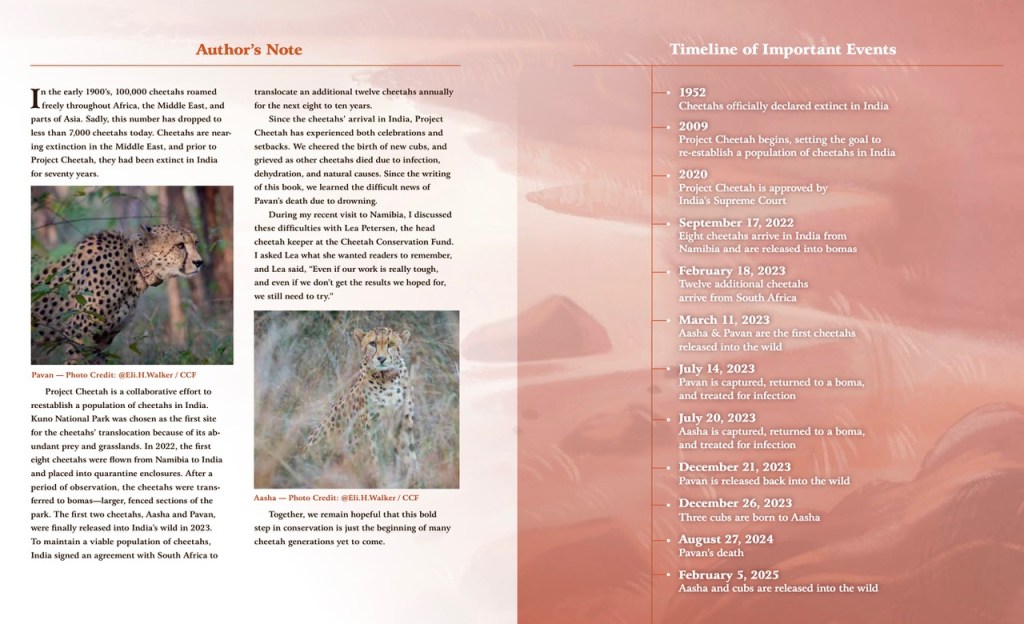
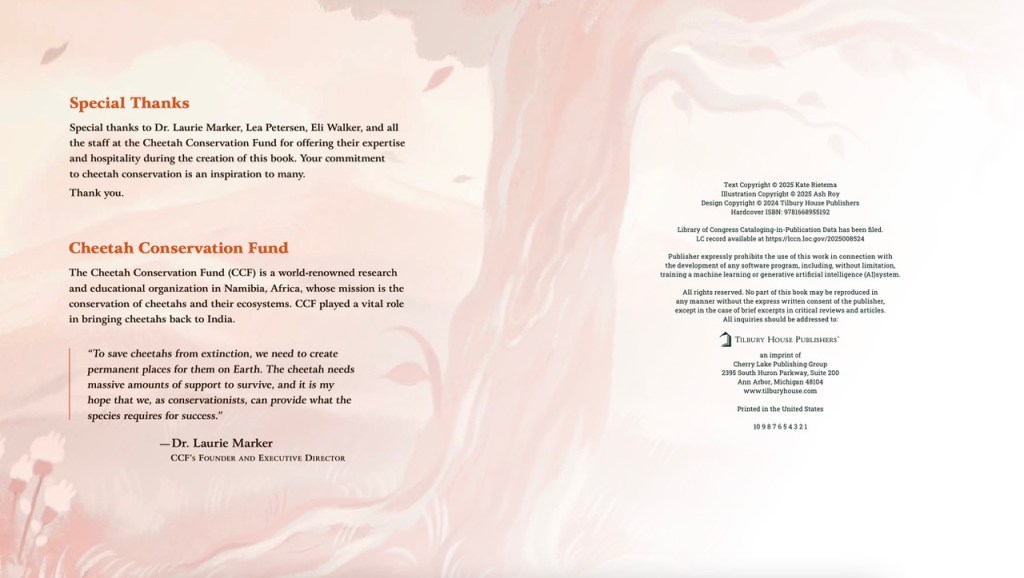
TOTAL: 550 words 2 spreads: Author’s Note: 290 words; Timeline: 133 words; Special Thanks: 42 words; About the Cheetah Conservation Fund: 85 words
What was the earliest version of the back matter like? Is there more information that you wanted to include in the back matter but didn’t make the cut?
The earliest version was much more extensive and broken down into several sections rather than its final form of (mainly) an author’s note and timeline. The original version also included maps, highlighting the historic range of cheetahs across Africa, the Middle East, and parts of Asia compared with their current range today. I was a little sad to see the maps go, but I was able to include some of that information in my author’s note. I also created an activity packet that includes a lot of educational material that didn’t make it into the back matter. You can check that out on my website!
How did you format the timeline for submission?
I simply listed the dates along with the significance of each. I anticipated the final product to be a horizontal timeline, but I think leaving it vertical increased the readability.
What changes and revisions (if any) came about after working with the editor/agent?
This story was tricky because my research and writing was happening in close succession to the actual events. In fact, my agent submitted this manuscript to Tilbury House before Aasha had her cubs—so it wasn’t until after the book was acquired that I added the spread about her litter. Then, after final edits were complete, I learned the sad news of Pavan’s death. Although we couldn’t add his death into the story, we included the event in a timeline as back matter.
What were some challenges (if any) that arose during the back matter writing and publishing process?
It was challenging to connect with primary sources, in part because they were all from outside the United States. I was able to travel to Africa and connected with amazing conservationists in Namibia, but I struck out in finding sources to talk with on the India side of the collaboration. After several attempts, I did receive a hand written note in the Urdu language, but even after I got it translated, it felt like a dead end.
How did you choose the photos that appear in the back matter? Were you involved in getting permission to include the photos?
I’m so glad to have actual photographs of the cheetahs, Aasha and Pavan. I learned that Eli Walker was part of the team from Namibia who flew with the cheetahs to India, staying to monitor and photograph their progress. I originally contacted Eli though social media and he was gracious enough to answer many questions and send me photographs along with permission to use them and how to credit his work.
Thank you, Kate! It’s great to learn how resourceful and thorough you were in your research, especially as events were still unfolding! Please support Kate:
Now for the giveaway! Kate has generously offered a free copy of CHEETAH’S RETURN TO INDIA to one lucky winner in the U.S. (excluding Alaska & Hawaii)!
To enter: leave one comment on this blog post by September 8 at 11:59pm Pacific Time. For additional entries, leave a comment on my (Judy’s) BlueSky and/or Instagram posts about this post for a maximum of 2 bonus entries. (Remember to check back on this blog post and social media to see if you are selected as a winner!)
Welcome to the Back Matter Break Down! I am so excited to share this interview today because we’re talking about a book that sits in one of my favorite types of stories: a mix of fact and fiction! I love when these lines get blurred because it always leads to lots of curious questions and gets readers excited to learn more. And don’t forget to read all the way to the end of the post so you can enter today’s giveaway! Let’s go!
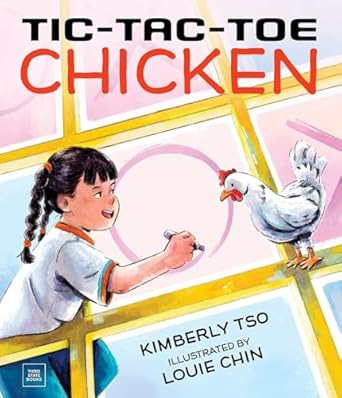
Book: Tic-Tac-Toe Chicken
Author: Kimberly Tso
Illustrator: Louie Chin
Publisher / Year: Third State Books, 2025
Genre: Fiction
Topics: Animals, New York City, Chinatown, History, Asian American History
Blurb: New York City is not a great place for a chicken to live. It’s crowded and loud and busy. But you can find the city’s most famous chicken, Lillie, a.k.a. the Tic-Tac-Toe Chicken, in Chinatown.
When tourists ask, “Where’s the Tic-Tac-Toe Chicken?” locals point them to a video-game arcade on Mott Street, where Lillie plays games of tic-tac-toe against anyone who wants to play against her. But eight-year-old Beatrice worries that the dark arcade is just not a good place for Lillie to live. She devises a clever plan: She will challenge the arcade’s Big Boss in a game of tic-tac-toe. Will Beatrice win Lillie’s freedom?
Book Word Count: 679
What is your back matter word count?
284 words
At what phase of the process did you decide your book needed back matter?
It was always evident that my book needed back matter, because the notion that there was a real chicken that could play tic-tac-toe was fantastical enough that it demanded explanation and context.
What kind of research did you do for the back matter?
I incorporated the research that I did for the book itself. Mostly it was reading through old newspaper articles written about the Tic-Tac-Toe Chicken, watching videos and documentaries created about it, and reading blog posts online that had been written.
What was the earliest version of the back matter like?
The original and the final versions were very close to each other. What changed was the opening paragraph where I wanted to explain in an accessible way why and how authors take inspiration from truth, and which parts of this story were real and which were made up.
Was there more information that you wanted to include in the back matter but didn’t make the cut?
There was more information that I could have included, but was not convinced should go in. For example, there is some discrepancy about how willingly the arcade owner gave up the chicken. The activists say that he did it because they asked nicely and he prayed on it, but the family of the arcade owner says that he was pressured unfairly. I didn’t want to distract from the point of the back matter (which was to clarify what was true and what was fiction), so I just left those details out.
How did you choose the photos that went into the back matter and were you involved in the process of securing them?
Yes, I was involved in the process of securing them. We had very few to be able to choose from, because we were unable to contact the sources. I wanted to include photos of the chicken, but most of the photos we could find were poor quality, unattributed, or we could not contact the source. Images abound online, but I think that reproducing them in a YouTube video is different than publishing them in a book for sale, so we really needed the proper permissions.
Of the photos that went in, one came from the Museum of the Chinese in America’s archival collection, and it was from inside the Chinatown Fair arcade itself, where the chicken lived. The contemporary photo was taken by a photographer hired by my publisher.
Thank you, Kimberly! I love your approach to giving readers the tools they need as they read a mix of fact and fiction! Please support Kimberly:
Kimberly Tso has generously offered a free signed book and special book swag to one lucky winner!To enter: leave one comment on this blog post by Monday, September 1 at 11:59pm Pacific Time. For additional entries, leave a comment on my (Judy’s) BlueSky and/or Instagram posts about this post for a maximum of 2 bonus entries. (Remember to check back on this blog post and social media to see if you are selected as a winner!)
Welcome to the Back Matter Break Down! Today’s interview is about back matter with a unique approach in the way it sends readers back to explore the pages of the book. I can’t wait for you to hear how the back matter came together! And don’t forget to scroll all the way to the bottom of the post to get the giveaway info! Let’s go!
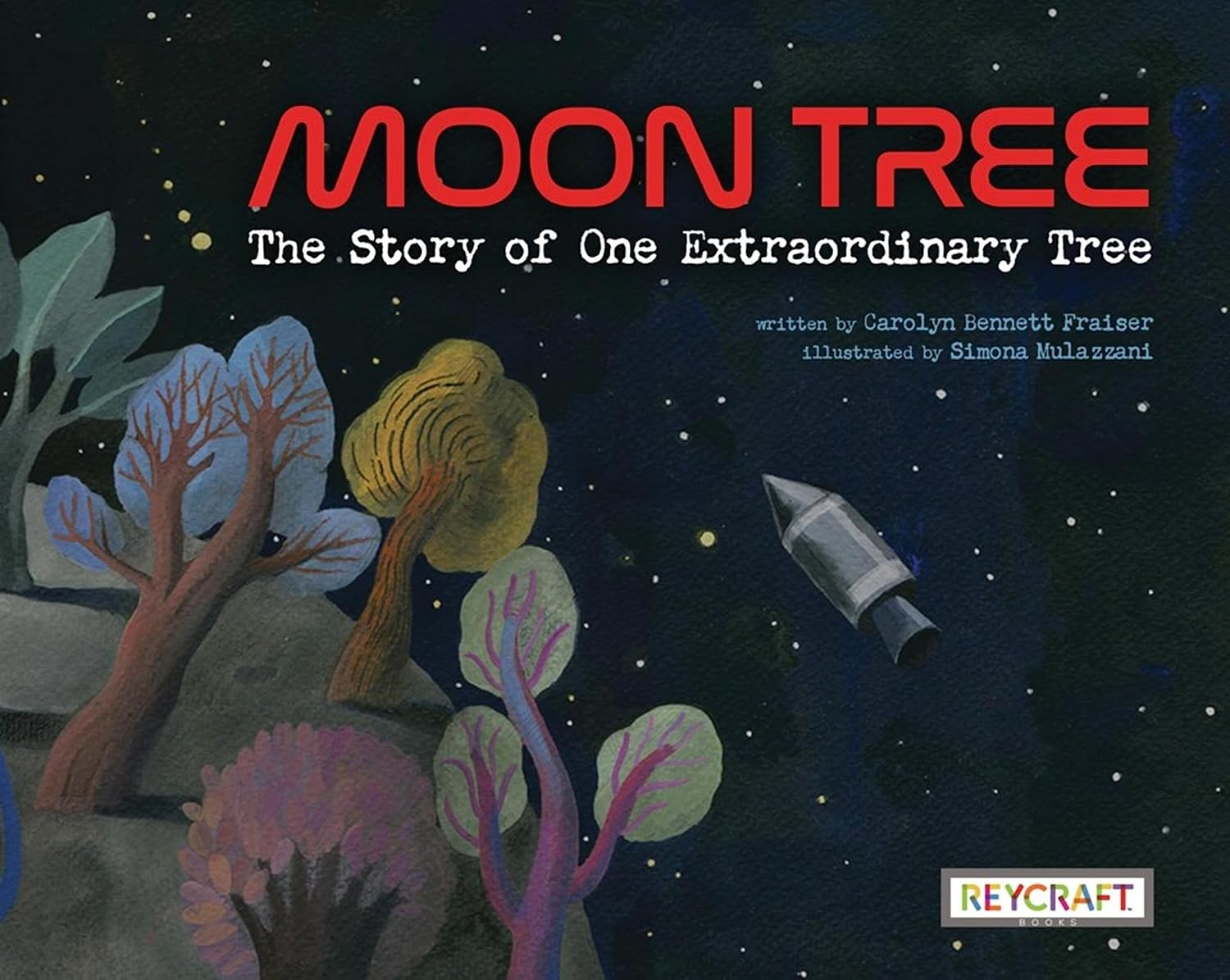
Book: Moon Tree: The Story of One Extraordinary Tree
Author: Carolyn Bennett Fraiser
Illustrator: Simona Mulazzani
Publisher / Year: Reycraft Books, 2022
Genre: Non-Fiction
Topics: Trees, Space, Science, STEM, History
Blurb: One tree has a secret – it flew to the moon on Apollo 14. The problem is no one remembers, even NASA…until a curious third-grade girl uncovers its mystery about a boy who dreamed of flying, a trip to the moon, and the American bicentennial.
Book Word Count: 350
What is your back matter word count?
1,082 words
What was the earliest version of the back matter like?
My earliest version included much of the back matter in the text or in sidebars. The draft at that point was more than 1,500 words long! Too long for a picture book. As I revised, my text became shorter. Once I had the final version, I evaluated which extra details would help students and teacher take into a deeper dive into the history and science behind the trees and re-envisioned the back matter to work hand-in-hand with the primary text. I ended up choosing a detailed retelling of the story that took a deeper dive into each page of the primary text, a listing of moon tree locations across the US, and a glossary of terms.
What changes and revisions (if any) came about after working with the editor/agent?
Not much. I sold the book on my own before I signed with my first agent and my editor kept most of what I had submitted. We did have to cut the list of second-generation trees because there simply wasn’t enough room in the back of the book to name them all! So I ended up summing up what a second generation moon was at the bottom of the list of locations.
Is there more information or that you wanted to include in the back matter but didn’t make the cut?
Oh yes! There were SO many fun and interesting stories that I wanted to include with the book, but not every detail or fun fact “fit” with the overall flow or made sense when I landed on the final version. I decided to cut quite a bit and save them for presentations after the book was published.
What were some challenges that arose during the back matter publishing process?
The main problem for me was that the listing of moon trees kept changing. Some trees died and others were discovered/confirmed during the publication process. By the time the book came out, the list of trees in the back of the book wasn’t the most current list. I updated the list after publication and sent it back to my editor so he could update the back matter list during the second printing.
I love how your back matter format encourages us to flip back and re-read the story again. Have you heard from any readers about how they are interacting with the back matter?
People LOVE the list of trees at the back of the book! When I introduce someone to the book, they automatically flip to back to see if a tree is listed in their state. If they find out, they usually mention that they will have to plan a visit to the tree. I love that it inspires people to go beyond the pages of the book to explore more.
You also have back matter in your new book, M is for Mason Jar. What was that process like?
It was a very different process. I had initially submitted two sections of back matter with the manuscript—a list of 26 activities (one for each letter) specifically for young children and a mason jar matching game. The game was completely cut. The artwork for this wasn’t included with the illustrator’s contract. Then the list of activities was shortened from 2 pages to 1 because there simply wasn’t room for another page once the artwork was final. However, this allows me to offer parents and teachers additional resources on my website and really make a classroom visits fresh and engaging with new material that is not in the book.
Are there resources you can share that would be helpful for anyone wanting to learn more about back matter? Are there any picture books you’d recommend for their back matter?
Nonfiction Fest is a blog event hosted by the Nonfiction Ninjas every February and offers a ton of information about writing nonfiction books of all kinds, and they always include some insightful articles on back matter. Anyone interested can search their website and read what they have posted in past years. It’s like a crash master’s course in writing back matter for kids!
So many authors do this well. I suggest browsing as many nonfiction picture books as possible to evaluate the different ways authors use back matter. Make a list. See what works best with your topic.
Thank you, Carolyn! I love how you connect your back matter process to creating materials and contents for school visits! It’s such a great way to use all those extra facts and activities that couldn’t fit into the book! Please support Carolyn:
Carolyn has generously offered to one lucky winner a 20-minute brainstorming session with an author to come up with various possibilities for back matter on their topic or picture book!
To enter: leave one comment on this blog post by August 25, 2025 at 11:59pm Pacific Time. For additional entries, leave a comment on my (Judy’s) BlueSky and/or Instagram posts about this post for a maximum of 2 bonus entries. (Remember to check back on this blog post and social media to see if you are selected as a winner!)
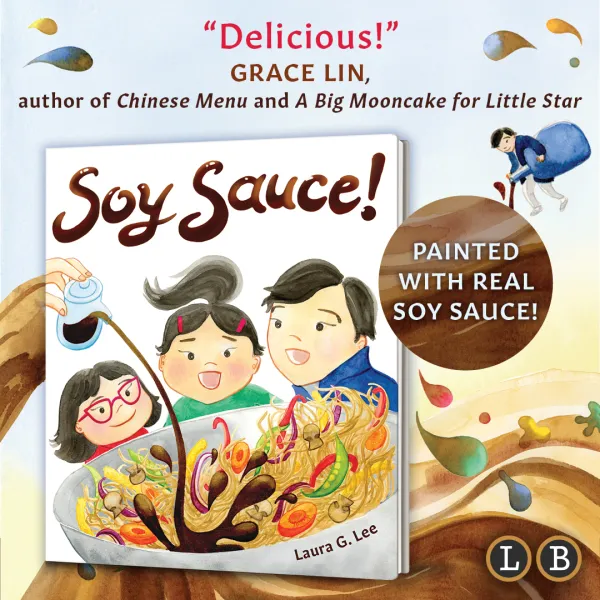
Welcome to the Back Matter Break Down! For today’s interview, I am excited to bring you a conversation with an amazing author-illustrator, Laura G. Lee! I was fascinated by her book from the moment I learned that she used actual soy sauce in the illustrations. Her experience putting together the back matter for this book is also super interesting, so I know you’re in for a good read. And don’t forget to scroll all the way to the end for this week’s author giveaway! Let’s go!
Book: Soy Sauce!
Author / Illustrator: Laura G. Lee
Publisher / Year: Little, Brown Books for Young Readers, 2025
Genre: Non Fiction
Topics: Food, Cooking, Asian Cultures
Blurb: Salty, savory, rich, and even sweet, soy sauce is as fascinating to make as it is delicious to eat! Luan makes a classic Chinese soy sauce. Haru uses his own recipe at his family’s traditional Japanese brewery. And Yoo-mi’s Korean soy sauce features special ingredients to make it spicy and sweet. With unique ingredients that reflect different Asian cultures, and a brewing process that can take years, even decades, soy sauce holds deep meaning and flavorful history in every drop.
Book Word Count: 278 words
What is your back matter word count?
207 words
At what phase of the drafting/revising/publishing process did you decide your book needed back matter?
Probably in my early research–I knew there were a lot of cultural ingredients and scientific terms that readers may not catch. The story of soy sauce is so rich historically and culturally, the back matter gave me a chance to point readers to deeper explorations in how soy sauce is made, and the countries that make it.
What was the earliest version of the back matter like? Can you show us snippets?
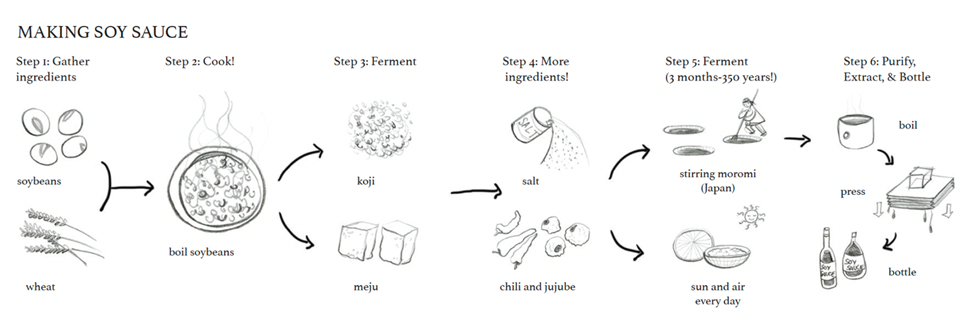
My earlier version of back matter included a ‘production’ diagram of how soy sauce is made. As we got into it, we realized it was somewhat of a challenge to make a single diagram for all soy sauce production. It’s made in many different ways, in different places. Instead, we opted to highlight the differences in ingredients in the Glossary, and steer away from the ‘how to’ diagram. However, I do use that same diagram to explain in school visits the ‘basic process’, then go into more specifics. Below is the diagram that got cut from the final back matter. As you can see, it became a challenge to represent the soy sauce making process in a singular way- as there are variations in ingredients, and process throughout.
Sketch version of Making Soy Sauce chart, courtesy of Laura G. Lee
What changes and revisions (if any) came about after working with the editor/agent? Are there any other soy sauce facts that you wanted to include in the back matter but didn’t make the cut?
I think the essence of the original back matter was preserved, but became more visual as I worked with my editorial and art team. They suggested creating more of a visual glossary, with recognizable elements and characters from the book, to peak reader’s interest. I really wanted to include the Korean soybean block step, making meju, in the original story but because that was streamlined, I was able to still create an element for it in the back matter. While I am sure there are some cool aspects of soy sauce that didn’t make the cut, I like to think of back matter at a jumping off point to deeper questions and research–so I think we did hit all the big highlights.
At any point, did you consider including a recipe in the back matter?
I think we considered it early on, but veered away from it because there is no single recipe for soy sauce that could have been the perfect one. So we chose instead to represent its diversity and range, and share its cultural and historical context instead.
What were some challenges (if any) that arose during the back matter publishing process?
At some point I learned I might not be able to print the book in China because of the reference in the back matter to Taiwan. It was an unexpected surprise in the process, and my publishing team leaned on me to decide what to do–I chose to keep the elements of Taiwan in, because it was important to me and my family (my kids are half-Taiwanese, half-Korean). So we printed the book in Malaysia instead. And I’m happy we did! I give huge kudos to my publishing team at Hachette for supporting my decision.
I love the idea of a Visual Glossary like you have in your book. What tips (if any) can you offer to author-illustrators about designing creative back matter?
Hm…. good question. I think back matter adds to the story, it’s something that like the book, ideally, kids will return to. So think of them as jumping off points to deeper explorations. Ask yourself, what might readers relate to, and want to know more about? Is there anything particularly symbolic in your book that has a backstory? Then dive in. I like to think of back matter as the starting point to a conversation.
Thank you, Laura! It’s so helpful and interesting to get a look into your creative process in putting this book together, as well as how you navigated some unexpected challenges. You’ve given us some great things to think about! Please support Laura:
– SOY SAUCE! Storytime and Signing at Water Street Books, Exeter, NH, on 5/3/25 at 1:15pm EST
– SOY SAUCE! Author Talk at the San Mateo Public Library, San Mateo, CA, on 5/10/25 at 11am PDT
– Bay Area Book Festival (Berkeley, CA) – Play with Your Food!, at Berkeley Public Library Children’s Nonfiction Area: Charlotte Cheng, Sara Fajardo, and Laura Lee emceed by Cinnamongirl Funmilayo on Saturday, May 31st at 3pm
Now for the giveaway!
Laura G. Lee has generously offered a 30 min zoom AMA to one lucky winner!To enter: leave one comment on this blog post by April 22, 2025 at 11:59pm Pacific Time. For additional entries, leave a comment on Judy’s BlueSky and/or Instagram posts about this post for a maximum of 2 bonus entries. (Remember to check back on this blog post and social media to see if you are selected as a winner!)
Welcome to the Back Matter Break Down! I am excited for you to read today’s interview with a debut author who came to back matter task with so many creative ideas. It’s so great to see the journey that led to the final version. And don’t forget to scroll all the way to the end of the interview you so you can enter the giveaway! Okay, let’s begin!
Book: Kai Po Che: Mini’s Perfect Kite
Author: Suhasini Gupta
Illustrator: Devika Oza
Publisher / Year: Gnome Road Publishing, 2025
Genre: Fiction
Topics: Kites, Indian Festivals, Indian Culture, Crafts, Siblings
Blurb: It’s Makar Sankranti, the Indian festival of kites, and Mini wants to join in the fun. But her older brother insists that flying kites is not for little girls. Using her craft-making skills, Mini constructs her own not-so-perfect kite and learns to fly it with her brother’s help. But during Sankranti, it’s fair game to cut another kite’s string and keep it as your own! When a red kite comes along and causes a KITE-ASTROPHE, Mini decides it’s time to challenge the red kite to a battle in the sky. In the end, she discovers that her not-so-perfect kite is really her very own perfect diamond.
Book Word Count: The story is approximately 570 words.
What is your back matter word count?
The back matter ended up at 440 words.
At what phase of the drafting/revising/publishing process did you decide your book needed back matter?
I wanted to include back matter toward the end of my revision process because kite flying is more than just an outdoor activity—it encompasses science, math, craft, inspirational values, and a full celebration. The back matter serves as an invitation to spark curiosity and meaningful conversations between children and grown-ups.
Did you do any research for the back matter to include the STEM content?
Since my childhood memories inspired this story, I incorporated an author’s note to give readers a glimpse of my personal connection to kite flying. The STEM content included basic engineering concepts related to how kites function, such as their unique shape and how it differs from a diamond-shaped kite, as well as the forces that help balance a kite in the sky. To ensure accuracy and make these concepts accessible to a young audience, I conducted additional research using reliable sources. Some of the resources include the American Kitefliers Association, which introduces people to the joy of kite flying, its rich history, the artistry of kite making, and how kites can be used as educational tools. Additionally, I explored kite-related educational content from NASA and PBS Learning Media which provide valuable insights into the science behind kite flight.
Tell us about the back matter revision process. Why did changes occur? What changes and revisions came about after working with the editor/agent?
I already had a few key elements in mind for the back matter, such as STEM concepts, a kite-making craft, and possibly a recipe for an Indian snack or dessert—because no Indian celebration is complete without food! Additionally, while the book was in the illustration process, I wrote a rap song that I wanted to include. However, since we had only one page available for the back matter, we had to make choices about what to include. We ultimately prioritized STEM over crafting because STEM and craft go hand in hand—understanding the facts behind kite flying makes designing and building a kite easier.
Is there anything else you wanted to include in the back matter but didn’t make the cut?
Yes, crafting a kite didn’t make it into the book due to space constraints. We could only fit the author’s note and STEM content on one page. Fortunately, I was able to include a QR code for my rap song, “I’m Not SMALL, Am Dynamite,” written by me and sung by my daughter. Additionally, Gnome Road Publishing offers Bonus Material and extra Educator Resources on their website for each book, making the content available there.
What was the most challenging part of the back matter publishing process?
The biggest challenge was working within the space constraints while ensuring the back matter remained engaging and informative for the young kids.
What do you hope readers will take away after reading your back matter content?
I hope kids feel inspired to explore more about kites, spark their curiosity, and create their own designs to soar high in the sky.
Reflecting on this process and what you learned, what tips can you offer picture book writers for writing back matter?
Here are a few tips in my opinion that could come handy.
1. Planning and Prioritizing Content – Think about your back matter in a way that connects to your story and theme, and be prepared to make tough choices about what to include if space is limited.
2. Keep It Engaging – Write in a way that sparks curiosity and encourages young readers to explore further, whether through fun facts, activities, or personal connections, while also offering value to parents and educators.
3. Be Flexible and Creative – If something doesn’t fit within the book, consider alternative ways to share it, such as through the publisher’s website, a QR code, or bonus materials.
Are there resources or comp titles you can share that would be helpful for writer’s wanting to learn more about back matter?
Your blog is a great resource for checking out authors’ testimonies on back matter. The best approach to learn more is by visiting the Society of Children’s Book Writers and Illustrators (SCBWI), where they offer workshops and articles on various aspects of writing, including how to craft back matter. Additionally, checking out books from local libraries on related topics and reaching out to author communities and online writer’s blogs for further tips can be incredibly helpful.
Thank you, Suhasini! I love how you had so many fun and engaging ideas in your head for the back matter. Even though they didn’t all make it into the book, it’s fun that you have great content that you are now using elsewhere. Please support Suhasini:
KAI PO CHE: MINI’S PERFECT KITE can be purchased anywhere books are sold. Online, it’s available at Amazon and Barnes&Noble, or directly from the Publisher. You can check your local Indie book store.
Now for the giveaway! Suhasini Gupta has generously offered a 20-min AMA or a PB critique (non-rhyming, 600 words or less) to one lucky winner!To enter: leave one comment on this blog post by April 8 at 11:59pm Pacific Time. For additional entries, leave a comment on my (Judy’s) BlueSky and/or Instagram posts about this post for a maximum of 2 bonus entries. (Remember to check back on this blog post and social media to see if you are selected as a winner!)
UPDATE: The giveaway is now closed. Congrats to Ginger B, you are the winner!
Welcome to the Back Matter Break Down! I am excited to share the first poetry book that I am featuring on this blog! Today’s interview has some great behind-the-scenes details about creating back matter with a debut picture book author. And don’t forget to read all the way to the end so you can get details on our giveaway – you could win a 30 minute AMA! Let’s go!
Book: Torrible Puns: A Collection of Punny Poems
Author: Tricia Torrible
Illustrator: Robert Dunn
Publisher / Year: Gnome Road Publishing, 2025
Genre: Fiction
Topics: Poetry, Wordplay, Jokes & Humor
Blurb: Packed with witty humor, this clever mix of poetry and puns features everything from animals and beloved nursery rhyme characters to outer space and favorite sports. Each poem contains at least one word or phrase with a double meaning, which will not only make children (and adults!) laugh out loud, but also provides a fun lesson on homonyms. The short poems, the lovely art, and the groan-worthy punchlines will leave readers begging for “just one more.”
What is your manuscript word count? What is your back matter word count
Because it is a poetry collection, it is a bit longer than your average picture book. The manuscript itself has about 2,120 words, and the back matter word count is approximately 1,120.
At what phase of the drafting/revising/publishing process did you decide your book needed back matter? Did you always plan to have explanations for each of the puns in the book?
When I first started writing punny poems, my focus was on the poems themselves, so I wasn’t really thinking about back matter. However, as I continued to recite my poems to my own children, it quickly became clear that back matter could be very beneficial. The playful nature of the poems along with the beautiful illustrations make this book an excellent fit for elementary age children.
However, wordplay is still a developing skill during these years. My three kids currently range in grades from kindergarten to sixth grade, and sometimes they wouldn’t immediately “get” some of the puns in the poems. Fortunately, as soon as a pun was explained, the “AHA!” moment was seen in their eyes and they LOVED it! My eldest child immediately understood many more puns than my youngest, but my youngest seemed to enjoy the poems just as much once he was “let in on the joke”. In fact, with his newfound understanding, my youngest gained a lot of confidence in language and began pointing out different homophones in real life and coming up with his own puns. This would never have happened if some of the puns had not been explained. As a result, I decided to write back matter for readers to make sure that no “AHA!” moment was missed, and to encourage a love of language.
What was the earliest version of the back matter like?
I started writing the back matter before I ever sold the manuscript, and the earliest version was much longer. At the time, I was mentally preparing myself to self-publish (while still hoping and striving to get a book deal). I personally lacked the artistic skill to illustrate a full color picture book, so I was envisioning more of a black and white poetry chapbook. This meant that I wasn’t limited on space when it came to back matter. Therefore, my earliest version had longer explanations for each poem.
What changes and revisions (if any) came about after working with the editor/agent?
After receiving a book deal (woohoo!) and realizing that TORRIBLE PUNS was actually going to be a fully illustrated picture book (double woohoo!), it quickly became clear that my original back matter was too long. My editor and I both agreed that we wanted to include as many poems that we could comfortably fit in the book, so we knew we had to keep the back matter limited to one spread. Thus, we took on the task of condensing my original pun explanations without losing their original meanings.
What were some challenges (if any) that arose during the back matter publishing process?
When I was originally writing the back matter, my biggest challenge was deciding how much detail I wanted to include. At one point, I had considered labeling the puns based on different categories such as homonyms/homophones/homographs, idioms, recursive puns, compound puns, etc. However, while most of the puns fit nicely into main categories, there were some that didn’t (which led me down some long linguistic rabbit holes!). Furthermore, it also became clear that not all sources agree on the exact definitions of some of the considered categories. For these reasons, I decided it was best to focus on simply explaining the puns.
Once I got past the decision of what to include, I wouldn’t say there were any big challenges, just necessary editing. As mentioned earlier, my editor and I had to reduce my original, longer pun explanations to fit on one spread. It took a couple rounds of back and forths, but I feel we were able to capture the same level of information within the space constraints. I definitely learned how to be less “wordy” when needed :).
What do you hope readers will take away after reading your back matter content?
I hope they will gain a greater love of language and wordplay. I want every poem to bring laughter and joy, and I hope everyone walks away with a firm understanding of each pun. Understanding brings confidence, and confidence can lead to experimenting and having fun with language.
Reflecting on this process and what you learned, what tips can you offer picture book writers for writing back matter?
Ask yourself what information would make the book more understandable and enjoyable. I personally think the beauty of back matter is you can stretch your audience a little by including material in your book beyond what they initially know. There certainly needs to be a balance to this, but including a few unknown words or concepts can be a great opportunity for learning.
Are there resources you can share that would be helpful for anyone wanting to learn more about back matter? Are there any picture books you’d recommend for their back matter?
Nonfiction picture books are often the go-to to find excellent back matter examples (though back matter is not limited to these!). One great example is DREAM SUBMARINE, written by Charlotte Gunnufson and illustrated by Cleonique Hilsaca. What I love most about this back matter is that it includes an “interactive map” that encourages readers to match the numbers on the map to information on the following pages. This way, readers can learn more about the places and creatures visited by the Dream Submarine.
Thank you, Tricia! It’s so interesting to read the journey you went on with your back matter, and how you arrived at this final version. It’s a good reminder for us all to think about how we might need to pivot in our approach at different phases of the process. Please support Tricia:
Now for the giveaway! Tricia has generously offered a 30 minute Ask-Me-Anything zoom chatto one lucky winner!To enter: leave one comment on this blog post by April 1, 2025 at 11:59pm Pacific Time. For additional entries, leave a comment on my (Judy’s) BlueSky and/or Instagram posts for a maximum of 2 bonus entries. (Remember to check back on this blog post and social media to see if you are selected as a winner!)
Welcome to the Back Matter Break Down! Today’s interview is with Kobina Commeh about his debut picture book, and I think you’re really going to enjoy the look behind the scenes that he gives us. This is a great interview to learn about how collaboration can lead to inspired and creative back matter. And don’t forget to scroll all the way to the bottom of the post so you don’t miss the giveaway! (Update: the giveaway is now closed) Let’s dive in!
Book: Kwesi and Nana Ruby Learn to Swim
Author: Kobina Commeh
Illustrator: Bárbara Quintino
Publisher / Year: Barefoot Books, 2025
Genre: Fiction
Topics: Swimming, Ghanaian Culture, West African Legends, Black History
Blurb: Kwesi doesn’t know how to swim… and discovers his grandmother doesn’t either! Can they conquer their fear of water together with the help of the West African legend Mami Wata?
Book Word Count: 1,118 words
What is your back matter word count?
Approximately 500 words
At what phase of the drafting/revising/publishing process did you decide your book needed back matter?
I submitted the original manuscript for Kwesi and Nana Ruby Learn to Swim with the glossary of names that people may not be familiar with. This included everything in the finished book. The addition was including the rest of the day names and not just ones of the characters in the book. Autumn Allen, the Senior Editor at Barefoot Books, recommended the complete list of day names.
Did you do any research for the back matter?
Yes! As I was learning how to swim at 40 years old, I realized that many Black and African American people did not know how to swim and so I delved into the history. I also brushed up on my knowledge of the meaning of Ghanaian day names. It was a total shock that my name, Kobina, was associated with the Ocean! What a happy coincidence. I did not want to use my own name as the character in the book. I chose Kwesi because it rhymes with “sea” and is also my father’s Ghanaian name.
Tell us about the back matter revision process. Why did changes occur? What changes and revisions came about after working with the editor?
It changed with the addition of the map, Adinkra symbols, and swim safety note. There was also the decision to have a separate section for the Ghanaian day names. Most of the changes occurred with the editor. The phonetics of the day names required a lot of work and tweaking.
Did you collaborate with the illustrator on the inclusion of Adinkra symbols in the illustrations and/or the note in the back matter to tell readers to hunt for them in the book?
Yes! The Adinkra symbols are integral as a way wisdom is passed down for generations. I sent a list to the illustrator (Bárbara) and she did a great job including them in the book. The idea to hunt for them in the back matter was from the Barefoot Books team.
Is there anything that you wanted to include in the back matter but didn’t make the cut?
There was no more room for the Fufu and peanut soup recipe. I’m glad to keep my mom’s family secret for now.
What was the most challenging part of process of the back matter publishing process?
Being creative with the material. I love how it turned out. The inclusion of the map and extensive day names enhances the experience of the story.
What do you hope readers will take away after reading your back matter content?
It’s actually what’s not in the back matter that I’m most proud of. We wanted to keep the bulk of the information about Black people’s swimming history being affected by segregation accessible to the child reader and in the main text. Typically, this is in the back matter. This took away from the back matter but allowed for extra information like the Adinkra symbol hunt.
I hope that readers learn, from the back matter, that names have special meanings that can have special outcomes. I was also moved by Bárbara being influenced by the story as she was illustrating it.
I hope that readers see my Author’s Note and read that it is never too late to learn a new skill. The best influences in your life can come in the most unexpected of packages, à la my daughters.
What tips can you offer picture book writers for writing back matter?
Include information that will enhance the reader’s experience. It’s also a good opportunity for the reader to get to know the author and illustrator.
Thank you, Kobina! It’s so interesting to see how your back matter came together as a result of collaboration between you, the illustrator, and the rest of your publishing team. And hopefully we can get that Fufu and peanut soup recipe in a future book!
Now for the giveaway! Kobina has generously offered to give a SIGNED COPY OF KWESI AND NANA RUBY LEARN TO SWIM to one lucky winner!
To enter: leave one comment on this blog post by March 7, 2025 at 11:59pm Pacific Time. For additional entries, leave a comment on my (Judy’s) BlueSky and/or Instagram posts about this post for a maximum of 2 bonus entries. (Remember to check back on this blog post and social media to see if you are selected as a winner!)
Update: the giveaway is now closed. Congrats to Yan-Yin Choy, you are the winner!