Back Matter Break Down: Impossible Moon

Welcome to the Back Matter Break Down! I stepped away from the blog over the summer, but I’m back at it again and excited to look at the back matter from a lovely, lyrical book. Let’s dive in!

Book: Impossible Moon

Author: Breanna J. McDaniel

Illustrator: Tonya Engel

Publisher / Year: Denene Millner Books/Simon & Schuster Books for Young Readers, 2022

Genre: Fiction

Topics: Stars, Constellations, Black History, Mythology

Blurb: Grana used to tell the best stories, and Mable used to long to soar through the heavens. Nowadays, Grana mostly lies in bed and Mable stays close to home. But one day, Grana asks, “If we can touch the moon, then what is impossible?”

So Mable decides to do just that, embarking on a journey through the stars where The Seven Sistahs, The Big Dipper, and other constellations help her on her quest and teach her about African mythology and African American history. With the support of her new companions, Mable reaches for her biggest dream yet: to make her sick grandma well again.

Book Word Count: about 679

Back Matter Word Count: about 1200

Back Matter Sections

1. Authors Note (about 600 words)

In author Breanna J. McDaniel’s note, she starts off by sharing how her own experience with her ailing grandmother became the initial spark for this story. She continues by detailing how her research led to see how Black characters and history were traditionally overlooked in presentations about stars and constellations. McDaniel notes that the movie Black Panther helped inspire her vision of the constellations as Black characters interacting with a young Black girl who loves astronomy. Finally, she shares her hope that Mable’s story will inspire young readers to love of science and keep dreaming in the impossible.

2. The Impossible Moon Sky (about 650 words)

In this section, McDaniel gives readers more information about astronomy and constellations that are presented in the story. She starts off with an introduction (about 200 words) that explains what constellations are. This section tells how constellations have been used by humans throughout history, including the fact that there are many stories that have been passed down about to constellations.

From there, the author highlights the seven constellations that she depicts in the book (about 450 words). She explains the origins of their names as well as some mythology that has traditionally been associated with the constellation. McDaniel also explains how she approached the depictions in the story as she highlighted the constellations importance to Black people throughout history. It’s extra insightful that she sometimes explains the symbolism behind her depictions that might not be immediately understood in a first reading by some.

Takeaways: Breanna J. McDaniel’s backmatter gives readers insight into her creative process as she was coming up with the themes and deeper meanings into this story. Readers who dive into her author note and explanations about the constellations will see the writer’s mind at work adding layers of meaning to her story. Especially for young readers, they may be surprised to learn of the symbolism and hidden meanings that McDaniel has infused into her story. This likely adds to the pleasure of re-reading the book as kids will be able to appreciate the story on another level while examining how Tonya Engel’s dreamy illustrations draw out these themes.

Tips: Let readers go behind-the-scenes on your creative process. As they understand what inspired your writing, how you pivoted to new ideas, or how research led you into surprising places, it will add to their appreciation of your story’s layers. If your story has symbolism, don’t shy away from explaining their meanings in your back matter. You will be equipping kids to understand how to analyze text at their own level, and I’m sure many educators will love to have such books to use as teaching examples for their students.

Thank you for reading! Leave a comment to keep the conversation going or to suggest a book for future blog posts!

Don’t miss future posts! Subscribe to my blog:

Back Matter Break Down: Like A Diamond In the Sky

Welcome to the Back Matter Break Down! Today’s post is looking at back matter that is so packed, there’s a little something for everyone! We have STEM info, biography, music and lyrics, and the most thorough bibliography I have ever seen in a picture book. Let’s check it out!

Book: Like a Diamond in the Sky: Jane Taylor’s Beloved Poem of Wonder and the Stars

Author: Elizabeth Brown

Illustrator: Becca Stadtlander 

Publisher / Year: Bloomsbury Children’s Books, 2022

Genre: Non-Fiction

Topics: Biography

Blurb: Twinkle, twinkle, little star, how I wonder what you are.
Did you ever wonder who wrote that famous verse? In the days when most girls were brought up to run a home, Jane Taylor had a different kind of education in the countryside, where she was inspired by nature and the stars, and dreamed of becoming a writer. But then, it was not considered proper for women to be writers. But Jane did write, and she never forgot her love for beauty of nature and the glow of stars, or her desire to write for children. Her published poetry became universally known for generations to come: Twinkle, twinkle little star.

Book Word Count: `about 1120

Back Matter Word Count: about 750, plus bibliography, timeline and sheet music

Back Matter Sections:

1. Author’s Note (about 130 words): This is a relatively short note that reflects on Jane Taylor’s lasting legacy as the author of the poem “The Star”, which was adapted to music as “Twinkle, Twinkle, Little Star.” This is more of a personal reflection since author Elizabeth Brown will provide a more detailed biography of Jane Taylor in a later section of the back matter.

2. Do Stars Twinkle? (about 60 words): Author Elizabeth Brown gives a short explanation about the science behind why stars appear to twinkle. It’s a little bit of STEM content in a historical biography, but connects nicely to the subject’s most famous poem.

3. Jane Taylor, 1783-1824 (about 500 words): Here we get a more complete biography of of Jane Taylor and her work, moving through her life chronologically. When it comes to Taylor’s budding writing career, Brown gives further context about Jane Taylor’s poetry and her place within Romantic Era poetry as a writer and a woman.

4. Quotes and Sources: Elizabeth Brown incorporated nine quotes from Jane Taylor’s writings into the main text of the book. Each of these quotes is cited. Here is an example:

“contemplate the dark blue depths of the sky”

The Writings of Jane Taylor in Five Volumes, Isaac Taylor, ed., vol. I, Memoirs and Poetical Remains (Boston: Perkins and Marvin, 1832), 132-133.

5. Timeline of Selected Works by Jane Taylor: This is a timeline presented in text format of Jane Taylor’s writings. Brown notes at times where poems were published and what other authors were involved in published books. Here is an example of how the timeline is presented:

1803 Jane’s poem “The Beggar Boy” is accepted for publication by William Darnton

6. Bibliography: This list of sources covers a full spread of the back matter. It is further divided into 3 sections: Primary sources (10 sources listed), Secondary sources (14 sources listed), and Other sources (10 sources listed. The primary sources are mostly comprised of works by Jane Taylor herself. The secondary sources appear to be a mix of writings about Jane Taylor or her poetry, or sources that give background on Romantic Era poetry or children’s poetry. The other sources are mostly articles about Jane Taylor or the origins of “Twinkle, Twinkle, Little Star” and likely were written using the primary or secondary sources for background. There are also a couple of academic articles about Romantic Era poetry or women’s roles during Jane Taylor’s lifetime. It is striking how thorough this bibliography is considering that bibliographies in picture books are often truncated to a shorter list of selected works. I don’t think I’ve ever seen a full 2-page spread dedicated to bibliography in a picture book before.

7. “Twinkle, Twinkle, Little Star” (sheet music plus note of about 80 words): The note attached to the sheet music is a short explanation of the French song that became attached to Jane Taylor’s poem, “The Star.” The sheet music shows the single notes and lyrics to the song on the treble clef. It shows only the first line of the song, which is likely the only lyrics many of us know.

8. “The Star”: Opposite of the sheet music, we get to see the full poem by Jane Taylor. With the sheet music and poem together on a spread, a reader could sing or play through the entirety of the poem including the lesser-known verses.

Takeaways: With 4 full spreads dedicated to the backmatter, Elizabeth Brown has plenty of real estate to work with. She makes excellent use of it all by giving readers a variety of elements to engage with. The author’s note and biography of the subject are more typical in a PB bio, but the bit of STEM content in the back matter is an likely an extra selling point for many readers. With the quotes and sources, timeline and thorough bibliography, this picture book becomes a valuable source of information on Jane Taylor and can help lead interested readers to even more sources for study. In addition, for those interested in improving their research skills, the bibliography is a great example of how to organize sources and visual representation on primary verses secondary sources. Finally, the sheet music and full poem are an appealing addition to let readers engage with a familiar song in a new way. Elizabeth Brown has something for everyone in her back matter! It’s clear that she and her editorial team put a lot of thought into this part of the book to find ways to keep readers turning the pages past the main text of the story.

Tips: Let your imagination run wild as you brainstorm possible elements for your back matter? Could there be a map? Sheet music? STEM elements related to your book? Photos? Try to think of what would be unexpected for your genre. Perhaps you will be able to find something unique but still relevant to expand your book’s appeal and keep readers turning the page.

Thank you for reading! Leave a comment to keep the conversation going or to suggest a book for future blog posts!

Don’t miss future posts! Subscribe to my blog:

Back Matter Break Down: Interview & Giveaway with Darcie Naslund

Welcome to the Back Matter Break Down! If you are interested in back matter in picture books, you have come to the right place. Today’s interview with Darcie Naslund is full of great behind the scenes info about she put together the back matter for her debut picture book. And don’t forget to read to the end for the giveaway! So much good stuff here, so let’s dive in!

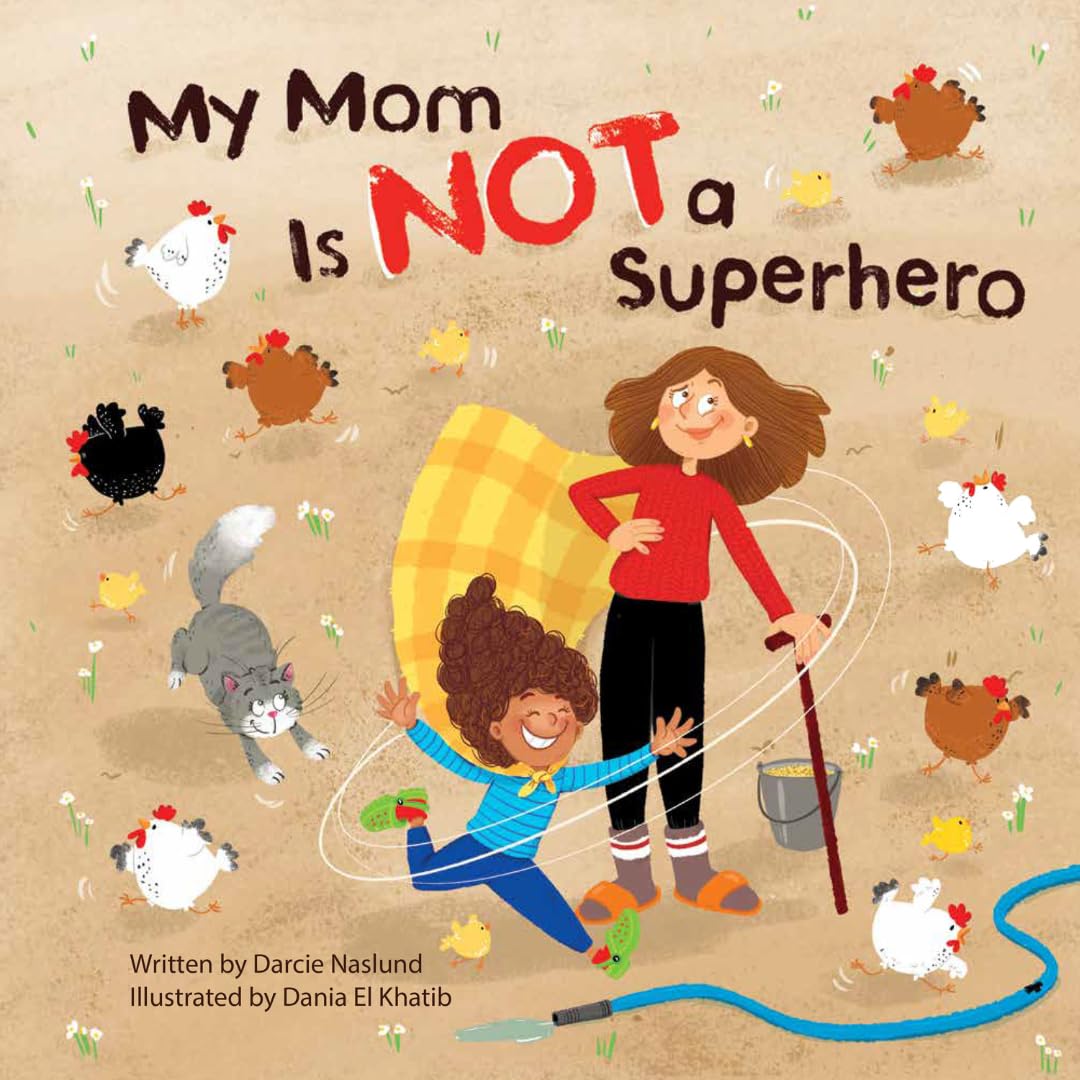
Book: My Mom is NOT a Superhero!

Author: Darcie Naslund

Illustrator: Dania El Khatib

Publisher / Year: DC Canada Education Publishing, 2024

Topics: Multiple Sclerosis, Chronic Illness, Mothers, Superheroes

Blurb: A little girl whose mother has Multiple Sclerosis discovers that some superheroes are fighting invisible battles. With the help of her cat and some X-ray glasses, she learns just how strong her mom is and how she can help her.

What is your manuscript word count? What is your back matter word count?

The manuscript I submitted was about 460 words, not including my illustration notes, which were around 100 words. Looking back now, I realize I didn’t need that many, but at the time, I thought they were necessary to explain the symptoms clearly as villains.

The back matter is about 500 words. It focuses on child readers or creating an adult-child conversation about Multiple Sclerosis and invisible illness.

At what phase of the drafting/revising/publishing process did you decide your book needed back matter? 

My first draft wasn’t a story at all. It was more like a well-written advertisement for MS. It was loaded with descriptions and not exciting for kid readers. The first draft was written on its own without back matter. The author’s note came next, as it was a suggestion from my critique group. They may have suggested back matter, but I can’t remember. What I do remember is that I was very stuck in my way with this manuscript. I would take some pieces of advice on the line level but refused to accept any whole-picture type of advice.

It wasn’t until I received some brutally honest, whole-picture feedback that I realized I needed to make a change. After my daughter’s endless questions about my worsening MS, I had an epiphany. I needed to find a way to make the invisible visible. That’s where the X-ray glasses came in. I rewrote the entire manuscript, cut the descriptions, and turned them into back matter.

Did you need to do any research for the back matter?

Having MS gave me first-hand experience explaining it to children. That being said, I still did a lot of research and connected with the MS Society of Canada. They sent me a few resources for having conversations with children. I also collected resources from other MS organizations around the world.

The organization of the back matter was very important to me. I didn’t want it to be overwhelming for kids if they wanted to learn more. I checked out dozens of picture books with back matter from the library to compare and eventually decided on a plan.

How did you come up with the activities that kids can do to understand MS symptoms?

When I was looking for resources for families, I came across several activity books for kids. Some of them included crossword puzzles, questions and stories. They helped parents explain MS to young children. That’s when I realized the problem— explaining alone doesn’t always lead to understanding. As the old saying goes,

“Tell me and I forget, teach me and I remember, involve me and I understand.”

I needed to put the readers in the shoes of someone with MS to even begin to understand. The analogies that I came up with were things I would say all the time to my family. “I feel like something is pulling my arms down.” Or “My legs feel like they are made of cement.” I have had times when I thought my glasses were dirty or smudged, but it was just my MS. I took all of my experiences and my little descriptions and included them in the backmatter. Even now that the book is published, I want to add or change something about the backmatter. For example, in the back matter, I suggest using ankle weights or socks full of sand to weigh your legs down.  Now, I realize that wearing very big, heavy boots creates a similar effect. Although I can’t make that change now, I will still include it in my activities and book events.

What did the first draft of the back matter look like?

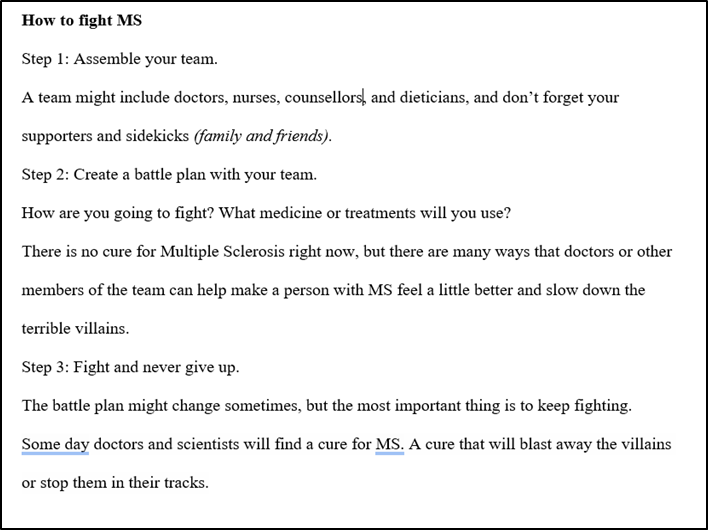
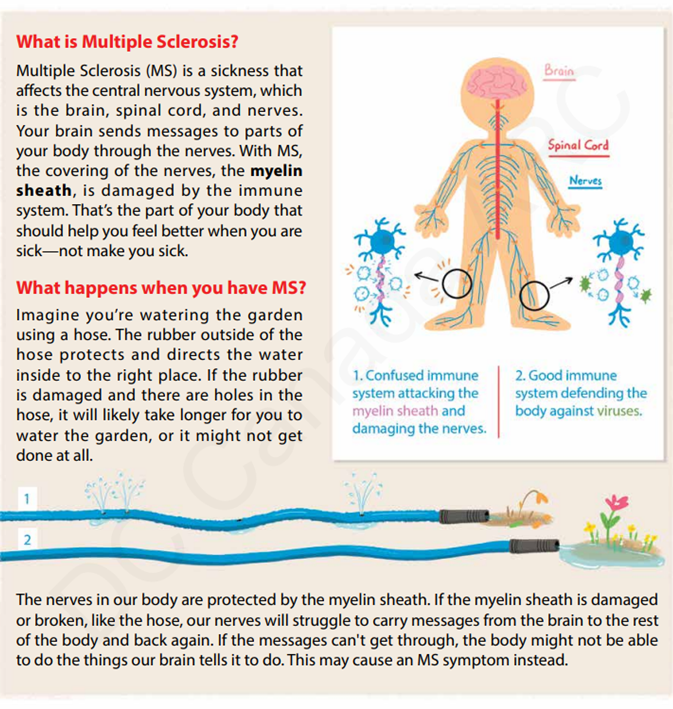
The first draft didn’t look much different in regards to the organization. It had the symptoms list and the “Try This” section. I also had a “How to Fight MS” section that I later took out. It did, however, have a completely different analogy for MS. Finding the right analogy was probably the most difficult part of writing the back matter. I tried many different analogies— a computer and wire, a rough hiking trail, and even mail delivery.  The computer analogy was what I submitted to DC Canada Education Publishing. It was later changed and explained using water flowing through a garden hose. This idea came from the wonderful team at DC Canada Education Publishing.

*Before

Draft of back matter text by Darcie Naslund

*After

Published back matter from My Mom is NOT a Superhero! by Darcie Naslund, Illustrated by Dania El Khatib

Dania El Khatib took my words and created back matter that was not only engaging but accessible. It is everything I dreamed it would be.

Tell us about the back matter revision process. Why did changes occur? What changes and revisions came about after working with the editor/agent? 

The back matter was probably the most difficult part of the revision process with my editor. We went back and forth several times, creating every analogy we could to explain what MS is in a clear, accessible way. I have always described MS as if my brain was a computer and my nerves were wires connecting to the rest of the body. Although this analogy felt most accurate with some MS symptoms, we decided that it was not the safest route to go, as we did not want children thinking that it was okay to play with electrical wires.

I created several more analogies, and so did my editor. When we reviewed them together, we finally concluded that the garden hose analogy would be best. It was clear and did not create a potential risk like the previous version.

My editor mentioned that she was very excited to have received the manuscript with back matter already created. It made her job much easier. She was also the one who thought to include the engaging questions for the readers.

What was the most challenging part of the process of the back matter publishing process?

As I mentioned in the previous question, the most difficult part was creating a clear, concise analogy for what MS is. It was also the beginning of the back matter and set the tone for the rest of the information. This was the most important, difficult and tedious part of the process.

Is your back matter aimed at kid readers or adults? What do you hope readers will take away after reading your back matter content?

I would say the back matter is aimed mostly at kid readers. I also wanted it to create conversations between the children and an adult reader.  My goal for the back matter was not only to explain what Multiple Sclerosis or MS is but to put them in the shoes and help readers understand. I also wanted readers to understand that many challenges and conditions are invisible, but it does not mean that they do not exist. There are superheroes fighting invisible battles all around us. With a little bit of kindness and understanding, even they can be superheroes.

Reflecting on this process, what have you learned? What tips (if any) can you offer picture book writers for writing back matter?

My first piece of advice is to decide what your goal is for your back matter. Once you have your goal, start by studying other picture books (both fiction and nonfiction). I like to use them as a blueprint for organizing my information. I didn’t use one specific book as a guide, but pieces from several books. Studying what was already out there was very helpful to me.

Are there resources or comp titles you can share that would be helpful for writers wanting to learn more about back matter? 

To be honest, I don’t have any resources for this. I studied many different books with back matter, both fiction and non-fiction, as these tended to be very different. The idea of blueprinting came from one of author Ebony Lynn Mudd’s writing courses. I found her courses very useful and would recommend them to all picture book writers.


Thank you, Darcie! You’ve given us some great tips on how to plan for our back matter!

Please support Darcie! Find her website and all of her links on Linktr.ee: Darcie Naslund Linktr.ee

 Purchase My Mom is NOT a Superhero!:

DC Canada Education Publishing

amazon.ca

amazon.com

Now for a giveaway! Update: the giveaway is now closed. Darcie has generously offered to give one lucky person a full manuscript critique that includes backmatter! To enter: leave one comment on this blog post by May 21, 2024 at 11:59pm Pacific Time. You may earn 1 bonus entry if you also comment on the Twitter/X post about this blog to let me know you commented here. (Please remember to check back on this blog post and Twitter/X to see if you are selected as a winner!)

Thank you for reading!

Don’t miss future posts! Subscribe to my blog:

Back Matter Break Down: Interview with Ann Suk Wang

Welcome to the Back Matter Break Down! Today I am excited to bring you an interview with Ann Suk Wang! Ann’s debut picture book is one of those special books that manages to deal with a tough topic, but is also is full of beauty and hope. Let’s take a look!

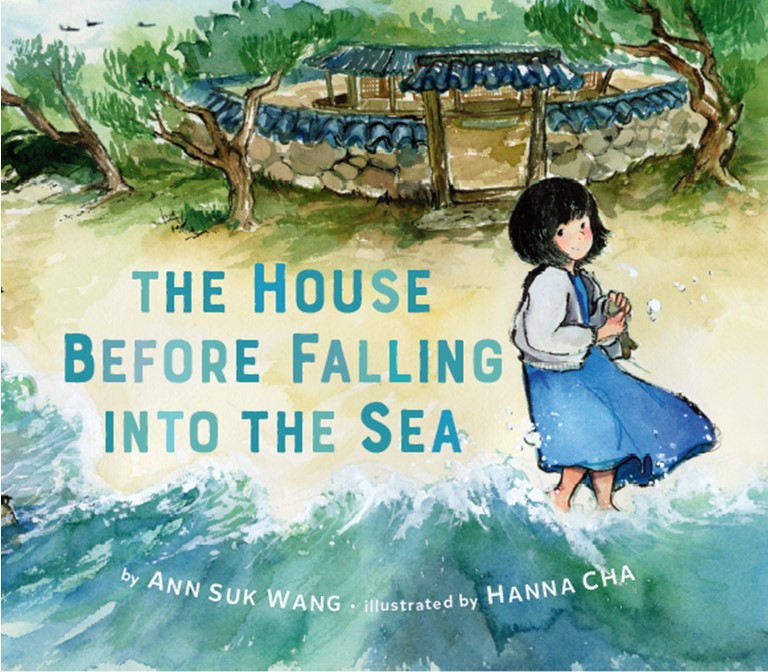
Book: The House Before Falling Into the Sea

Author: Ann Suk Wang

Illustrator: Hanna Cha

Publisher / Year: Dial Books, 2024

Topics: Refugees, War, Kindness, Korea

Blurb: Every day, more and more people fleeing war in the north show up at Kyung Tak and her family’s house on the southeastern shore of Korea. With nowhere else to go, the Taks’ home is these migrants’ last chance of refuge “before falling into the sea,” and the household quickly becomes crowded, hot, and noisy. Then war sirens cry out over Kyung’s city too, and her family and their guests take shelter underground. When the sirens stop, Kyung is upset—she wishes everything could go back to the way it was before: before the sirens, before strangers started coming into their home. But after an important talk with her parents, her new friend Sunhee, and Sunhee’s father, Kyung realizes something important: We’re stronger when we have each other, and the kindness we show one another in the darkest of times is a gift we’ll never regret.

Word Count: Just under 800

Back Matter Word Count: Just over 1000 words

At what phase of the drafting/revising/publishing process did you decide your book needed back matter?

I knew from the very beginning. In fact, when I queried agents, I included it.

Did you need to do any research for the back matter?

A little bit because I included a glossary of Korean words that are spelled in English many different ways. I didn’t know which was officially correct. I also had to make sure my Korean War facts were accurate. I had to double and triple check. (It’s probably the journalist in me?)

What did the first draft of the back matter look like?

Unfortunately, I don’t really save older copies. I really should because it would be interesting to see how it evolved. But usually, I wipe things clear so I don’t get confused with different versions. But basically, it was shorter. I had fewer Korean words for the glossary. I don’t think I included my section on Korean names until later.

Tell us about the back matter revision process. Why did changes occur? What changes and revisions came about after working with an editor/agent?

My ideas in my author’s note stayed about the same. But with my editor’s help, of course, it was greatly improved and tightened up. And I knew I wanted to include “Questions to Consider” because kids could easily go deeper into the subject matter, if asked various questions. So this was added.

Did you know the story of Hanna Cha’s family prior to seeing her illustrator note?

Yes. After she accepted the project, she started to ask her grandmother questions about the war. Then in a letter to my editor, she mentioned that she discovered how her family were on the opposite side of the story, making their way down to Busan. It was such an amazing pairing, two stories merging in an author and illustrator! She really understood the story and embraced it in her illustrations, elevating the whole book in an entirely special way. I think it shows!

What was the most challenging part of process of the back matter publishing process?

I think the glossary was the most challenging because of the different spelling of Korean words in English (the Romanization is tricky.) What’s mostly used is not necessarily correct. So we had to decide how to spell things. It felt “important” in that the way we spelled things could be passed on and add to the common usage. So I wanted to get it right.

Is your back matter aimed for kid readers or adults?

Definitely, it’s for kids. But I understand that adults may be more interested.

What do you hope readers will take away after reading your back matter content?

I hope kids will become more interested in Korean culture, but mostly in being kind to people around them and growing in more love toward their neighbors.

What tips or resources (if any) can you offer picture book writers for writing back matter?

I don’t know of any resources for back matter, except your wonderful blog. But as for tips, I can just say to treat the back matter with respect. The back is where the facts can shine and kids have a chance to go deeper into the subject matter. So put on your journalism hat and research well while putting all the most important things into a succinct story, listing, graph, etc.


Thank you, Ann, for getting all of us picture book writers excited about putting on our journalism hats so we can tackle our back matter with confidence!

Please support Ann! Visit her website and subscribe to her blog: www.annsukwang.com. Follow her on Instagram: @annsukwang. For event updates and purchasing information for signed copies of The House Before Falling Into the Sea, visit her Linktr.ee: linktr.ee/annsukwang.

Now for a giveaway! Ann has generously offered to give one lucky person a signed copy of The House Before Falling Into the Sea! To enter: leave one comment on this blog post by April 23, 2024 at 11:59pm Pacific Time. A winner will be chosen at random and notified on April 17, 2024. One entry per person.

UPDATE: The giveaway is now closed. Congrats to Andrea W! You are the winner!

Thank you for reading!

Don’t miss future posts! Subscribe to my blog:
Back Matter Break Down: Interview with Andrew Hacket

Welcome to the Back Matter Break Down! Today we will be looking at a lovely new book and hearing from the author about how back matter came together. Debut author Andrew Hacket will be joining us today on his blog tour and I’m so excited for you all to learn more about his book and his back matter journey! Let’s dive in!

Book: Ollie, the Acorn, and the Mighty Idea

Author: Andrew Hacket

Illustrator: Kaz Windness

Publishers / Year: Page Street Kids, 2024

Topics: Bullying, Social-Emotional Learning

Blurb: Ollie Alexander Kandersteen, successful amateur gardener, longs to be a tree: Strong. Tall. And mighty enough to stand up to Everett, the bully next door. Ollie is rather short for his age, and when things are too heavy or too high to reach, Everett is sure to point it out. Ollie wilts, he withers. Inside and out, he feels small. But when Everett, feeling jealous of Ollie’s gardening skills, steals Ollie’s sapling, an idea takes root…
“I couldn’t. I shouldn’t.”
But he does! Ollie SWALLOWS an acorn. He waits, wonders, and rumbles … Burp! With a little care and cultivation, a tree-mendous transformation begins! Ollie’s feet root, his arms branch, his locks leaf, and his limbs stretch to the clouds. He’s finally strong and tall enough to confront Everett. But when he does, he finds out that being the biggest doesn’t always mean you’re the mightiest and getting even with a bully might just make you feel smaller than ever.

Word Count: about 600 words

Back Matter Word Count: about 350 words

At what phase of the drafting/revising/publishing process did you decide your book needed back matter? 

I began drafting what would become Ollie in October of 2020. It wasn’t until May of 2021, after receiving a critique from Jolene Guiterrez, that she suggested back matter as an option. Up until this point I had received some concerned feedback that Ollie’s ingesting of non-food items could present a problem for some families. Jolene’s suggestion was the perfect suggestion to allow me to address this concern while keeping the story intact.

What kind of research did you do for the back matter?

My back matter serves as a big PSA encouraging readers not to copy Ollie’s action. I knew that just saying “Hey, don’t eat acorns!” wasn’t substantial enough to need back matter. What I had to do was consider what facts related to Ollie’s actions would be interesting and informative to the reader. For some parts, such as not eating acorns, I knew I wanted to give the why as well as share some information about who can eat them. For other aspects, such as drinking water, I needed to get a little more creative. This began in the form of brainstorming all of the possible related concepts I could explore. After that I began eliminating options based on whether or not I thought kids would find them interesting. With a smaller list in hand, I then began doing internet searches to find the specific facts from reputable sources that would complete the back matter.

What did the first draft of the back matter look like?

Surprisingly, the first draft to final copy of the back matter is almost exactly the same. We included a few additional sentences, but for the most part that first attempt was spot on. 

Your back matter uses 2nd person/direct address and continues the alliteration and wordplay found in the book’s main text. How did you arrive at this voice for the back matter? 

The voice came very naturally to me. I had spent so much time drafting and revising the main text, agonizing over each and every word, that by the time I got to the back matter I was ready to have some fun. I was so well-acquainted with the voice and tone from the picture book manuscript that writing similarly in the back matter just felt natural. The use of 2nd person was intentional as well. I wanted the child listener to feel these words/warnings were being spoken directly to them. I mostly wanted this because it welcomes the reader into feeling part of the story, but I also wanted the DO NOT EAT disclaimer to also feel like it was being spoken directly to them. 

Tell us about the back matter revision process. Why did changes occur? What changes and revisions came about after working with the editor/agent?

Funnily enough, after several back and forths with an R&R to get Ollie acquired, the back matter was barely touched. My incredible editor, Kayla Tostevin, had a few suggestions for clarity that we added in, but overall the revision process was quick and easy for this part.

What was the most challenging part of process of the back matter publishing process?

I am fortunate to say that the publishing part of the back matter was smooth sailing. 

What do you hope readers will take away after reading your back matter content? 

Ollie is a pretty weird book with loads of actions we did not want our readers to emulate. So my biggest hope is for kids to not start eating acorns and dirt because of me. Additionally, I wanted to give some fun related facts that piggybacked on the small underlying science content embedded within Ollie’s actions.

Reflecting on this process and what you learned, what tips (if any) can you offer picture book writers for writing back matter?

There are so many types of back matter for authors to investigate and study prior to jumping into writing their own. I recommend that authors explore these options and see what works for them and best compliments their story. 


Thank you, Andrew! I love that you took the concerns of your early readers and found a way to problem-solve with some clever and fun back matter!

Please support Andrew! Purchase signed copies of his books from Tidepool Bookshop:

Ollie, the Acorn, and the Mighty Idea https://www.tidepoolbookshop.com/book/9781645677888

Curlilocks & the Three Hares -https://www.tidepoolbookshop.com/book/9781956378184

Hope and the Sea -https://www.tidepoolbookshop.com/book/9781546005384

Follow Andrew on social media:

Website – https://www.andrewhacket.com/

X/Twitter – https://twitter.com/AndrewCHacket

Instagram – https://www.instagram.com/andrewchacket/

Facebook – https://www.facebook.com/AndrewCHacket

Now for a giveaway! Andrew has generously offered to give one lucky person a 30-minute AMA! To enter: Leave one comment on this blog post by April 16, 2024 at 11:59pm Pacific Time. A winner will be chosen at random and notified on April 17, 2024. One entry per person.

UPDATE: The giveaway is now closed. Congrats, brilawyer! You are the winner!

Thank you for reading!

Don’t miss future posts! Subscribe to my blog:

Back Matter Break Down: Ice Cream Everywhere

Welcome to the Back Matter Break Down! I am SUPER excited because today I get to share all about back matter in my very own book! I am going to use the same format I use for my other author interviews so this blog series can remain a useful resource. I hope you enjoy learning a bit more about the journey I went on with this book. And stay to the end for a giveaway! Let’s dive in!

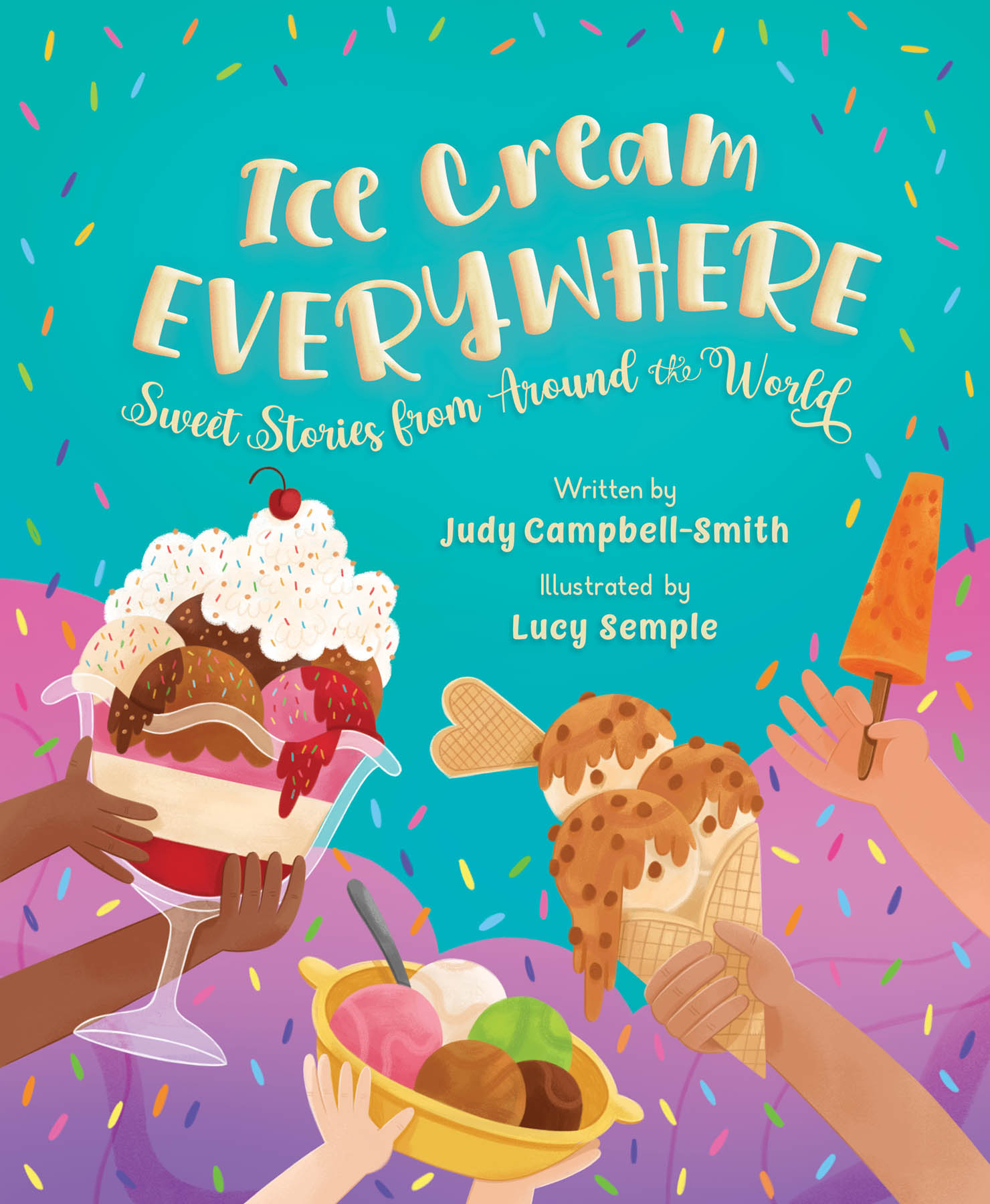
Book: Ice Cream Everywhere: Sweet Stories from Around the World

Author: Judy Campbell-Smith (it’s me!)

Illustrator: Lucy Semple

Publisher / Year: Sleeping Bear Press, 2023

Topics: Ice Cream, Geography, Food

Blurb: Everywhere you go, all around the world people are eating ice cream! And while some folks spoon up sundaes and some savor Syrian bouza–one thing is always true: ice cream is joy! Travel the globe and discover a mouthwatering selection of cold, creamy treats. Which one is your favorite?! Ice Cream Everywhere includes a map, an author’s note–and three scoops of fun!

Word Count: 1300

Back matter word count: 275

Back Matter Sections:

1. Map (47 words): In which I wrap up the theme of joy in the book along with an illustrated map showing the countries where each of the book’s ice cream treats.

2. Author’s Note (108 words): In my author’s note, I explain how my time spent in New Zealand eating ice cream and gelato provided the inspiration for this book. I also add that living in Southern California gave me many opportunities to try out the treats mentioned in the book as part of my research. Lucy Semple framed my note in the center of a delightful scene of the books characters sharing an ice cream picnic together.

3. What’s the Difference? (120 words): On this page, I briefly explain the differences between ice cream, gelato, kulfi, Turkish Maraş and Syrian bouza. Again, Lucy Semple added illustrations of each treat to accompany the explanations.

At what phase of the drafting/revising/publishing process did I decide my book needed back matter?

Once I figured out what the structure of the book would be and I finally had a full draft (which took a looooong time), I knew there would be back matter with the book. It just made sense considering how much information was packed into the book and fit in with other books of the genre.

What did the first draft of the back matter look like?

The first draft of the back matter consisted of an attempt at a glossary of terms found in the book and a note showing the difference between ice cream versus gelato. I say “attempt” because it was very messy in the first draft. I also had a list of selected resources which stuck around for quite a while in subsequent drafts.

Why did changes occur? What changes and revisions came about after working with the editor/agent?

The idea of a glossary went by the wayside during my own revision process. A glossary didn’t seem necessary after I pivoted to including factual sidebars to go alongside the fictional stories about each country and ice cream treat.

The version that I queried with and ended up submitting to editors had the “What’s the Difference?” section now expanded to also include kulfi, bouza, and Maraş. It also still had a bibliography of resources and a list of ice cream themed picture books for further reading. When I started working with Sarah Rockett, my editor at Sleeping Bear Press, she recommended removing the resources and the further reading elements with the idea they could be used in in additional materials or teacher guides. I was thrilled when Sarah suggested we add an illustrated map in the back matter. I hadn’t considered that before it was a perfect addition for this book. My first book, AJ’s Neighborhood, features a map at the end, so I thought it was cool that maps can be part of my author brand.

At this point I requested that we add a short author’s note to the back matter because I wanted to give readers a little bit about how my own travels provided the inspiration for the book.

Is my back matter aimed at kid readers or adults? What do I hope readers will take away after reading your back matter content?

I think my back matter is really more aimed at kid readers. I know lots of kids like exploring maps and I tried to keep the text in the back matter short so kids would not be intimidated to keep reading. I hope readers will come away with a growing curiosity about other countries and be inspired to explore new foods.

Reflecting on this process and what you learned, what tips can you offer picture book writers for writing back matter?

My tip for picture book writers is to look at your mentor texts and books in your genre to start thinking about your own back matter. My mentor texts had back matter but also sidebar facts which is what got me thinking about what info would be better used within my spreads and what info should stay in the back matter. From there, think about what else you could add to your back matter–get creative!

Are there resources to share that would be helpful for writer’s wanting to learn more about back matter?

When I was putting this manuscript together, the blog posts at Nonfiction Fest were very helpful. Yes, they focus on nonfiction specifically but there is a lot of great content for dealing with factual presentations in picture books. The Nonfiction Fest blog posts were very helpful to me for a lot of things.


Thank you so much for reading post about my book!

Purchase Ice Cream Everywhere: Sweet Stories from Around the World

Say hi to me on Twitter: @J_CampbellSmith

Say hi to me on Instagram: @judycampbellsmith

Follow @PBBuds24 on Instagram and Twitter to learn more about amazing books coming out this year!

Join our community at PB Power Hour!

Time for a giveaway! I would like to offer 1 lucky winner their choice of either A) a 30 minute Ask-Me-Anything zoom chat (to talk about writing, publishing, back matter, etc) or B) a FREE 30-minute max Virtual School Visit (for yourself or gift to a teacher of your choice). To enter, leave a comment on the blog post by 11:59pm PT on March 25, 2024. One entry per person.

Update: The giveaway is now closed. Congrats to Donna – you are the winner!

Thanks for reading!

Don’t miss future posts! Subscribe to my blog:

#50PRECIOUSWORDS 2024 Contest 

It’s time for one of the most fun kid lit contests! The #50PreciousWords contest is run by Vivian Kirkfield challenges writers to come up with a full story in only 50 words. I wasn’t planning on entering this year, but my son said something about robots eating pizza and suddenly a story was in my head. I managed to clock in at 49 words! Please enjoy my entry below, and head over to Vivian Kirkfield’s website to read all the entries. Good luck to all of us!

“Do Robots Dream of Electric Cheese (And Pepperoni)?” by Judy Campbell-Smith

Jamie flipped a switch. Beep! Boop! His robot sparked to life.

“FUEL REQUIRED.”

Jamie brought a bowl of batteries.

“YUCK.”

Jamie whipped up wires in a wok.

“ERROR.”

Jamie served a saucer of circuits.

“NOPE.”

Then Jamie had an idea. He plated up a piping hot pizza.

“INPUT ACCEPTED.”

Back Matter Break Down: Interview with Annette Whipple

Welcome to the Back Matter Break Down! Today we get to enjoy this interview with author Annette Whipple! She has so much great information to share with us as she has tackled back matter in so many of her non-fiction books. We are in for a treat because she’s going to share about several of her books today. Let’s dive in!

How do you decide what information will end up in the back matter versus in the main text of your non-fiction picture books?

As I’m writing, I can’t include all the wonderful facts I find in the main text. I use the interesting facts that don’t fit and consider if they’d work as back matter. I also want to include a way for the reader to interact with the topic more, so I often include hands-on activities as well as additional resources to learn more.

Tell us about the back matter revision process. Why do changes occur? What contributions and changes come as a result of working with editors?

I love back matter, so the revision process often includes me writing lots and letting my editor know that it doesn’t all need to be included. In a picture book, it’s important to leave room in the page count for it. I try to envision what it might look like (with photographs and/or illustrations), but sometimes something needs to be removed.

In The Truth About series, there are a lot of photos used alongside the text with some illustrated and graphic elements. How does your back matter text look when you are ready to submit? Do you use illustration notes?

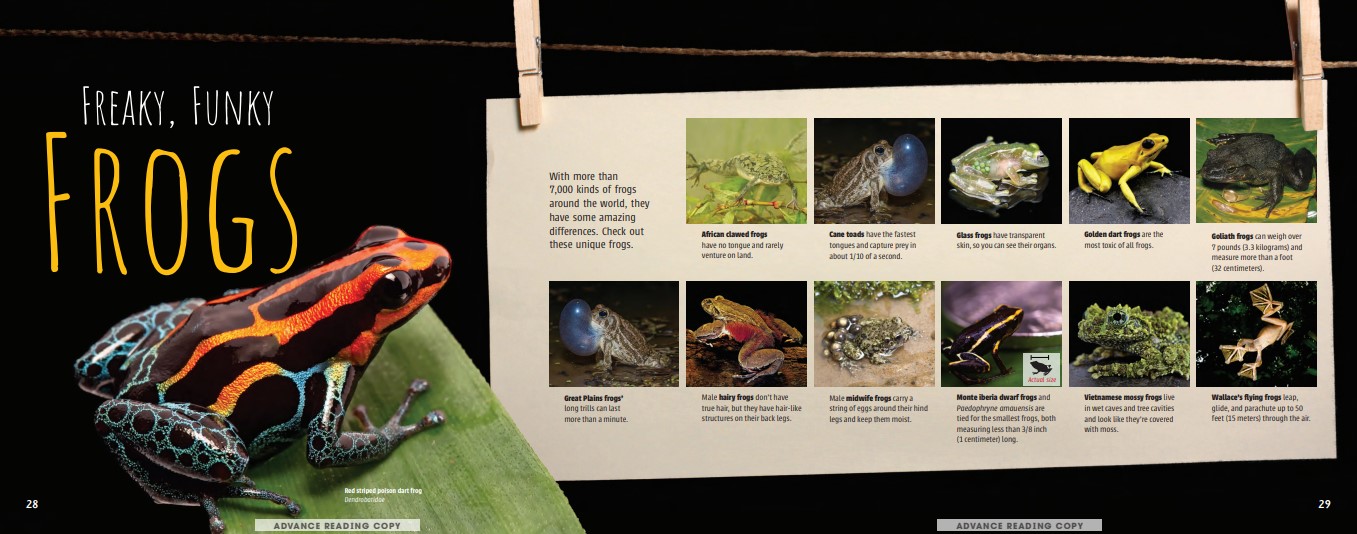
This series is beautifully designed. My illustration notes are fairly limited throughout the book, including the back matter. In the book Ribbit! The Truth About Frogs, I wanted to highlight cool frog species. I titled it “Freaky, Funky Frogs.” After a brief introduction, I wrote a sentence about each frog and what set it apart from others. At the end of this section of back matter, I included an illustration note. (My illustration notes are in gray text and brackets.)

The 228 words I wrote became a two-page spread seen here.

Ribbit! The Truth About Frogs actually had eight pages of back matter (plus another page with my author bio and photo on it). That’s a lot for a picture book.

Is your back matter aimed for kid readers or adults? What do you hope readers will take away after reading your back matter content?

At this point, my back matter has always been aimed at the kid reader instead of the adult. I write it with the purpose of helping the reader immerse themselves in the topic even more.

How do you come up with the projects that appear in the back matter for The Truth About Series? 

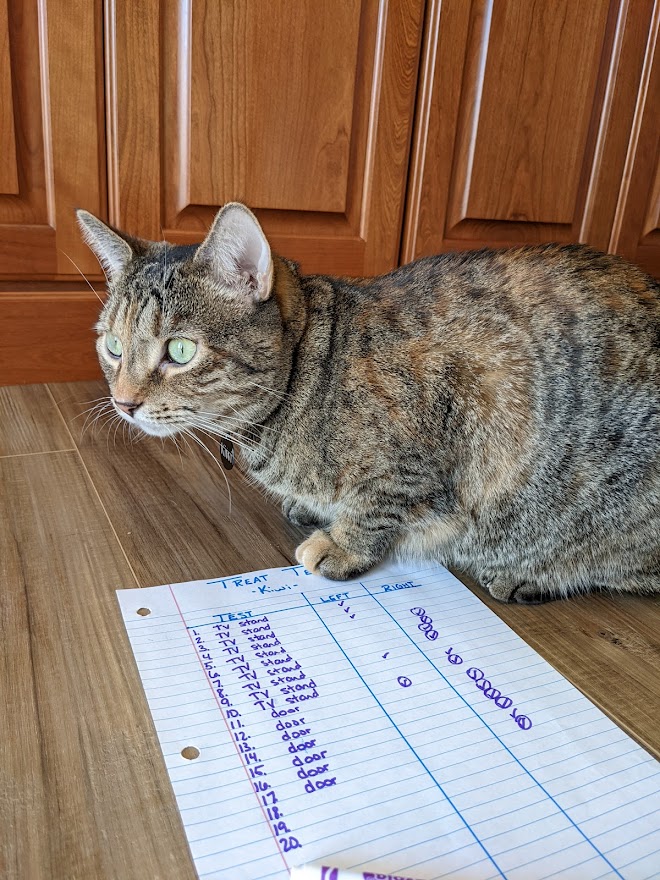
I was once a teacher, so I love coming up with hands-on ideas. I had a lot of trouble brainstorming a science-focused craft or activity for Meow! The Truth About Cats so I turned to Pinterest. There I found a great idea and made it my own. You wouldn’t believe how much fun it is learning if your cat is right-pawed or left-pawed!

What tips can you offer picture book writers for writing back matter?

Go beyond the bibliography/resources and glossary. Make the back matter something the reader will engage with. I have a whole blog post about back matter. https://www.annettewhipple.com/2022/01/writers-questions-about-back-matter.html

Are there resources or comp titles you can share that would be helpful for writer’s wanting to learn more about back matter? 

I’ve heard some authors use my series, The Truth About, for inspiration. However, I think borrowing 25 recently published books from your local library is a great place to start.  


Thank you, Annette! There’s so much good information here for anyone interested in back matter!

Please support Annette!

https://www.annettewhipple.com/ is full of resources for writers, both published and unpublished.

Follow Annette:

@AnnetteWhippleBooks on Instagram and Facebook

@AnnetteWhipple Twitter/X and Blusky

Thank you for reading!

Don’t miss future posts! Subscribe to my blog:
Back Matter Break Down: Interview with Lindsay Farley

Welcome to the Back Matter Break Down! Today, I am happy to bring an interview with Lindsay Farley! Her book is unique in so many ways as it brings together sports and social-emotional learning, plus math in the back matter! I’m excited for you all to learn more about her journey, so let’s go!

Book: An Above Par Day

Author: Lindsay Farley

Illustrator: Anglika Dewi

Publisher / Year: Kiddywink Crew, 2023

Topics: Golf, Sports, Social-Emotional

Blurb: Does practice really make perfect? And is perfect really what it’s all about? An Above Par Day is an engaging and relatable story about a boy, Liam, who thinks he will be as good as the pros when he goes out on a real golf course. Liam’s frustration gets in the way of enjoying his family golf outing. Will he be able to turn his attitude around and make some memories with his sister and parents?

Word Count: 762

Back matter word count: 309

At what phase of the drafting/revising/publishing process did you decide to add back matter in your book? 

I think I always knew I would add some type of back matter. But I was all over the place with what I wanted it to be for a while! In the very beginning stages I wanted to include a “board game” in the back. Then I went back and forth about adding in more information about the actual game of golf (i.e. explain par, bogie, etc). I also thought about having readers figure out the scores throughout the book, but I felt that took away from the storyline.  

I ended up adding in the back matter right at the end, right before it was published. After what I thought was the final read through, I felt like it didn’t showcase the math in golf as much as I wanted it to. I didn’t want to interrupt the actual story with too much math, so back matter felt like the perfect place for it.  

What did the first draft of the back matter look like? Can you show us snippets?

The very first draft of the back matter was a board game. Here are pictures of what I had initially envisioned. I had the thought that you would go to my website to download and print the cards (a few of the cards are pictured here), but then I thought maybe it would be better to bring this game and activities to visits instead of having them in the book.

Tell us about the back matter revision process. Why did changes occur? 

Initially I was publishing this book on my own. And then, in a twist of fate, I met my now business partner, Julianna Bria. We created Kiddywink Crew together, and this book was published as part of our kids entertainment company.  

A big part of what we do with Kiddywink Crew is promote the importance of conversations between kids and adults. That helped me think about the back matter differently. That’s a big part of why I changed it to questions for kids and adults to talk about from the book.

Is your back matter aimed for kid readers or adults? What do you hope readers will take away after reading your back matter content?

It’s aimed at parents and kids so they can talk about the math in the book.  I hope kids and adults see the math throughout the story, and use some of the questions to inspire questions they can ask their children the next time they play golf!

Have you heard back from any readers about how they are using the Math Connections? 

I’ve heard from a few teacher friends that they’ve used it with their classes! As a parent, I totally get why it might be hard to use with your kids, especially when you are reading at night and are ready for it to be bedtime! But I do hope that more people refer back to the questions as they reread the book!

Reflecting on this process and what you learned, what tips (if any) can you offer picture book writers for writing back matter? 

I think my biggest tip would be to wait until you’ve finished the manuscript.  It might even be best to wait until it’s illustrated too. I think you figure out the best back matter for your book once it’s as final as possible.  


Thank you, Lindsay! It’s so interesting to see your thought process! Hopefully it will help other authors as they are problem-solving their own back matter.

Please support Lindsay!

You can purchase copies of An Above Par Day here: https://www.kiddywinkcrew.com/shop

Find Kiddywink Crew on Instagram and Pinterest

Listen to Kiddywink Crew podcast on any podcast platform! https://podcasts.apple.com/au/podcast/kiddywink-crew-podcast/id1691379364

Now for the giveaway! Here is Lindsay’s generous offer: We have kids as guests on our Kiddywink Crew podcast. I would like to offer up a kid spot on our podcast for a lucky winner! Best for kids ages 4 – 10. To enter: Leave one comment on this blog post by February 26, 2024 at 11:59pm PT. A winner will be chosen at random and notified on February 27, 2024. One entry per person!

UPDATE: The giveaway is now closed.

Thank you for reading!

Don’t miss future posts! Subscribe to my blog!

Back Matter Break Down: Interview with Razeena Omar Gutta

Welcome to the Back Matter Break Down! Today, we are all in for a treat! I’m bringing you an interview with author Razeena Omar Gutta to talk about the back matter in her debut, Hana’s Hundreds of Hijabs. The back matter in this book is informative, fun and really unique–but also a perfect addition to this story about creativity and culture! Let’s dive in!

Book: Hana’s Hundreds of Hijabs

Author: Razeena Omar Gutta

Illustrator: Manal Mirza

Publisher / Year: Barefoot Books, 2022

Topics: Fashion, Creativity, Muslim Culture

Blurb: “Hana has a humongous collection of hijabs and accessories – and her hijab is always styled superbly. But when her overflowing collection gets a little out of hand, Hana knows something needs to be done . . . and comes up with a clever plan for sharing her talents and possessions with her community! Young makers will chuckle along with this humorous tale of creative problem-solving and learning to help others.”

Word Count: 524

Back matter word count? Around 300 words

At what part of the writing/revising/publishing process did you start working on your back matter?

Once most of the editing of the manuscript was done, and the illustrations were well underway giving us a good feel for the book, we started looking at ideas for back matter. There were a few things not reflected in the manuscript that I needed to clarify and explain in the back matter, and we had also been given some great feedback by beta readers within Barefoot Books that made us realise we needed some further explanation.

How did working with an agent or editor affect your back matter?

Being my very first traditionally published picture book, and first time working with an editor, it was great to have some guidance on the matter. We discussed a few options and then decided on the interview style.

Why did you decide to do a greeting in the voice of your main character to explain more about hijabs instead of a more typical author’s note or fact box?

Hana is such a vibrant character and the way she’s illustrated by Manal made her a character that I felt kids would just resonate with. By the end of the book, we just loved her personality (and readers have said the same) and so it was just natural that she should flow on into the back matter.

How did the interview section come about? Was that your idea or the editor? Who came up with questions? 

The interview was my idea, and I came up with the questions, but it was after some prompting from my editor that it would be great to make the back matter a bit creative. Also, hijab is something personal – and since Manal and I are both hijab wearing Muslim women, I felt it was a good way to get our own points of view across and our own journeys too. In a world that doesn’t always understand hijabs, or the choices Muslim women make, it was a good opportunity for us to speak up and make our views heard.

Did any other books help inspire your back matter content?

I can’t say that they did. We wanted it to be unique.

What do you hope readers will get from your back matter content? Is your back matter aimed for kid readers, adults or both?

It’s definitely aimed at both. I think Muslim kids really resonate with our interview answers, and it helps non-Muslim adult readers explain the hijab to non-Muslim kids in a way that accessible and authentic to our experiences.

I hope Muslim girls in particular will feel inspired and confident in the choices they make once they’re older, with regard to the hijab. And I hope non-Muslim readers close the book with a better understanding and appreciation for Muslim women and girls.

What advice do you have for any picture book writers who are working on their back matter?

Keep the back matter authentic and true to yourself and the book. If there’s a strong connection between yourself and the story, it would really enhance the experience of the book if you’re comfortable to share that. But also, only share what’s comfortable to you. Make it concise and accessible to readers in creative ways does help readers connect with the book. We have had many compliments on the back matter of our book.

What picture book with excellent back matter would you recommend to writers who want to study a good example?

I do love the back matter of Halal Hot Dogs by Susannah Aziz because we get to see the author’s family pictures and learn more about her. I also really loved The Night Before Eid by Aya Khalil for the same reason.


Thank you, Razeena! I think you will inspire other authors to explore new and creative options in their back matter…and I think Hana would approve!

Please support Razeena!

Follow me on Instagram @razeenareads where I share books for all ages.

Purchase copies of Hana’s Hundreds of Hijabs: https://www.barefootbooks.com/hanas-hundreds-of-hijabs

Purchase Maymoona’s Moon: https://www.hardiegrant.com.au/au/publishing/bookfinder/book/maymoona_s-moon-by-razeena-omar-gutta/9781761211898

Thank you for reading!

Don’t miss future posts! Subscribe to my blog: