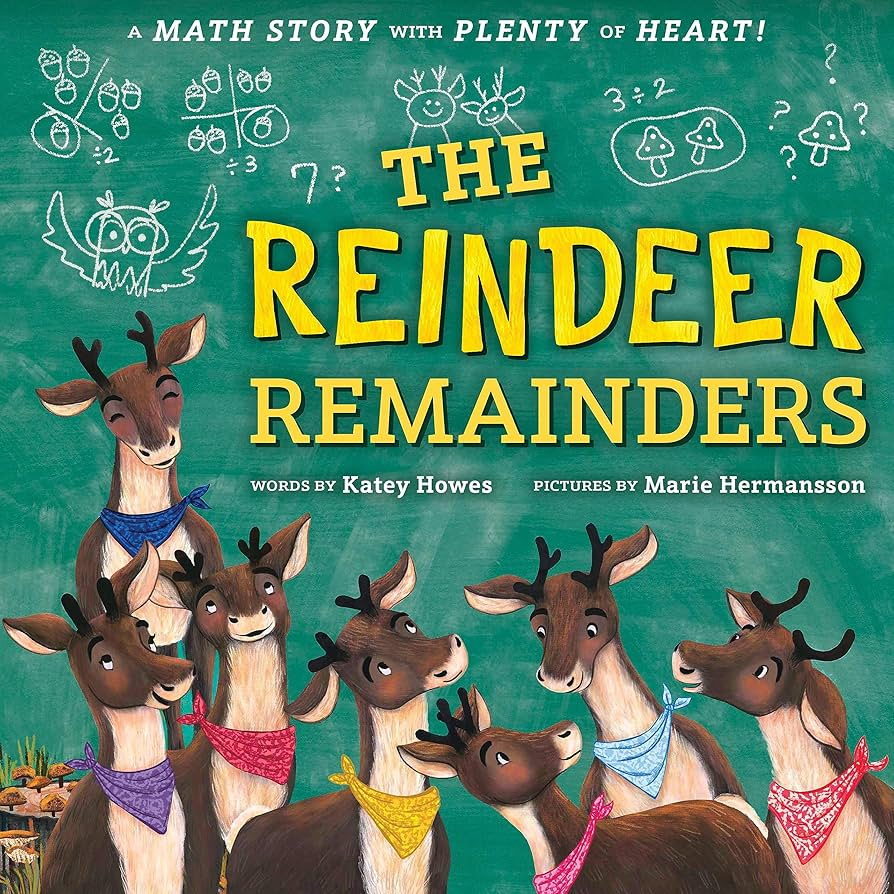
Back Matter Break Down: The Reindeer Remainders

Welcome to the Back Matter Break Down! For my final blog post of the year, I must have Christmas and holidays on the brain which is why I gravitated towards this book featuring reindeer. But let’s be clear, this is NOT a Christmas book! Instead we have a autumnal color palette with a mix of math and lessons in inclusion, all wrapped up in a delightful rhyming package! The back matter is going to give us plenty of things to talk about too, so let’s dive in!

Book: The Reindeer Remainders

Author: Katey Howes

Illustrator: Marie Hermansson

Publisher / Year: Sourcebooks Explore, 2024

Genre: Fiction

Topics: Math Concepts, School, Inclusion, Belonging

Blurb: A class of a dozen reindeer is preparing for the big showcase night event when a new student arrives. This isn’t a big deal until it’s time to divide in groups, and there’s a leftover reindeer every single time. How will the class make sure everyone feels included? And what will they learn in the process?

Book Word Count: about 430 words

Back Matter Word Count: about 370 words

Back Matter Sections:

1. Remainders and Primes (about 120 words)

To kick off the back matter, author Katey Howes, spends a page giving readers more explanation about the math concepts that are demonstrated in the story. In an earlier spread, the idea of prime numbers is introduced with illustrations doing most the heavy lifting for readers. Here, Marie Hermansson’s illustrations and kid friendly diagrams are placed alongside Howe’s explanations of remainders and prime numbers to ensure that the meaning will be clear to a range of ages. The section ends with the question, “Can you name any other prime numbers?” and kids should be able to answer based on the images and information provided.

2. When Someone Is Left Out (about 250 words)

The second page of the back matter switches gears to focus on the book’s other important theme of inclusion and belonging. Here Howes talks directly to readers to help them identify the feelings that can arise in someone who feels left out, and provides some tools to deal with those feelings. There are helpful solutions for kids to use when they are the one feeling left out, but Howes doesn’t end it there. She also makes sure to help kids build empathy and take action to help when they observe someone else being left out. Within this text, we get more illustrations of the book’s reindeer characters demonstrating these emotions and connecting readers back to the events of the story.

Takeaways: The mix of illustrations and text in the math section are a great way to ensure that readers of different age levels will be able to grasp the concepts. And the section on inclusion, has great questions and tips that will engage kids or lead into important conversations with the adults reading with them. When I look at these two pages side-by-side, it occurs to me that either one could have been decent back matter for this book on its own. But put them together, and you have back matter that is twice as good and lends itself to re-readability. Readers have choice about what topic they want to focus on and both can lead to interesting conversations with kids.

Tips: Try to make room in the back matter to cover all of different themes contained in your book! This will add to your re-readability factor and will be an extra selling point, especially if you are able to hit different disciplines.

Thank you for reading! Leave a comment to keep the conversation going or to suggest a book for future blog posts!

Don’t miss future posts! Subscribe to my blog:

Back Matter Break Down: Interview & Giveaway with Helen Kampion & Reneé Critcher Lyons

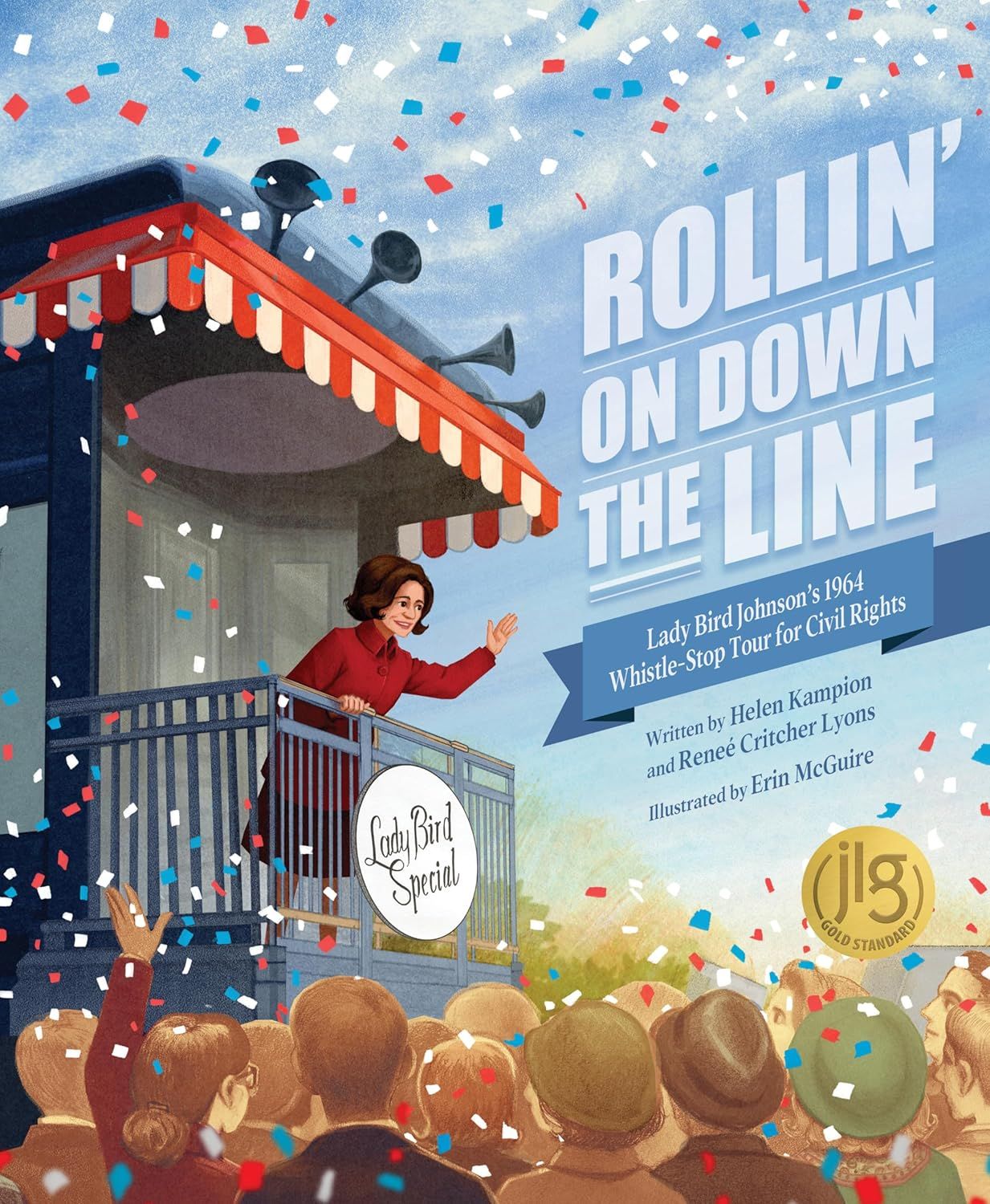
Welcome to the Back Matter Break Down! This week we have a fantastic interview with a dynamic duo behind a new PB bio! I’m so glad these two have decided to let us see behind the scenes into what their process was to put together the back matter in their book. And make sure you make it to the end of the post so you can enter the giveaway for a free book! Let’s dive in!

Book: Rollin’ on Down the Line: Lady Bird Johnson’s 1964 Whistle-Stop Tour for Civil Rights

Authors: Helen Kampion and Reneé Critcher Lyons

Illustrator: Erin McGuire

Publisher / Year: Sleeping Bear Press, 2024

Topics: Biography, US History, Civil Rights, Politics

Blurb: The late summer and early fall of 1964 was a turbulent time in America. After years of racial struggle, in July President Lyndon Baines Johnson signed the Civil Rights Act. This law, declaring that all citizens were equal, outlawed racial segregation. Many Americans cheered this legislation; yet some did not. Many Southerners despised it and worried about what it meant for their traditions and way of life. With the upcoming November presidential election, President Johnson was advised not to campaign in the South due to the threats of violence since the signing of the new law. But someone needed to visit the citizens in the South and explain why the new law was necessary and good for the entire country.

Born in Texas, First Lady Claudia Alta “Lady Bird” Johnson was from the South and understood its people and customs. Despite her fear of public speaking and threats to her own safety, Lady Bird undertook a train tour to reach out to her fellow citizens and Southerners. This is the true story of her historic Whistle-Stop journey, making almost fifty stops through eight Southern states in four days. 

What is your manuscript word count? What is your back matter word count? 

The main manuscript word count is approximately 1700 words and the back matter with bibliography and source notes is 950 words.

At what phase of the drafting/revising/publishing process did you decide your book needed back matter?

As the book is non-fiction, we knew it would need back matter from the very beginning of our work. Since it is a “slice” of Lady Bird’s life, we understood children reading the book would want to learn more about this iconic First Lady.

What did the first draft of the back matter look like?

The first draft of the back matter was mostly additional facts about the train trip, author’s notes, and also included a “read more” list. The draft constituted 1,500 words, lengthier than the finished product, and also included Lady Bird’s pecan pie recipe (as fed to dignitaries on the trip). 

Fifteen source notes are found in the final publication, whereas the first draft held nineteen. The bibliography in the first draft included eight entries, however, the final product referenced six sources. 

Tell us about the back matter revision process. Why did changes occur? What changes and revisions came about after working with the editor/agent? 

The revision process proved amicable. Changes occurred due to our editor’s suggestions. The editor wanted to cut down our facts about the train ride itself, and place more emphasis on Lady Bird’s legacy, her contributions to our society, lasting into the current day. As the main text targets the train trip extensively, we were happy to emphasize Lady Bird’s political work in the back matter.

How did you choose the photos that appear in the back matter? Were you involved in getting permission to include the photos? 

The editor reached out to us about photos to use in the back matter. Since we had been in touch with the LBJ Presidential Library and the First Ladies Library and Museum while researching the book, we passed on our contact information. The editor contacted the library and museum, decided on the photos, and we were delighted with the choices.

What was the most challenging part of the back matter publishing process?

Many of the quotes in the back matter were ones we had “lovingly” selected. The editor, nonetheless, wanted to paraphrase one or two of these. While we did so, it was a challenging edit. Also, we included many train trip details in the original text, such as her daughters’ contributions to the tour, the manner in which Lady Bird reached out to Southern governors, and Lady Bird’s favorite pecan pie recipe, served on the train. These were all eventually not included in the final back matter.

Is your back matter aimed for kid readers or adults? What do you hope readers will take away after reading your back matter content? 

The back matter is geared toward kids, but serves as an engaging read for adults as well. We want readers to further understand the extent of Lady Bird’s almost “super-human” bravery and courage. During the train tour, she was threatened, jeered, and endured sniper threats and a bomb scare. We also want readers to remember her important legacy of caring for and preserving natural areas. 

Reflecting on this process and what you learned, what tips (if any) can you offer picture book writers for writing back matter?

We suggest:

  1.  View the back matter as a means of providing a broader scope of the book’s subject matter;
  2. Use back matter to address any areas not covered in the story, but which assist with additional inquiry;
  3. Consider back matter as a way readers can enhance internalization of the story itself, providing details that don’t “fit” into the non-fiction narrative;
  4. Write back matter in an engaging way as well – don’t give up after the narrative text is finished;
  5. You will find tons of facts about your subject and be overwhelmed as to the extent!  Use the most important or poignant facts you find outside of the storyline.

Are there resources or comp titles you can share that would be helpful for writer’s wanting to learn more about back matter?  

 Children’s Books That Connect the Past to the Present with Back Matter

Use these books as examples of the “differing” types of children’s non-fiction, paying particular attention to the back matter:

Night Owl, Night by Susan Edwards Richmond (narrative non-fiction)

Seashells, More Than A Home by Melissa Stewart (traditional non-fiction)

The Leaf Detective by Heather Lang (biographical)


Thank you, Helen and Reneé! It’s so helpful for us all to see how the editing process happened and how you landed on the final version we see in the book.

Please support Helen and Reneé!

Purchase Rollin’ on Down the Line at these sellers:

LBJ Library Bookstore 

Bookshop

Amazon

Learn more about Rollin’ on Down the Line:

Jr. Library Guild distinction

Read With A Ranger:  First Ladies National Historic Site

The Children’s Bookshelf

Kathy Temean highlight

Vivian Kirkfield 

Kirkus Review 

Follow Helen and Reneé on social media:

@helenkampion

@reneelyonsMFA

Visit Helen and Reneé’s websites:

Helen Kampion

Renee’ Lyons

Now for a giveaway! Helen and Reneé have generously offered to give one lucky person a free copy of Rollin’ on Down the Line: Lady Bird Johnson’s 1964 Whistle-Stop Tour for Civil Rights! To enter: leave one comment on this blog post by October 8, 2024 at 11:59pm Pacific Time. Leave a comment on my Twitter/X, BlueSky, and/or Instagram posts a bout this blog for a maximum of 3 bonus entries. (Remember to check back on this blog post and social media to see if you are selected as a winner!)

Thank you for reading!

Don’t miss future posts! Subscribe to my blog:
Back Matter FAQs: Submitting Back Matter

Welcome to the Back Matter Break Down, my blog series all about back matter in picture books! I wanted to try something new with post and answer a common question I have encountered from picture book authors who are working on manuscripts with back matter. It’s a question I also had when I first started writing, so hopefully some of you find this post helpful.

Should I include back matter when submitting my picture book manuscript to agents / editors?

The short answer is YES.

Here’s the long answer: Generally, speaking, if you want to include any kinds of back matter text, you should write, revise, and submit it along with your manuscript when you’re querying agents or editors. By text, I am referring to author’s notes, glossaries, recipes, additional biographies for PB bios, bibliographies and references, etc. These are all the types of things that you can write up yourself, so you should go ahead and include it in your submission so agents and editors can see it with your manuscript.

There may be graphic elements that you’d like to include in your backmatter, like photos, maps, graphs, or diagrams. Unless you’re an author-illustrator, I suggest leaving a note in your back matter section with the heading “Suggested Back Matter” or “Proposed Back Matter” and then list out the graphic elements you’d hope to include. Your book’s illustrator and design team will then create those elements with your help, but it’s great to show agents and editors that you’ve at least thought of these things.

I hope that helps!

Do you agree with my answer? Have tips for authors about submitting back matter? Leave a comment!

And if you have any other questions about back matter, please drop a comment and maybe I’ll answer it in a future FAQ blog post!

Don’t miss future posts! Subscribe to my blog:
Back Matter Break Down: Interview & Giveaway with Rachel Funez

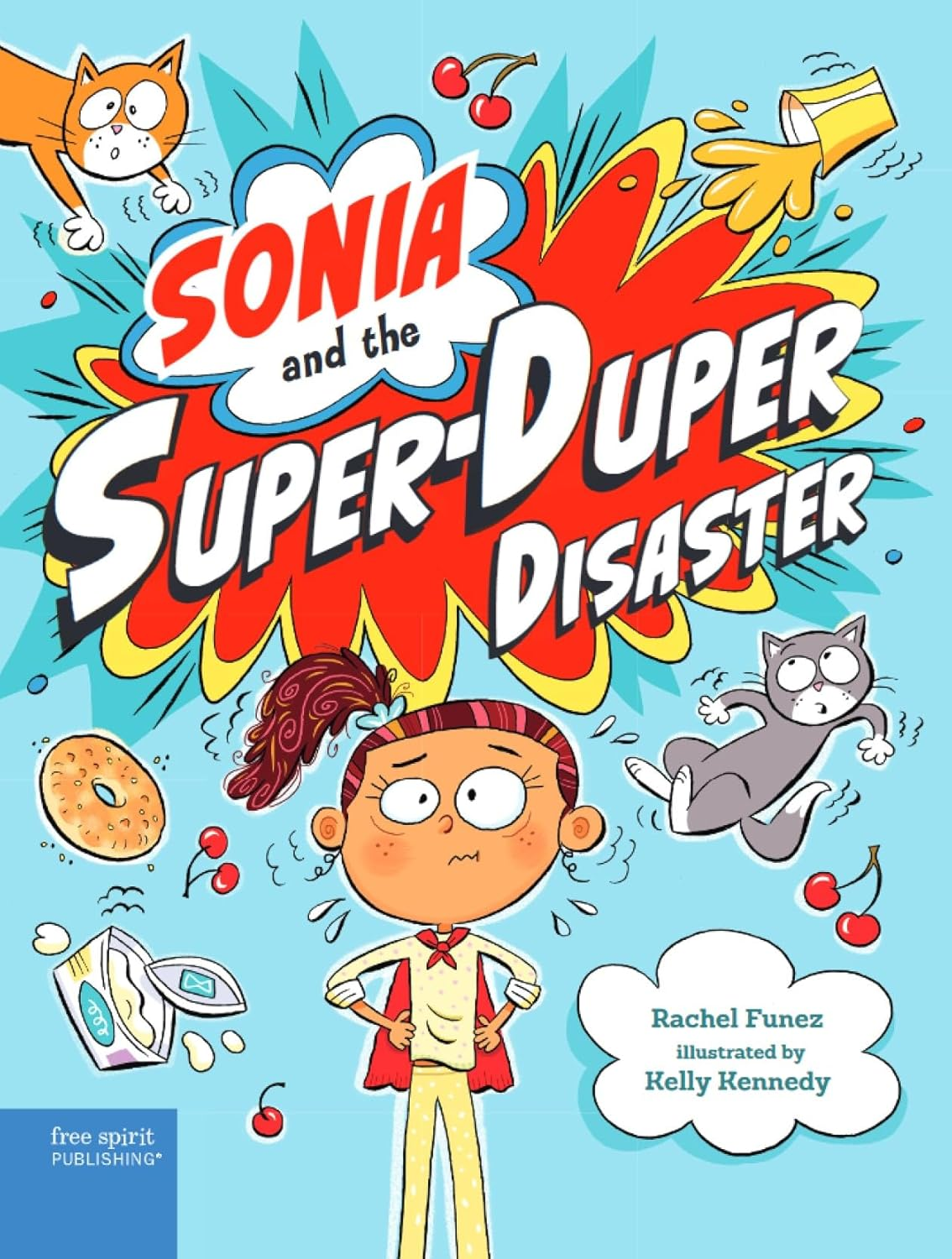
Welcome to the Back Matter Break Down! I am excited for today’s interview and giveaway with Rachel Funez! The back matter for her picture book reaches both kid and adult readers and carries on the super-hero theme of the main text. So much fun and good info here, and don’t forget to read all the way to the end of the interview for a chance at a PB critique by Rachel! Let’s dive in!

Book: Sonia and the Super-Duper Disaster

Author: Rachel Funez

Illustrator: Kelly Kennedy

Publisher / Year: Free Spirit Publishing, 2024

Topics: Anxiety, Super Heroes, ADHD, Social Emotional Learning

Blurb: When Sonia forgets Mom’s birthday, she’s determined to whip up a super surprise and become Mom’s hero. But her ADHD foils her best-laid plans, and her anxiety multiplies as the chaos grows. Sonia has to use all her coping skills to find a new recipe for success and become her own superhero.

What is your manuscript word count?

Final manuscript word count: 507

What is your back matter word count? 

Back Matter Word count: approx. 1424

At what phase of the drafting/revising/publishing process did you decide your book needed back matter?

It was toward the end of the revision process. The book had been through many iterations before I decided to make the ADHD and anxiety components more explicit. I added coping strategies that Sonia uses to help her calm down and focus. When I did that, I decided it needed back matter to give readers more insight into these “worry-fighting gadgets” and how to use them.

Did you do any research for the back matter?

Initially, I didn’t do any research for the author’s note. I grew up with anxiety and ADHD, and the “worry-fighting gadgets” I incorporated into the story were ones that I have learned to use through the years. I’m not a psychologist, but I’ve been through a lot of therapy and read a lot of self-help and parenting books. I also grew up with two counselors and married one. So the author’s note was written from my personal experiences and things I have learned from others along the way. But I did run it by my parents and husband (the counselors in my life), as well as my critique partners.

When my editor asked me to add the “Guide for Caring Adults,” I did additional research for that section. I wanted to make sure the facts I cited were accurate, and the techniques were widely accepted and recommended. 

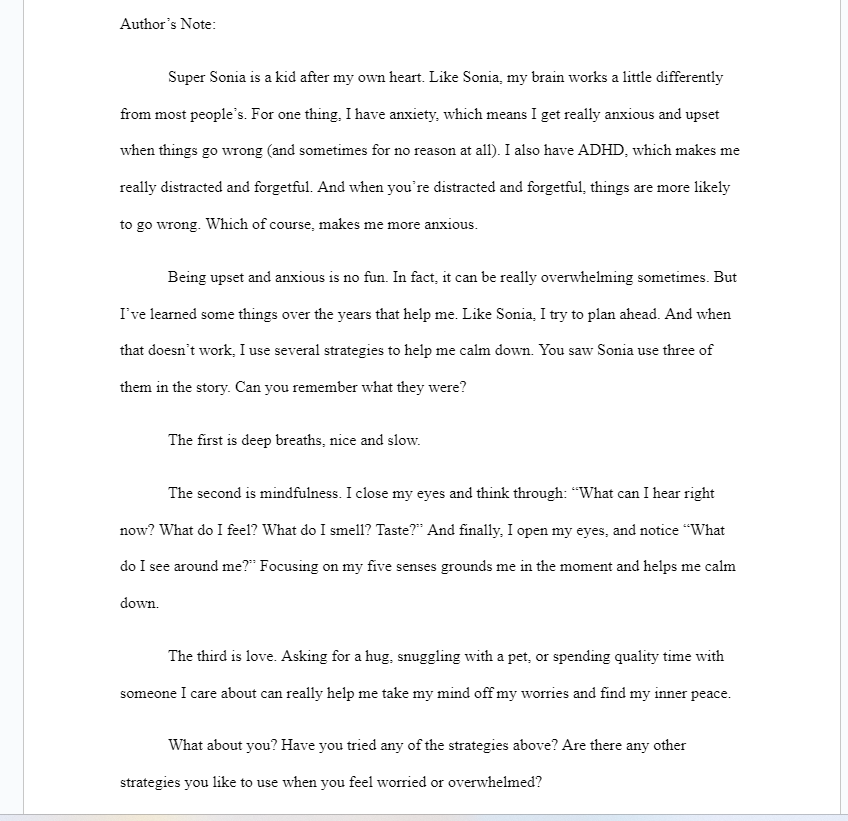
What did the first draft of the back matter look like? Can you show us snippets?

Tell us about the back matter revision process. Why did changes occur? What changes and revisions came about after working with the editor/agent?  

I was unagented when SONIA AND THE SUPER-DUPER DISASTER was acquired so it was just me and my critique partners at first. The first draft was just the author’s note. It’s actually pretty similar to the final version of the author’s note in a lot of ways. But I changed the “strategies” to “worry-fighting gadgets” and added the fun superhero themed names. (Thank you, critique partners, for that awesome suggestion!) 
I also added “Stellar Self-talk” as a tool, because I thought it was a simple and kid friendly way to combat worry. 
Once the book was acquired by Free Spirit Publishing, my editor and I went through several revisions of the back matter, and she made a lot of great suggestions. For example, “love” ended up being rephrased as “help” at the suggestion of my editor, which I loved, because even superheroes need help sometimes. She also suggested adding the section called “Guide for Caring Adults,” which ended up being one of my favorite parts of the book.

Is there more information or calming techniques that you wanted to include in the back matter but didn’t make the cut?

Yes. I initially had “planning ahead” in there. That’s a big strategy I use for both ADHD and anxiety. But it didn’t really fit well with the other “worry-fighting gadgets” and I cut the planning part of the story for pacing reasons. So I took it out of the back matter, too.

What was the most challenging part of the back matter publishing process?

I really enjoyed the publishing part of the process. My editor, Christine Zuchora-Walske, was wonderful to work with and had great suggestions. 

I think the most difficult thing for me was a feeling of “imposter syndrome.” Since I’m not a professional counselor or psychologist, I felt like, who am I to tell people how to cope with these things? But ultimately none of that information was unique content I thought up on my own. It was all things I learned from people who are much smarter than I am, and have tried to put into practice in my own life with varying degrees of success or failure. I think that allowed me to write with humility and compassion, instead of talking down to the reader.

What do you hope readers will take away after reading your back matter content? 
I hope that neurodivergent children and caregivers will feel seen and celebrated. And I hope all readers, whether neurodivergent or not, will walk away with tools they can put into practice to make some of the difficult moments just a little less challenging. 

Have you heard from any readers about the back matter and if they have been putting the tips into practice?

I have! It’s so rewarding to hear from parents who are neurodivergent and/or raising neurodivergent children, and who found the back matter helpful. It makes my heart happy! One parent wrote, “I will not only make sure to teach my girls your tips and worry-fighting gadgets but I will also use them myself.” 

Reflecting on this process and what you learned, what tips (if any) can you offer picture book writers for writing back matter?
I think if you have something important to say that doesn’t quite fit in the text of the picture book, go for it! I especially love author’s notes when they explain the author’s personal connection to the story. 

Are there resources or comp titles you can share that would be helpful for writers wanting to learn more about back matter?  
This website is perfect for learning more about back matter and finding comp titles! 
If you’re looking at sending a book to a specific publisher, I also recommend looking at their website, pulling several of their books from your local library, and checking out the type of back matter they typically include. 


Thank you, Rachel! I love hearing about how you overcame your imposter syndrome and drew from your own life to create your back matter!

Please support Rachel!

SONIA AND THE SUPER-DUPER DISASTER can be purchased anywhere books are sold, but please check with your local Indie. Online, it’s available at Amazon and Barnes&Noble, or directly from the Publisher.

Rachel’s website is www.rachelfunez.com

You can subscribe to her newsletter here.

Follow her on social media platforms: TwitterBlueSkyInstagramFacebook.

Now for a giveaway! Rachel has generously offered to give one lucky person a free PB critique! To enter: leave one comment on this blog post by September 24, 2024 at 11:59pm Pacific Time. You may earn 1 bonus entry if you leave a comment on the Twitter/X and Instagram posts about this blog to let me know you commented here. (Please remember to check back on this blog post and Twitter/X to see if you are selected as a winner!)

Update: The giveaway is now closed! Congrats to Abby Mumford!

Thank you for reading!

Don’t miss future posts! Subscribe to my blog:
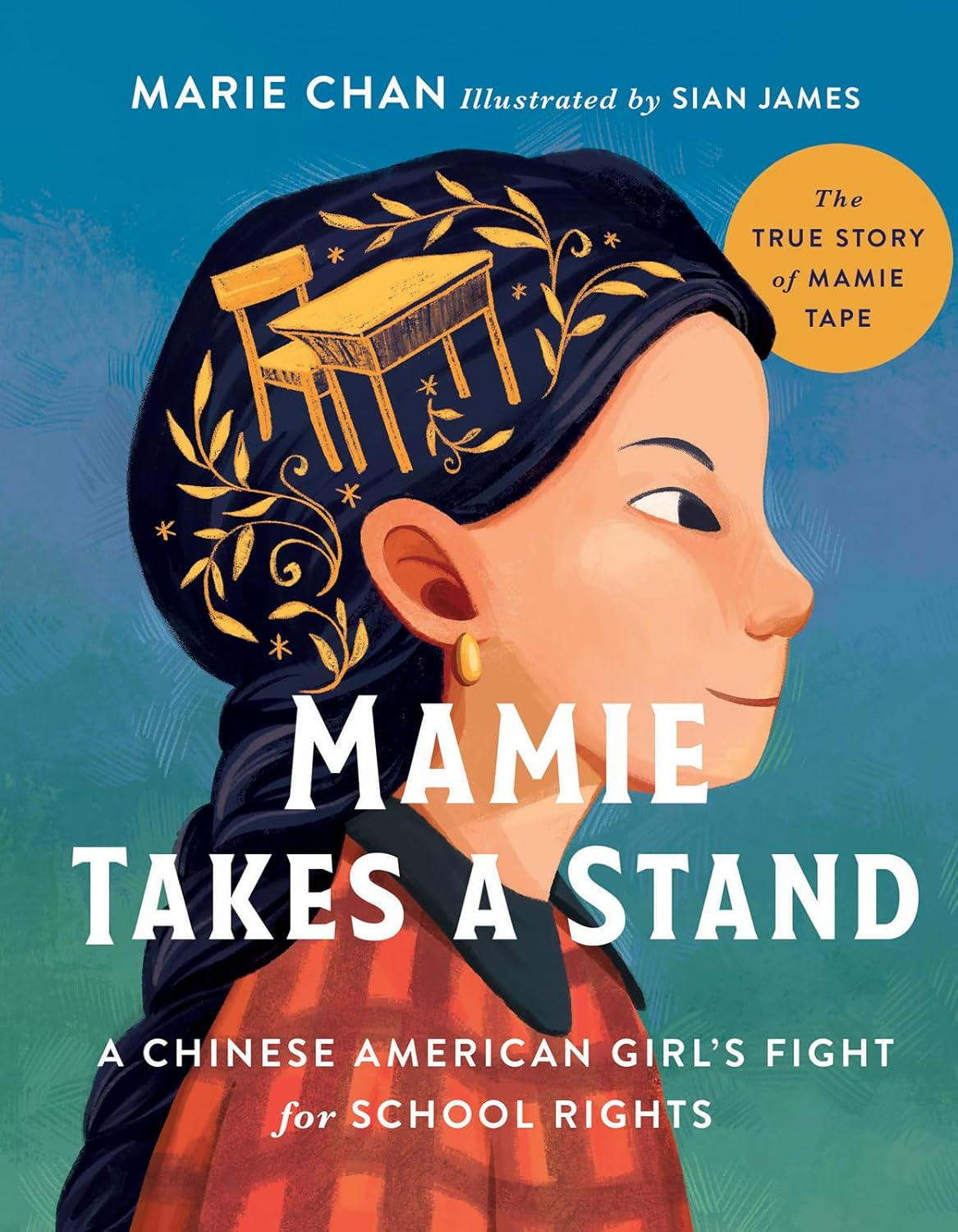
Back Matter Break Down: Interview & Giveaway with Marie Chan

Welcome to the Back Matter Break Down! I am so excited today to bring an interview with one of my writing friends about her debut picture book! Marie Chan was actually one of the first people I met when I joined SCBWI a few years ago, and it’s amazing to get to see her reach this milestone. She put so much work into the back matter of her book, so this will be a treat. And don’t forget to read all the way to the end so you can enter the giveaway for a free copy of her book! Let’s dive in!

Book: Mamie Takes a Stand: The True Story of Mamie Tape, a Chinese American Girl’s Fight for School Rights

Author: Marie Chan

Illustrator: Sian James

Publisher / Year: Ten Peaks Press, 2024

Topics: Biography, US History, Civil Rights, Chinese American History

Blurb: In the fall of 1884 in San Francisco, California, Mamie excitedly arrived for her first day at an American public school, only to find the principal blocking her way. Why? Because Mamie was Chinese.
 
Thus began the Tape family’s yearlong struggle to secure Mamie’s right to attend public school. In the spring of 1885, Mamie’s case reached the California Supreme Court, who reaffirmed a lower court’s ruling that public schools should be open to children of all races.

What is your manuscript word count? What is your back matter word count? 

Manuscript word count: 1,700 words; plus 182 words for excerpts from Mrs. Mary Tape’s letter; total 1,882 words.

Back matter word count: 1,072 words (not including quotation source notes in the bibliography); 578 words for the timeline; total 1,650 words.

My manuscript word count is higher than a usual picture book, but that is because my acquisitions editor envisioned my biography to be geared more toward middle grade readers, ages 8-12. Having an Asian American editor, who understood my intention behind why I included certain cultural details, such as Chinese words (and decided not to omit them), positively impacted the authenticity of Mamie Takes a Stand. I am grateful that my editor understood the nuances of Chinese culture, the bicultural aspects of being Chinese and American, and also could differentiate between the various dialects of Chinese because of his own lived experience.

At what phase of the drafting/revising/publishing process did you decide your book needed back matter?  

From the beginning, I knew I would need a significant amount of back matter to explain this very complex court case and explain how difficult it was to research this hidden figure. I wanted to include additional facts to explain US and California laws, the Tape v. Hurley court case and other school rights’ cases; provide more background about different key leaders in the case; and share interesting family facts, quotation sources, additional resources, archival photographs, discussion questions, a glossary, and a timeline.

What did the first draft of the back matter look like? Can you show us snippets?

I originally formulated my back matter as “Did you know?” sidebars that were to appear on each page. Later, I took the content and incorporated the information into the timeline, main text, and allowed the illustrations to show the information. I also included some of the sidebar information in my 45-page digital Parent & Educator Guide that I wrote to accompany Mamie Takes a Stand.

Tell us about the back matter revision process. Why did changes occur? What changes and revisions came about after working with the editor/agent?  

My publisher preferred to put everything in the back matter, so it would look more like a narrative picture book than a reference or educational book that reads more like an encyclopedia entry.

Unfortunately, there was only enough space to put my source notes for my quotes and not my full bibliography. My back matter pages were really full, and my editor and I didn’t want the font to be any smaller, which would make the text difficult to read. My actual bibliography is much longer; I probably have enough sources to write a doctoral dissertation! I may post my full bibliography on my website in the future.

I wanted to include more photographs, but there wasn’t enough space for more photos and all my historic notes to fit in 48 pages. I had suggested inserting additional photographs on the end papers, but the art director and designer decided otherwise. Instead, I included some historic Tape family photographs in the Parent & Educator Guide for Mamie Takes a Stand.

I am grateful for the designer, who created a beautiful layout for the interior, and took my comments into consideration when I shared ways to format the text to improve readability and to make the text more accessible to students with dyslexia. I liked how she added spot illustrations to the timeline, which really help students comprehend the content better when they have visuals next to the text. I also liked how the designer framed the archival photographs like they were in a scrapbook and kept some of the original borders on the photos to reflect the time period.

How did you choose the photos that appear in the back matter? Were you involved in getting permission to include the photos?

I chose the photos that were rarer and showed the span of Mamie’s life. I wanted to cite and include at least one photo from the National Archives to encourage students to utilize their library of primary sources. It was important to show the photo of the Chinese Primary School.

I had to obtain photo permission release forms from the Tape family descendants. I also asked UC Berkeley for the correct citations. The National Archives provided a guide to help me evaluate whether a primary source was within copyright or public domain and how they would like me to write the citation.

I wrote to a California historian and a professor who specializes in Asian American history to gather more information and ask questions about different historic photographs.

What was the most challenging part of the back matter publishing process?

Fact checking everything again after the designer created the layout for each page. Sometimes there were typos and other times the mistakes were mine.

I thought I was done researching, but then I would uncover new evidence that made me question whether another source I had used was completely accurate. Discrepancies abound! It was important to dig deep and look at multiple primary sources before deciding on what to print.

I spent weeks researching the difference in one letter in the transliteration of a single Chinese character (word). This involved contacting a professor who specialized in the research of Chinese dialects and asking an elderly friend who spoke Toisanese to gather more insights. Thankfully, my father had an antique Chinese dictionary that confirmed my research that listed the word with an alternative pronunciation.

Also, there was so much propaganda written against the Chinese during the era of the 1882 Chinese Exclusion Act, that even newspaper articles sometimes were biased in their reporting, so I had to search for other reliable primary sources to make sure the facts were accurate.

Is your back matter aimed for kid readers or adults? What do you hope readers will take away after reading your back matter content? 

I wrote the back matter more for adults, but I encourage kids to read the afterword, author’s note, and historic note, analyze the archival photos, and evaluate the primary and secondary sources. I intentionally wrote this biography to read like a story with a narrative arc, but still have robust historical facts so that a child could use my book as a resource for research when writing a biography report for class.

I hope the timeline can be used as a springboard for researching other hidden figures and significant civil rights court cases in US history that involve Asian Americans. Furthermore, I wanted to broaden readers’ perspectives of historic school rights’ cases and show solidarity between different minority groups (e.g., African Americans, Chinese Americans, and Mexican Americans) and how these cases were interconnected and built on one another.

Reflecting on this process, what tips can you offer picture book writers for writing back matter?

If you’re writing a biography, make your own family tree of the person while you are conducting research. Write notes to show how family members are related to each other and where they lived.

Use Google maps to pin key locations in the setting of your story. Take natural disasters into consideration when you do your research. The 1906 San Francisco earthquake resulted in many structures being rebuilt, so I had to check that my reference images of school buildings and other locations pre-dated this earthquake. Some schools moved, were remodeled, or were renamed as well.

Use Zotero to keep track of your sources and to create one version of your manuscript with footnotes for every sentence in your text; this way you will know where the evidence comes from for each fact you write.

Although binders may be cumbersome, one time I needed to fact check something for my manuscript, and the online archive was down for maintenance or inaccessible. I am glad that I had printed out the articles and was able to refer to the hard copy when the electronic version was unavailable. Over the years of research, there have been cases where webpages were no longer existent.

Keep good records of your photo permissions. Copyright can be complicated. Publishers want images that are 300dpi or higher, so make sure photos are scanned at a high resolution for printing.

Also, download the digital educator guides that accompany mentor texts to use as samples when you write a resource guide for your book. Lee & Low Books makes very thorough educator guides that are good examples.

Are there resources or comp titles you can share that would be helpful for writers wanting to learn more about back matter?  

I referred to historic Bloomingdale’s, Sears Roebuck, and Montgomery Ward catalogues when I needed images of historic artifacts from the late 1800s-early 1900s. These catalogues gave me a better glimpse of Mamie’s daily life and what clothing, toys, books, and materials may have been in her classroom and home.

I also utilized city directories and Sanborn Fire Insurance Maps to approximate the locations of different places to describe the setting for Mamie Takes a Stand.

A good reference book and general guide to writing children’s nonfiction books is:

Facklam, Margery, and Peggy Thomas. Anatomy of Nonfiction: Writing True Stories for Children. Writer’s Institute Publications, 2011.

Next, on my “want to read” list is, Nonfiction Writers Dig Deep: 50 Award-Winning Children’s Book Authors Share the Secret of Engaging Writing, edited by Melissa Stewart, National Council of Teachers of English, 2020.

The websites of these authors are helpful as well. When I first began writing Mamie Takes a Stand, I had the opportunity to converse with a few of the authors on this list, who were very generous in sharing their experiences in writing nonfiction for children.

Nonfiction Fest

Beth Anderson

Tina Cho

Lesa Cline-Ransome

Lisa Crayton

Julie Leung

Annette Whipple

Children’s Picture Book Biographies Back Matter Examples

Anderson, Beth. Lizzie Demands a Seat!: Elizabeth Jennings Fights for Streetcar Rights. Illus. E.B Lewis. New York: Calkins Creek, an imprint of Boyds Mills & Kane, 2020.

Brockenbrough, Martha, with Grace Lin. I Am an American: The Wong Kim Ark Story. Illus. Julia Kuo. New York: Little, Brown, and Company, 2021.

Hale, Christy. All Equal: The Ballad of Lemon Grove. New York: Children’s Book Press, an imprint of Lee & Low Books Inc., 2019.

Maclear, Kyo. It Began with a Page: How Gyo Fujikawa Drew the Way. Illus. Julie Morstad. New York: HarperCollins, 2019.

Tonatiuh, Duncan. Separate is Never Equal: Sylvia Mendez and Her Family’s Fight for Desegregation. New York: Abrams Books for Young Readers, an imprint of Abrams, 2014.


Thank you, Marie! You’ve given all of us some great tips and resources for working on our nonfiction picture books and back matter!

Please support Marie!

To order Mamie Takes a Stand: mariechan.com/books

To access digital download of Parent & Educator Guide for Mamie Takes a Stand: mariechan.com/books. This extensive 45-page guide includes engaging, multi-sensory, cross-curricular activities with analysis of archival photographs and primary sources. (I felt like I was writing a second book!)

For upcoming events and to get signed books: mariechan.com/upcoming-events/

I will be teaching Chinese calligraphy and sharing some of the Chinese words in Mamie Takes a Stand at some of my book events. Bring your whole family for art and story time!

Follow Marie on Instagram: @mariechanbooks

Follow Marie on Facebook: @mariechanbooks

Now for a giveaway! Marie and her publisher, Ten Peaks Press, have generously offered to give one lucky person copy of Mamie Takes a Stand! To enter: leave one comment on this blog post by September 17 2024 at 11:59pm Pacific Time. You may earn 1 bonus entry if you leave a comment on the Twitter/X and Instagram posts about this blog to let me know you commented here. (Please remember to check back on this blog post and Twitter/X to see if you are selected as a winner!)

UPDATE: The giveaway is now closed. Congrats to Jamie on winning a copy of Mamie Takes A Stand!

Thank you for reading!

Don’t miss future posts! Subscribe to my blog:
Back Matter Break Down: The Very True Legend of the Mongolian Death Worms

Welcome to the Back Matter Break Down! The book we’ll be looking at today is very charming and I just love the illustrations. The back matter is also very fun and takes an interesting approach to myth. This feels different than some of the other books I have reviewed lately, so I’m excited to dive in!

Book: The Very True Legend of the Mongolian Death Worms

Author / Illustrator: Sandra Fay

Publisher / Year: Godwin Books (Henry Holt and Company), 2022

Genre: Fiction

Topics: Animals/Insects, Humor, Legends/Folklore

Blurb: Like the ongoing search for Big Foot and the Loch Ness Monster, scientists have searched the Gobi Desert for these giant worms. Reported sightings claim that their skin is blood red; their fangs razor sharp. The worms are supposedly poisonous and electrifying . . . or are they?

In this funny story, we meet the Mongolian Death Worm family: Beverly, Trevor, Neville and Kevin. In spite of their deadly reputation, they’re determined to make nice and win over the other animals. Their overtures of friendship are . . . not reciprocated. But when disaster strikes, it’s the Mongolian Death Worm family to the rescue!

Book Word Count: about 650

Back Matter Word Count: about 250 plus references

Back Matter: The Truth Behind the Mongolian Death Worm Legend

Back Matter Sections:

1. Are Mongolian Death Worms Real? Well, Maybe! (45 words)

In this brief introduction to the back matter, author Fay explains the origin of the legendary creatures that she depicted as the main characters in her story.

2. Here’s What People Believe To Be True About the Real-Life Mongolian Death Worm (75 words)

While the Mongolian Death Worm’s in Fay’s story, are anthropomorphized and wear clothes, here Fay illustrates in her signature style what the “real” creatures would look like based on the legends and tales. She includes text descriptions of what their alleged behavior and main characteristics.

3. The Scientific Search for The Mongolian Death Worms (140 words)

Fay spends some time giving the history of this legend, revealing that there have been many attempts to confirm the Mongolian death worm’s existence. Readers are also treated to a re-telling of a more recent sighting of the creatures. Fay summarizes a 2011 eyewitness account in which a woman has an encounter with the the death worms and is so terrified, that she and her family moved away right afterwards.

4. Sources:

Fay includes three resources related to research on the Mongolian death worm. These are presented in much smaller text at the bottom of the page, and seem to be in MLA style formatting.

Takeaways: Fay’s back matter, like the introduction to her story, make it clear that the Mongolian Death Worms are legendary creatures. But I think it’s fun that the back matter treats readers to information that helps them imagine clearly what the Death worms would be like in real life. While a little Wikipedia searching by me revealed that scientist strongly suspect that these creatures do not exist, Fay leaves readers with a story that leans to the other side of the argument. In the case of this myth, rather than debunking it, Fay’s back matter leaves us curious and wondering, and I think this adds to overall fun and playful tone of her book.

Tips: If your book deals with real life mysteries, disputed facts, or myths, consider using your back matter to explore the possibilities. Think about leaving your readers with questions they can continue to explore instead of removing all uncertainty. This is also a great opportunity to show young readers that there are still amazing discoveries to be made in the world.

Thank you for reading! Leave a comment to keep the conversation going or to suggest a book for future blog posts!

Don’t miss future posts! Subscribe to my blog:

Back Matter Break Down: Impossible Moon

Welcome to the Back Matter Break Down! I stepped away from the blog over the summer, but I’m back at it again and excited to look at the back matter from a lovely, lyrical book. Let’s dive in!

Book: Impossible Moon

Author: Breanna J. McDaniel

Illustrator: Tonya Engel

Publisher / Year: Denene Millner Books/Simon & Schuster Books for Young Readers, 2022

Genre: Fiction

Topics: Stars, Constellations, Black History, Mythology

Blurb: Grana used to tell the best stories, and Mable used to long to soar through the heavens. Nowadays, Grana mostly lies in bed and Mable stays close to home. But one day, Grana asks, “If we can touch the moon, then what is impossible?”

So Mable decides to do just that, embarking on a journey through the stars where The Seven Sistahs, The Big Dipper, and other constellations help her on her quest and teach her about African mythology and African American history. With the support of her new companions, Mable reaches for her biggest dream yet: to make her sick grandma well again.

Book Word Count: about 679

Back Matter Word Count: about 1200

Back Matter Sections

1. Authors Note (about 600 words)

In author Breanna J. McDaniel’s note, she starts off by sharing how her own experience with her ailing grandmother became the initial spark for this story. She continues by detailing how her research led to see how Black characters and history were traditionally overlooked in presentations about stars and constellations. McDaniel notes that the movie Black Panther helped inspire her vision of the constellations as Black characters interacting with a young Black girl who loves astronomy. Finally, she shares her hope that Mable’s story will inspire young readers to love of science and keep dreaming in the impossible.

2. The Impossible Moon Sky (about 650 words)

In this section, McDaniel gives readers more information about astronomy and constellations that are presented in the story. She starts off with an introduction (about 200 words) that explains what constellations are. This section tells how constellations have been used by humans throughout history, including the fact that there are many stories that have been passed down about to constellations.

From there, the author highlights the seven constellations that she depicts in the book (about 450 words). She explains the origins of their names as well as some mythology that has traditionally been associated with the constellation. McDaniel also explains how she approached the depictions in the story as she highlighted the constellations importance to Black people throughout history. It’s extra insightful that she sometimes explains the symbolism behind her depictions that might not be immediately understood in a first reading by some.

Takeaways: Breanna J. McDaniel’s backmatter gives readers insight into her creative process as she was coming up with the themes and deeper meanings into this story. Readers who dive into her author note and explanations about the constellations will see the writer’s mind at work adding layers of meaning to her story. Especially for young readers, they may be surprised to learn of the symbolism and hidden meanings that McDaniel has infused into her story. This likely adds to the pleasure of re-reading the book as kids will be able to appreciate the story on another level while examining how Tonya Engel’s dreamy illustrations draw out these themes.

Tips: Let readers go behind-the-scenes on your creative process. As they understand what inspired your writing, how you pivoted to new ideas, or how research led you into surprising places, it will add to their appreciation of your story’s layers. If your story has symbolism, don’t shy away from explaining their meanings in your back matter. You will be equipping kids to understand how to analyze text at their own level, and I’m sure many educators will love to have such books to use as teaching examples for their students.

Thank you for reading! Leave a comment to keep the conversation going or to suggest a book for future blog posts!

Don’t miss future posts! Subscribe to my blog:
Back Matter Break Down: Like A Diamond In the Sky

Welcome to the Back Matter Break Down! Today’s post is looking at back matter that is so packed, there’s a little something for everyone! We have STEM info, biography, music and lyrics, and the most thorough bibliography I have ever seen in a picture book. Let’s check it out!

Book: Like a Diamond in the Sky: Jane Taylor’s Beloved Poem of Wonder and the Stars

Author: Elizabeth Brown

Illustrator: Becca Stadtlander 

Publisher / Year: Bloomsbury Children’s Books, 2022

Genre: Non-Fiction

Topics: Biography

Blurb: Twinkle, twinkle, little star, how I wonder what you are.
Did you ever wonder who wrote that famous verse? In the days when most girls were brought up to run a home, Jane Taylor had a different kind of education in the countryside, where she was inspired by nature and the stars, and dreamed of becoming a writer. But then, it was not considered proper for women to be writers. But Jane did write, and she never forgot her love for beauty of nature and the glow of stars, or her desire to write for children. Her published poetry became universally known for generations to come: Twinkle, twinkle little star.

Book Word Count: `about 1120

Back Matter Word Count: about 750, plus bibliography, timeline and sheet music

Back Matter Sections:

1. Author’s Note (about 130 words): This is a relatively short note that reflects on Jane Taylor’s lasting legacy as the author of the poem “The Star”, which was adapted to music as “Twinkle, Twinkle, Little Star.” This is more of a personal reflection since author Elizabeth Brown will provide a more detailed biography of Jane Taylor in a later section of the back matter.

2. Do Stars Twinkle? (about 60 words): Author Elizabeth Brown gives a short explanation about the science behind why stars appear to twinkle. It’s a little bit of STEM content in a historical biography, but connects nicely to the subject’s most famous poem.

3. Jane Taylor, 1783-1824 (about 500 words): Here we get a more complete biography of of Jane Taylor and her work, moving through her life chronologically. When it comes to Taylor’s budding writing career, Brown gives further context about Jane Taylor’s poetry and her place within Romantic Era poetry as a writer and a woman.

4. Quotes and Sources: Elizabeth Brown incorporated nine quotes from Jane Taylor’s writings into the main text of the book. Each of these quotes is cited. Here is an example:

“contemplate the dark blue depths of the sky”

The Writings of Jane Taylor in Five Volumes, Isaac Taylor, ed., vol. I, Memoirs and Poetical Remains (Boston: Perkins and Marvin, 1832), 132-133.

5. Timeline of Selected Works by Jane Taylor: This is a timeline presented in text format of Jane Taylor’s writings. Brown notes at times where poems were published and what other authors were involved in published books. Here is an example of how the timeline is presented:

1803 Jane’s poem “The Beggar Boy” is accepted for publication by William Darnton

6. Bibliography: This list of sources covers a full spread of the back matter. It is further divided into 3 sections: Primary sources (10 sources listed), Secondary sources (14 sources listed), and Other sources (10 sources listed. The primary sources are mostly comprised of works by Jane Taylor herself. The secondary sources appear to be a mix of writings about Jane Taylor or her poetry, or sources that give background on Romantic Era poetry or children’s poetry. The other sources are mostly articles about Jane Taylor or the origins of “Twinkle, Twinkle, Little Star” and likely were written using the primary or secondary sources for background. There are also a couple of academic articles about Romantic Era poetry or women’s roles during Jane Taylor’s lifetime. It is striking how thorough this bibliography is considering that bibliographies in picture books are often truncated to a shorter list of selected works. I don’t think I’ve ever seen a full 2-page spread dedicated to bibliography in a picture book before.

7. “Twinkle, Twinkle, Little Star” (sheet music plus note of about 80 words): The note attached to the sheet music is a short explanation of the French song that became attached to Jane Taylor’s poem, “The Star.” The sheet music shows the single notes and lyrics to the song on the treble clef. It shows only the first line of the song, which is likely the only lyrics many of us know.

8. “The Star”: Opposite of the sheet music, we get to see the full poem by Jane Taylor. With the sheet music and poem together on a spread, a reader could sing or play through the entirety of the poem including the lesser-known verses.

Takeaways: With 4 full spreads dedicated to the backmatter, Elizabeth Brown has plenty of real estate to work with. She makes excellent use of it all by giving readers a variety of elements to engage with. The author’s note and biography of the subject are more typical in a PB bio, but the bit of STEM content in the back matter is an likely an extra selling point for many readers. With the quotes and sources, timeline and thorough bibliography, this picture book becomes a valuable source of information on Jane Taylor and can help lead interested readers to even more sources for study. In addition, for those interested in improving their research skills, the bibliography is a great example of how to organize sources and visual representation on primary verses secondary sources. Finally, the sheet music and full poem are an appealing addition to let readers engage with a familiar song in a new way. Elizabeth Brown has something for everyone in her back matter! It’s clear that she and her editorial team put a lot of thought into this part of the book to find ways to keep readers turning the pages past the main text of the story.

Tips: Let your imagination run wild as you brainstorm possible elements for your back matter? Could there be a map? Sheet music? STEM elements related to your book? Photos? Try to think of what would be unexpected for your genre. Perhaps you will be able to find something unique but still relevant to expand your book’s appeal and keep readers turning the page.

Thank you for reading! Leave a comment to keep the conversation going or to suggest a book for future blog posts!

Don’t miss future posts! Subscribe to my blog:
Back Matter Break Down: Interview & Giveaway with Darcie Naslund

Welcome to the Back Matter Break Down! If you are interested in back matter in picture books, you have come to the right place. Today’s interview with Darcie Naslund is full of great behind the scenes info about she put together the back matter for her debut picture book. And don’t forget to read to the end for the giveaway! So much good stuff here, so let’s dive in!

Book: My Mom is NOT a Superhero!

Author: Darcie Naslund

Illustrator: Dania El Khatib

Publisher / Year: DC Canada Education Publishing, 2024

Topics: Multiple Sclerosis, Chronic Illness, Mothers, Superheroes

Blurb: A little girl whose mother has Multiple Sclerosis discovers that some superheroes are fighting invisible battles. With the help of her cat and some X-ray glasses, she learns just how strong her mom is and how she can help her.

What is your manuscript word count? What is your back matter word count?

The manuscript I submitted was about 460 words, not including my illustration notes, which were around 100 words. Looking back now, I realize I didn’t need that many, but at the time, I thought they were necessary to explain the symptoms clearly as villains.

The back matter is about 500 words. It focuses on child readers or creating an adult-child conversation about Multiple Sclerosis and invisible illness.

At what phase of the drafting/revising/publishing process did you decide your book needed back matter? 

My first draft wasn’t a story at all. It was more like a well-written advertisement for MS. It was loaded with descriptions and not exciting for kid readers. The first draft was written on its own without back matter. The author’s note came next, as it was a suggestion from my critique group. They may have suggested back matter, but I can’t remember. What I do remember is that I was very stuck in my way with this manuscript. I would take some pieces of advice on the line level but refused to accept any whole-picture type of advice.

It wasn’t until I received some brutally honest, whole-picture feedback that I realized I needed to make a change. After my daughter’s endless questions about my worsening MS, I had an epiphany. I needed to find a way to make the invisible visible. That’s where the X-ray glasses came in. I rewrote the entire manuscript, cut the descriptions, and turned them into back matter.

Did you need to do any research for the back matter?

Having MS gave me first-hand experience explaining it to children. That being said, I still did a lot of research and connected with the MS Society of Canada. They sent me a few resources for having conversations with children. I also collected resources from other MS organizations around the world.

The organization of the back matter was very important to me. I didn’t want it to be overwhelming for kids if they wanted to learn more. I checked out dozens of picture books with back matter from the library to compare and eventually decided on a plan.

How did you come up with the activities that kids can do to understand MS symptoms?

When I was looking for resources for families, I came across several activity books for kids. Some of them included crossword puzzles, questions and stories. They helped parents explain MS to young children. That’s when I realized the problem— explaining alone doesn’t always lead to understanding. As the old saying goes,

“Tell me and I forget, teach me and I remember, involve me and I understand.”

I needed to put the readers in the shoes of someone with MS to even begin to understand. The analogies that I came up with were things I would say all the time to my family. “I feel like something is pulling my arms down.” Or “My legs feel like they are made of cement.” I have had times when I thought my glasses were dirty or smudged, but it was just my MS. I took all of my experiences and my little descriptions and included them in the backmatter. Even now that the book is published, I want to add or change something about the backmatter. For example, in the back matter, I suggest using ankle weights or socks full of sand to weigh your legs down.  Now, I realize that wearing very big, heavy boots creates a similar effect. Although I can’t make that change now, I will still include it in my activities and book events.

What did the first draft of the back matter look like?

The first draft didn’t look much different in regards to the organization. It had the symptoms list and the “Try This” section. I also had a “How to Fight MS” section that I later took out. It did, however, have a completely different analogy for MS. Finding the right analogy was probably the most difficult part of writing the back matter. I tried many different analogies— a computer and wire, a rough hiking trail, and even mail delivery.  The computer analogy was what I submitted to DC Canada Education Publishing. It was later changed and explained using water flowing through a garden hose. This idea came from the wonderful team at DC Canada Education Publishing.

*Before

Draft of back matter text by Darcie Naslund

*After

Published back matter from My Mom is NOT a Superhero! by Darcie Naslund, Illustrated by Dania El Khatib

Dania El Khatib took my words and created back matter that was not only engaging but accessible. It is everything I dreamed it would be.

Tell us about the back matter revision process. Why did changes occur? What changes and revisions came about after working with the editor/agent? 

The back matter was probably the most difficult part of the revision process with my editor. We went back and forth several times, creating every analogy we could to explain what MS is in a clear, accessible way. I have always described MS as if my brain was a computer and my nerves were wires connecting to the rest of the body. Although this analogy felt most accurate with some MS symptoms, we decided that it was not the safest route to go, as we did not want children thinking that it was okay to play with electrical wires.

I created several more analogies, and so did my editor. When we reviewed them together, we finally concluded that the garden hose analogy would be best. It was clear and did not create a potential risk like the previous version.

My editor mentioned that she was very excited to have received the manuscript with back matter already created. It made her job much easier. She was also the one who thought to include the engaging questions for the readers.

What was the most challenging part of the process of the back matter publishing process?

As I mentioned in the previous question, the most difficult part was creating a clear, concise analogy for what MS is. It was also the beginning of the back matter and set the tone for the rest of the information. This was the most important, difficult and tedious part of the process.

Is your back matter aimed at kid readers or adults? What do you hope readers will take away after reading your back matter content?

I would say the back matter is aimed mostly at kid readers. I also wanted it to create conversations between the children and an adult reader.  My goal for the back matter was not only to explain what Multiple Sclerosis or MS is but to put them in the shoes and help readers understand. I also wanted readers to understand that many challenges and conditions are invisible, but it does not mean that they do not exist. There are superheroes fighting invisible battles all around us. With a little bit of kindness and understanding, even they can be superheroes.

Reflecting on this process, what have you learned? What tips (if any) can you offer picture book writers for writing back matter?

My first piece of advice is to decide what your goal is for your back matter. Once you have your goal, start by studying other picture books (both fiction and nonfiction). I like to use them as a blueprint for organizing my information. I didn’t use one specific book as a guide, but pieces from several books. Studying what was already out there was very helpful to me.

Are there resources or comp titles you can share that would be helpful for writers wanting to learn more about back matter? 

To be honest, I don’t have any resources for this. I studied many different books with back matter, both fiction and non-fiction, as these tended to be very different. The idea of blueprinting came from one of author Ebony Lynn Mudd’s writing courses. I found her courses very useful and would recommend them to all picture book writers.


Thank you, Darcie! You’ve given us some great tips on how to plan for our back matter!

Please support Darcie! Find her website and all of her links on Linktr.ee: Darcie Naslund Linktr.ee

 Purchase My Mom is NOT a Superhero!:

DC Canada Education Publishing

amazon.ca

amazon.com

Now for a giveaway! Update: the giveaway is now closed. Darcie has generously offered to give one lucky person a full manuscript critique that includes backmatter! To enter: leave one comment on this blog post by May 21, 2024 at 11:59pm Pacific Time. You may earn 1 bonus entry if you also comment on the Twitter/X post about this blog to let me know you commented here. (Please remember to check back on this blog post and Twitter/X to see if you are selected as a winner!)

Thank you for reading!

Don’t miss future posts! Subscribe to my blog:

Back Matter Break Down: Interview with Ann Suk Wang

Welcome to the Back Matter Break Down! Today I am excited to bring you an interview with Ann Suk Wang! Ann’s debut picture book is one of those special books that manages to deal with a tough topic, but is also is full of beauty and hope. Let’s take a look!

Book: The House Before Falling Into the Sea

Author: Ann Suk Wang

Illustrator: Hanna Cha

Publisher / Year: Dial Books, 2024

Topics: Refugees, War, Kindness, Korea

Blurb: Every day, more and more people fleeing war in the north show up at Kyung Tak and her family’s house on the southeastern shore of Korea. With nowhere else to go, the Taks’ home is these migrants’ last chance of refuge “before falling into the sea,” and the household quickly becomes crowded, hot, and noisy. Then war sirens cry out over Kyung’s city too, and her family and their guests take shelter underground. When the sirens stop, Kyung is upset—she wishes everything could go back to the way it was before: before the sirens, before strangers started coming into their home. But after an important talk with her parents, her new friend Sunhee, and Sunhee’s father, Kyung realizes something important: We’re stronger when we have each other, and the kindness we show one another in the darkest of times is a gift we’ll never regret.

Word Count: Just under 800

Back Matter Word Count: Just over 1000 words

At what phase of the drafting/revising/publishing process did you decide your book needed back matter?

I knew from the very beginning. In fact, when I queried agents, I included it.

Did you need to do any research for the back matter?

A little bit because I included a glossary of Korean words that are spelled in English many different ways. I didn’t know which was officially correct. I also had to make sure my Korean War facts were accurate. I had to double and triple check. (It’s probably the journalist in me?)

What did the first draft of the back matter look like?

Unfortunately, I don’t really save older copies. I really should because it would be interesting to see how it evolved. But usually, I wipe things clear so I don’t get confused with different versions. But basically, it was shorter. I had fewer Korean words for the glossary. I don’t think I included my section on Korean names until later.

Tell us about the back matter revision process. Why did changes occur? What changes and revisions came about after working with an editor/agent?

My ideas in my author’s note stayed about the same. But with my editor’s help, of course, it was greatly improved and tightened up. And I knew I wanted to include “Questions to Consider” because kids could easily go deeper into the subject matter, if asked various questions. So this was added.

Did you know the story of Hanna Cha’s family prior to seeing her illustrator note?

Yes. After she accepted the project, she started to ask her grandmother questions about the war. Then in a letter to my editor, she mentioned that she discovered how her family were on the opposite side of the story, making their way down to Busan. It was such an amazing pairing, two stories merging in an author and illustrator! She really understood the story and embraced it in her illustrations, elevating the whole book in an entirely special way. I think it shows!

What was the most challenging part of process of the back matter publishing process?

I think the glossary was the most challenging because of the different spelling of Korean words in English (the Romanization is tricky.) What’s mostly used is not necessarily correct. So we had to decide how to spell things. It felt “important” in that the way we spelled things could be passed on and add to the common usage. So I wanted to get it right.

Is your back matter aimed for kid readers or adults?

Definitely, it’s for kids. But I understand that adults may be more interested.

What do you hope readers will take away after reading your back matter content?

I hope kids will become more interested in Korean culture, but mostly in being kind to people around them and growing in more love toward their neighbors.

What tips or resources (if any) can you offer picture book writers for writing back matter?

I don’t know of any resources for back matter, except your wonderful blog. But as for tips, I can just say to treat the back matter with respect. The back is where the facts can shine and kids have a chance to go deeper into the subject matter. So put on your journalism hat and research well while putting all the most important things into a succinct story, listing, graph, etc.


Thank you, Ann, for getting all of us picture book writers excited about putting on our journalism hats so we can tackle our back matter with confidence!

Please support Ann! Visit her website and subscribe to her blog: www.annsukwang.com. Follow her on Instagram: @annsukwang. For event updates and purchasing information for signed copies of The House Before Falling Into the Sea, visit her Linktr.ee: linktr.ee/annsukwang.

Now for a giveaway! Ann has generously offered to give one lucky person a signed copy of The House Before Falling Into the Sea! To enter: leave one comment on this blog post by April 23, 2024 at 11:59pm Pacific Time. A winner will be chosen at random and notified on April 17, 2024. One entry per person.

UPDATE: The giveaway is now closed. Congrats to Andrea W! You are the winner!

Thank you for reading!

Don’t miss future posts! Subscribe to my blog: