Back Matter Break Down: Interview & Giveaway with Steena Hernandez

Welcome to the Back Matter Break Down! Today I’m excited to bring you an interview with a wonderful debut author, Steena Hernandez. She gives us a look into the process of writing and revising her back matter, and how she landed on mixing her personal story with some facts about dancers and ballet shoes. And don’t forget to scroll all the way to the bottom of the post so you don’t miss the giveaway! (Update: the giveaway is now closed) Let’s go!

Book: Lupita’s Brown Ballet Slippers

Author: Steena Hernandez

Illustrator: Melissa Castillo

Publisher / Year: Beaming Books, 2024

Genre: Fiction

Topics: Ballet, Dancers, Latine Stories, Race/Diversity

Blurb: Lupita’s big ballet recital is approaching. The music is perfect. Her ballet moves are strong. But her peachy pink ballet slippers don’t match her skin tone. Lupita searches for the right pair only to discover it will take hard work–and messy measures–in order for her shoes to dance with her.

What is your manuscript word count? What is your back matter word count? 

My manuscript word count is 539. The back matter, including an Author’s Note and Ballet Is For Everyone section, has a word count of 458.

At what phase of the drafting/revising/publishing process did you decide your book needed back matter?  

My very first draft had a small paragraph of back matter. I always knew I wanted to elaborate on ballet slippers specifically, but I needed to research and gather facts.

What kind of research did you do for the back matter?

I checked out books from my library about ballet and dancers like Misty Copeland. I searched many online sites and watched several videos.

What did the first draft of the back matter look like? Can you show us snippets?

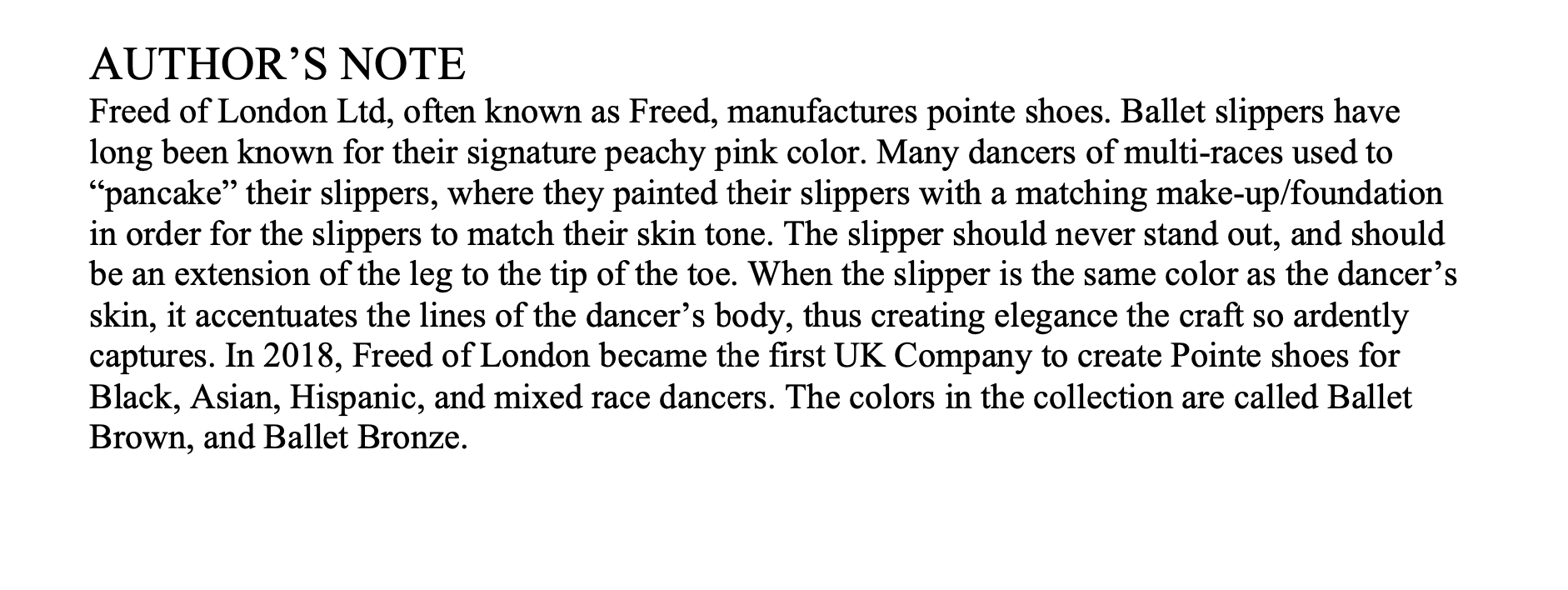
This was my very first draft of my back matter. I shared it with my critique partners and received positive feedback and decided to leave it in the story.

Screenshot of Steena’s original back matter reads: AUTHOR’S NOTE: Freed of London, Ltd, often known as Freed, manufactures pointe shoes. Ballet slippers have long been known for their signature peachy pink color. Many dancers of multi-races used to “pancake” their slippers, where they painted their slippers with a matching make-up/foundation in order for the slippers to match their skin tone. The slipper should never stand out, and should be an extension of the leg to the tip of the toe. When the slipper is the same color as the dancer’s skin, it accentuates the lines of the dancer’s body, thus creating elegance the craft so ardently captures. In 2018, Freed of London became the first UK Company to create Pointe shoes for Black, Asia, Hispanic, and mixed race dancers. The colors in the collection are called Ballet Brown, and Ballet Bronze.

Tell us about the back matter revision process. Why did changes occur? What changes and revisions came about after working with the editor/agent?  

*This was before I had an agent. 🙂 My back matter changed during my Las Musas mentorship, when my mentor suggested I include information about my own dance journey and professional dancers of color.

Are there any other dancers or information that you wanted to include in the back matter but didn’t make the cut?

No, not really. My editor liked the back matter, and the order of the information was the only major change made.

Did you have kid readers or adult readers in mind when working on your back matter? What do you hope readers will take away after reading your back matter content?

As I was sharing my story, I was surprised to hear how many adults had never heard of “pancaking” ballet slippers. That made me want to include more information about the process, where dancers of darker skin tones apply a matching foundation/makeup to their traditional pink slippers, giving them elongated lines. Not until around 2018 did ballet companies begin creating ballet pointe shoes for dancers of color. I hope readers, kids and adults, will have a better understanding of some of the challenges dancers of color have faced and the importance of inclusion.

Reflecting on this process and what you learned, what tips (if any) can you offer picture book writers for writing back matter?

I look forward to reading the back matter in picture books. My favorite part is an Author’s Note that gives more information about their connection to the story. If your story is a personal one, try to expand on why you wrote the story and share memories and examples that may not be included in the story.

Also, if your story is nonfiction or based on true events, research online and visit your local library, collecting as much information about your topic as possible. You can organize your notes once you’ve researched and gathered your information.

Are there resources or comp titles you can share that would be helpful for writer’s wanting to learn more about back matter?  

Annette Whipple has a great post on her website about back matter and frequently asked questions. She includes examples from her, The Truth About series, which all have wonderful back matter to reference.

https://www.annettewhipple.com/2022/01/writers-questions-about-back-matter.html

Other books I love with back matter:

Ice Cream Everywhere: Sweet Stories from Around the World by Judy Campbell-Smith, illustrated by Lucy Semple (Includes an Author’s Note and What’s the Difference? of ice creams section.)

Lola Out Loud: Inspired by the Childhood of Activist Dolores Huerta by Jennifer Torres, illustrated by Sara Palacios (Includes an Author’s Note about Dolores Huerta.)

Tamales For Christmas by Stephen Briseño, illustrated by Sonia Sánchez (Includes and Author’s Note and a delicious recipe for tamales.)

Enrö Rubik and His Magic Cube by Kerry Aradhya, illustrated by Kara Kramer (Includes The Magic Cube, By the Numbers, and Author’s Note sections.)

Ladybug Launch: Inspired by a True Story of Chinitas in Space by Melissa Trump and Natalia Ojeda, illustrated by Manuela Montoya. (Includes Author’s Note from Natalia and a Spanish to English Glossary.)

Shark Lady: The True Story of How Eugenie Clark Became the Ocean’s Most Fearless Scientist by Jess Keating, illustrated by Marta Alvarez Miguens (Includes additional information about sharks and a timeline of Eugenie’s life.)


Thank you, Steena! I love hearing how you found a way to make your back matter both informative and personal at the same time! Plus, you’ve given us some excellent recommendations of books to add to our lists (and thank you for the shout-out for my book, Ice Cream Everywhere!). Please support Steena:

-Steen’a Picture Book: Lupita’s Brown Ballet Slippers

Steena’s Linktree: https://linktr.ee/steenahernandez?fbclid=PAZXh0bgNhZW0CMTEAAaZ0dz_vWBDng7HoAyWlZPStU1_rEnp5y-SL9q9SYQtLQvjcRyYkZ87Ys7o_aem_QZBTaBdpmq5FP7aFKpdmhQ

Instagram: @steenahernandez

-Bluesky:  https://bsky.app/profile/steenahernandez.bsky.social

Website: www.steenahernandez.com

-Check out Steena’s critique services at My Critique Boutique: https://www.steenahernandez.com/critique-boutique

Now for the giveaway! Steena has generously offered a SIGNED COPY OF LUPITA’S BROWN BALLET SLIPPERS to one lucky winner!

To enter: leave one comment on this blog post by February 11, 2025 at 11:59pm Pacific Time. For additional entries, leave a comment on my (Judy’s) BlueSky and/or Instagram posts about this post for a maximum of 2 bonus entries. (Remember to check back on this blog post and social media to see if you are selected as a winner!)

Update: The giveaway is now closed! Congrats to Bri – you are the winner!

Thank you for reading!

Don’t miss future posts! Subscribe to my blog:

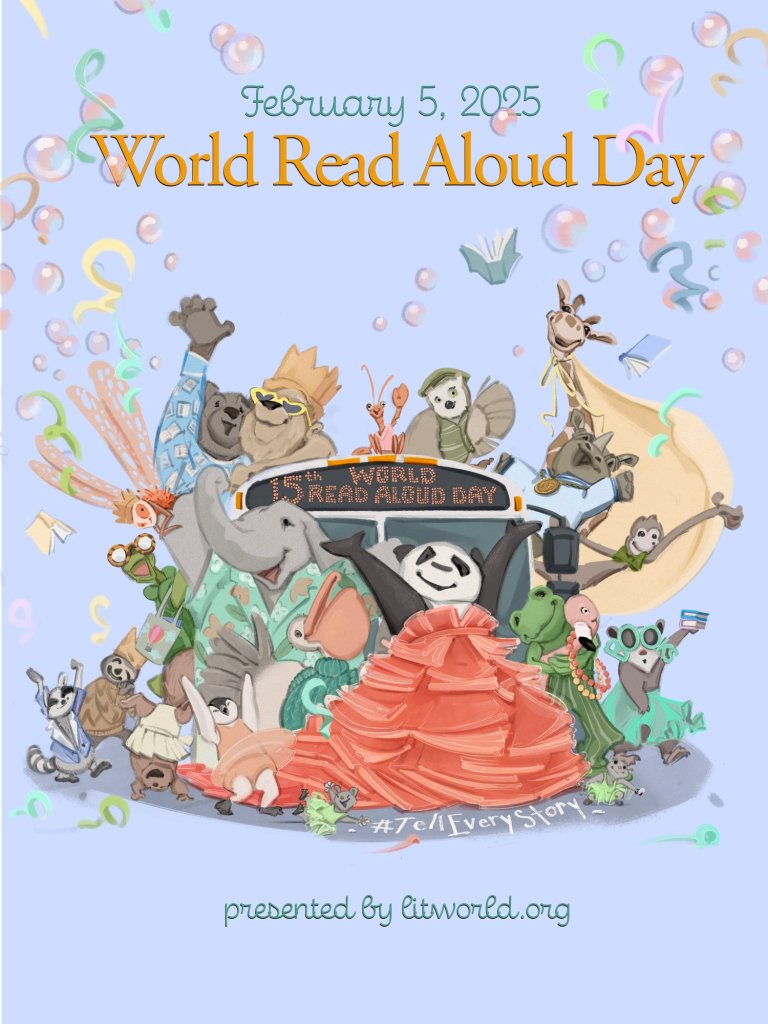
World Read Aloud Day 2025 – Zoom with a Self-Published Author or Illustrator

It’s time to get ready for World Read Aloud Day 2025! The list of self-published volunteers is live! Keep reading for all the details:

If you’re new here, I’m Judy Campbell-Smith. I am the author of AJ’s Neighborhood, a picture book I self-published in 2022, and Ice Cream Everywhere: Sweet Stories from Around the World, released by Sleeping Bear Press in March 2024. A few years ago, I discovered that the amazing Kate Messner was organizing volunteers for World Read Aloud Day, but she was focusing on traditionally published authors and illustrators. So I decided to step up so that self-published authors and illustrators could also participate in this wonderful celebration of reading and literacy.

World Read Aloud Day is February 5, 2025! If you are an educator or librarian, you can contact a volunteer to zoom with your group on this day.

WRAD virtual visits are not elaborate or time-consuming to plan. Your presentation should last 10-15 and should go something like this:

1-2 minutes: Author gives a quick introduction & talks a little about their books.
3-5 minutes: Author reads aloud a short picture book, or a short excerpt from a chapter book/novel
5-10 minutes: Author answers a few questions from students about reading/writing
1-2 minutes: Author book-talks a couple books they love (but didn’t write!) as recommendations

To set up a WRAD 2025 visit:

  • Take a look at this list of self-published volunteers and check out their books to see who will be a good fit for your group/schedule.
  • Use the contact info listed to get in touch with the volunteer directly to request a visit. In your message, be sure to include:
    • Your name and what grade(s) you work with
    • Your city and time zone (this is important for scheduling!)
    • Possible times to connect on February 5th. Please note authors’ availability and time zones. Adjust accordingly if yours is different!
    • Your preferred platform (Zoom, Google Meet, etc.)
    • A phone number where you can be reached on that day in case of technical issues

A note for educators and librarians: please honor your commitments and plan accordingly. Please do not double book or cancel unless there is an emergency. Also, if you’re looking for traditionally published authors and illustrators, check out Kate Messner’s list of traditionally published authors and illustrators.

A note for self-published volunteers: please remember to let me know when your schedule is full so that I can remove your name from the list! If you haven’t signed up yet, there’s still time to join in the fun! Use this link and fill out the form: WRAD 2025 – Call for Self-Published Volunteers

For more info, visit the WRAD website: https://www.litworld.org/learn-more-about-wrad

Don’t miss future posts! Subscribe to my blog:

Back Matter Break Down: Interview & Giveaway with Helen Kampion & Reneé Critcher Lyons

Welcome to the Back Matter Break Down! This week we have a fantastic interview with a dynamic duo behind a new PB bio! I’m so glad these two have decided to let us see behind the scenes into what their process was to put together the back matter in their book. And make sure you make it to the end of the post so you can enter the giveaway for a free book! Let’s dive in!

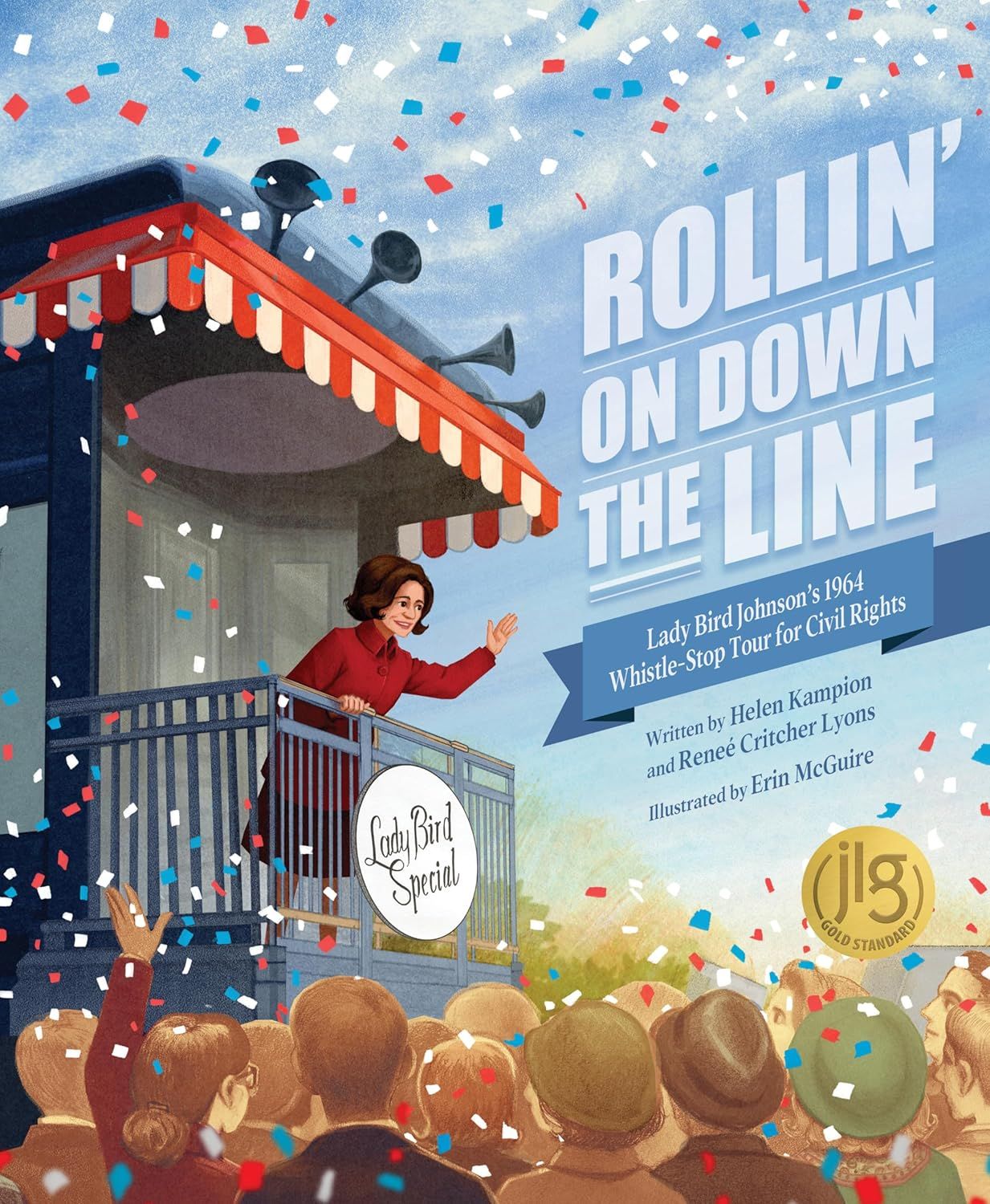
Book: Rollin’ on Down the Line: Lady Bird Johnson’s 1964 Whistle-Stop Tour for Civil Rights

Authors: Helen Kampion and Reneé Critcher Lyons

Illustrator: Erin McGuire

Publisher / Year: Sleeping Bear Press, 2024

Topics: Biography, US History, Civil Rights, Politics

Blurb: The late summer and early fall of 1964 was a turbulent time in America. After years of racial struggle, in July President Lyndon Baines Johnson signed the Civil Rights Act. This law, declaring that all citizens were equal, outlawed racial segregation. Many Americans cheered this legislation; yet some did not. Many Southerners despised it and worried about what it meant for their traditions and way of life. With the upcoming November presidential election, President Johnson was advised not to campaign in the South due to the threats of violence since the signing of the new law. But someone needed to visit the citizens in the South and explain why the new law was necessary and good for the entire country.

Born in Texas, First Lady Claudia Alta “Lady Bird” Johnson was from the South and understood its people and customs. Despite her fear of public speaking and threats to her own safety, Lady Bird undertook a train tour to reach out to her fellow citizens and Southerners. This is the true story of her historic Whistle-Stop journey, making almost fifty stops through eight Southern states in four days. 

What is your manuscript word count? What is your back matter word count? 

The main manuscript word count is approximately 1700 words and the back matter with bibliography and source notes is 950 words.

At what phase of the drafting/revising/publishing process did you decide your book needed back matter?

As the book is non-fiction, we knew it would need back matter from the very beginning of our work. Since it is a “slice” of Lady Bird’s life, we understood children reading the book would want to learn more about this iconic First Lady.

What did the first draft of the back matter look like?

The first draft of the back matter was mostly additional facts about the train trip, author’s notes, and also included a “read more” list. The draft constituted 1,500 words, lengthier than the finished product, and also included Lady Bird’s pecan pie recipe (as fed to dignitaries on the trip). 

Fifteen source notes are found in the final publication, whereas the first draft held nineteen. The bibliography in the first draft included eight entries, however, the final product referenced six sources. 

Tell us about the back matter revision process. Why did changes occur? What changes and revisions came about after working with the editor/agent? 

The revision process proved amicable. Changes occurred due to our editor’s suggestions. The editor wanted to cut down our facts about the train ride itself, and place more emphasis on Lady Bird’s legacy, her contributions to our society, lasting into the current day. As the main text targets the train trip extensively, we were happy to emphasize Lady Bird’s political work in the back matter.

How did you choose the photos that appear in the back matter? Were you involved in getting permission to include the photos? 

The editor reached out to us about photos to use in the back matter. Since we had been in touch with the LBJ Presidential Library and the First Ladies Library and Museum while researching the book, we passed on our contact information. The editor contacted the library and museum, decided on the photos, and we were delighted with the choices.

What was the most challenging part of the back matter publishing process?

Many of the quotes in the back matter were ones we had “lovingly” selected. The editor, nonetheless, wanted to paraphrase one or two of these. While we did so, it was a challenging edit. Also, we included many train trip details in the original text, such as her daughters’ contributions to the tour, the manner in which Lady Bird reached out to Southern governors, and Lady Bird’s favorite pecan pie recipe, served on the train. These were all eventually not included in the final back matter.

Is your back matter aimed for kid readers or adults? What do you hope readers will take away after reading your back matter content? 

The back matter is geared toward kids, but serves as an engaging read for adults as well. We want readers to further understand the extent of Lady Bird’s almost “super-human” bravery and courage. During the train tour, she was threatened, jeered, and endured sniper threats and a bomb scare. We also want readers to remember her important legacy of caring for and preserving natural areas. 

Reflecting on this process and what you learned, what tips (if any) can you offer picture book writers for writing back matter?

We suggest:

  1.  View the back matter as a means of providing a broader scope of the book’s subject matter;
  2. Use back matter to address any areas not covered in the story, but which assist with additional inquiry;
  3. Consider back matter as a way readers can enhance internalization of the story itself, providing details that don’t “fit” into the non-fiction narrative;
  4. Write back matter in an engaging way as well – don’t give up after the narrative text is finished;
  5. You will find tons of facts about your subject and be overwhelmed as to the extent!  Use the most important or poignant facts you find outside of the storyline.

Are there resources or comp titles you can share that would be helpful for writer’s wanting to learn more about back matter?  

 Children’s Books That Connect the Past to the Present with Back Matter

Use these books as examples of the “differing” types of children’s non-fiction, paying particular attention to the back matter:

Night Owl, Night by Susan Edwards Richmond (narrative non-fiction)

Seashells, More Than A Home by Melissa Stewart (traditional non-fiction)

The Leaf Detective by Heather Lang (biographical)


Thank you, Helen and Reneé! It’s so helpful for us all to see how the editing process happened and how you landed on the final version we see in the book.

Please support Helen and Reneé!

Purchase Rollin’ on Down the Line at these sellers:

LBJ Library Bookstore 

Bookshop

Amazon

Learn more about Rollin’ on Down the Line:

Jr. Library Guild distinction

Read With A Ranger:  First Ladies National Historic Site

The Children’s Bookshelf

Kathy Temean highlight

Vivian Kirkfield 

Kirkus Review 

Follow Helen and Reneé on social media:

@helenkampion

@reneelyonsMFA

Visit Helen and Reneé’s websites:

Helen Kampion

Renee’ Lyons

Now for a giveaway! Helen and Reneé have generously offered to give one lucky person a free copy of Rollin’ on Down the Line: Lady Bird Johnson’s 1964 Whistle-Stop Tour for Civil Rights! To enter: leave one comment on this blog post by October 8, 2024 at 11:59pm Pacific Time. Leave a comment on my Twitter/X, BlueSky, and/or Instagram posts a bout this blog for a maximum of 3 bonus entries. (Remember to check back on this blog post and social media to see if you are selected as a winner!)

Thank you for reading!

Don’t miss future posts! Subscribe to my blog:

Back Matter Break Down: Interview & Giveaway with Rachel Funez

Welcome to the Back Matter Break Down! I am excited for today’s interview and giveaway with Rachel Funez! The back matter for her picture book reaches both kid and adult readers and carries on the super-hero theme of the main text. So much fun and good info here, and don’t forget to read all the way to the end of the interview for a chance at a PB critique by Rachel! Let’s dive in!

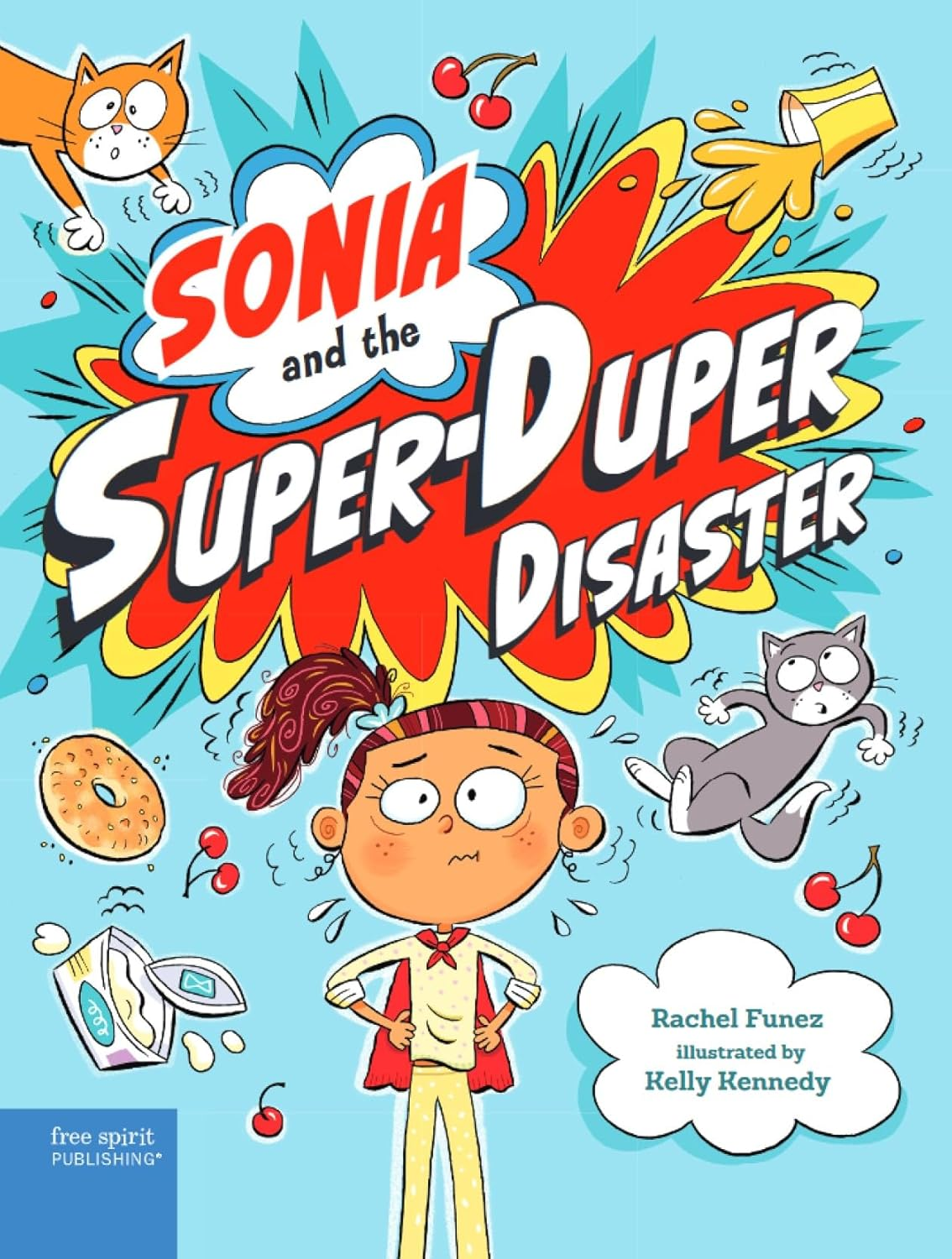
Book: Sonia and the Super-Duper Disaster

Author: Rachel Funez

Illustrator: Kelly Kennedy

Publisher / Year: Free Spirit Publishing, 2024

Topics: Anxiety, Super Heroes, ADHD, Social Emotional Learning

Blurb: When Sonia forgets Mom’s birthday, she’s determined to whip up a super surprise and become Mom’s hero. But her ADHD foils her best-laid plans, and her anxiety multiplies as the chaos grows. Sonia has to use all her coping skills to find a new recipe for success and become her own superhero.

What is your manuscript word count?

Final manuscript word count: 507

What is your back matter word count? 

Back Matter Word count: approx. 1424

At what phase of the drafting/revising/publishing process did you decide your book needed back matter?

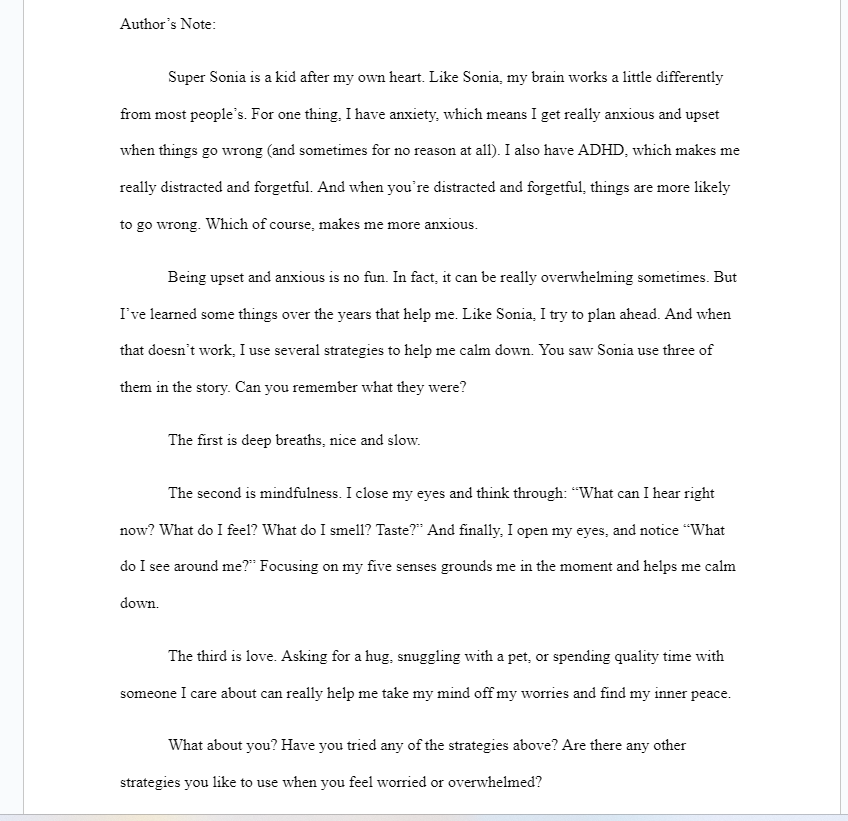
It was toward the end of the revision process. The book had been through many iterations before I decided to make the ADHD and anxiety components more explicit. I added coping strategies that Sonia uses to help her calm down and focus. When I did that, I decided it needed back matter to give readers more insight into these “worry-fighting gadgets” and how to use them.

Did you do any research for the back matter?

Initially, I didn’t do any research for the author’s note. I grew up with anxiety and ADHD, and the “worry-fighting gadgets” I incorporated into the story were ones that I have learned to use through the years. I’m not a psychologist, but I’ve been through a lot of therapy and read a lot of self-help and parenting books. I also grew up with two counselors and married one. So the author’s note was written from my personal experiences and things I have learned from others along the way. But I did run it by my parents and husband (the counselors in my life), as well as my critique partners.

When my editor asked me to add the “Guide for Caring Adults,” I did additional research for that section. I wanted to make sure the facts I cited were accurate, and the techniques were widely accepted and recommended. 

What did the first draft of the back matter look like? Can you show us snippets?

Tell us about the back matter revision process. Why did changes occur? What changes and revisions came about after working with the editor/agent?  

I was unagented when SONIA AND THE SUPER-DUPER DISASTER was acquired so it was just me and my critique partners at first. The first draft was just the author’s note. It’s actually pretty similar to the final version of the author’s note in a lot of ways. But I changed the “strategies” to “worry-fighting gadgets” and added the fun superhero themed names. (Thank you, critique partners, for that awesome suggestion!) 
I also added “Stellar Self-talk” as a tool, because I thought it was a simple and kid friendly way to combat worry. 
Once the book was acquired by Free Spirit Publishing, my editor and I went through several revisions of the back matter, and she made a lot of great suggestions. For example, “love” ended up being rephrased as “help” at the suggestion of my editor, which I loved, because even superheroes need help sometimes. She also suggested adding the section called “Guide for Caring Adults,” which ended up being one of my favorite parts of the book.

Is there more information or calming techniques that you wanted to include in the back matter but didn’t make the cut?

Yes. I initially had “planning ahead” in there. That’s a big strategy I use for both ADHD and anxiety. But it didn’t really fit well with the other “worry-fighting gadgets” and I cut the planning part of the story for pacing reasons. So I took it out of the back matter, too.

What was the most challenging part of the back matter publishing process?

I really enjoyed the publishing part of the process. My editor, Christine Zuchora-Walske, was wonderful to work with and had great suggestions. 

I think the most difficult thing for me was a feeling of “imposter syndrome.” Since I’m not a professional counselor or psychologist, I felt like, who am I to tell people how to cope with these things? But ultimately none of that information was unique content I thought up on my own. It was all things I learned from people who are much smarter than I am, and have tried to put into practice in my own life with varying degrees of success or failure. I think that allowed me to write with humility and compassion, instead of talking down to the reader.

What do you hope readers will take away after reading your back matter content? 
I hope that neurodivergent children and caregivers will feel seen and celebrated. And I hope all readers, whether neurodivergent or not, will walk away with tools they can put into practice to make some of the difficult moments just a little less challenging. 

Have you heard from any readers about the back matter and if they have been putting the tips into practice?

I have! It’s so rewarding to hear from parents who are neurodivergent and/or raising neurodivergent children, and who found the back matter helpful. It makes my heart happy! One parent wrote, “I will not only make sure to teach my girls your tips and worry-fighting gadgets but I will also use them myself.” 

Reflecting on this process and what you learned, what tips (if any) can you offer picture book writers for writing back matter?
I think if you have something important to say that doesn’t quite fit in the text of the picture book, go for it! I especially love author’s notes when they explain the author’s personal connection to the story. 

Are there resources or comp titles you can share that would be helpful for writers wanting to learn more about back matter?  
This website is perfect for learning more about back matter and finding comp titles! 
If you’re looking at sending a book to a specific publisher, I also recommend looking at their website, pulling several of their books from your local library, and checking out the type of back matter they typically include. 


Thank you, Rachel! I love hearing about how you overcame your imposter syndrome and drew from your own life to create your back matter!

Please support Rachel!

SONIA AND THE SUPER-DUPER DISASTER can be purchased anywhere books are sold, but please check with your local Indie. Online, it’s available at Amazon and Barnes&Noble, or directly from the Publisher.

Rachel’s website is www.rachelfunez.com

You can subscribe to her newsletter here.

Follow her on social media platforms: TwitterBlueSkyInstagramFacebook.

Now for a giveaway! Rachel has generously offered to give one lucky person a free PB critique! To enter: leave one comment on this blog post by September 24, 2024 at 11:59pm Pacific Time. You may earn 1 bonus entry if you leave a comment on the Twitter/X and Instagram posts about this blog to let me know you commented here. (Please remember to check back on this blog post and Twitter/X to see if you are selected as a winner!)

Update: The giveaway is now closed! Congrats to Abby Mumford!

Thank you for reading!

Don’t miss future posts! Subscribe to my blog:

Back Matter Break Down: Interview & Giveaway with Marie Chan

Welcome to the Back Matter Break Down! I am so excited today to bring an interview with one of my writing friends about her debut picture book! Marie Chan was actually one of the first people I met when I joined SCBWI a few years ago, and it’s amazing to get to see her reach this milestone. She put so much work into the back matter of her book, so this will be a treat. And don’t forget to read all the way to the end so you can enter the giveaway for a free copy of her book! Let’s dive in!

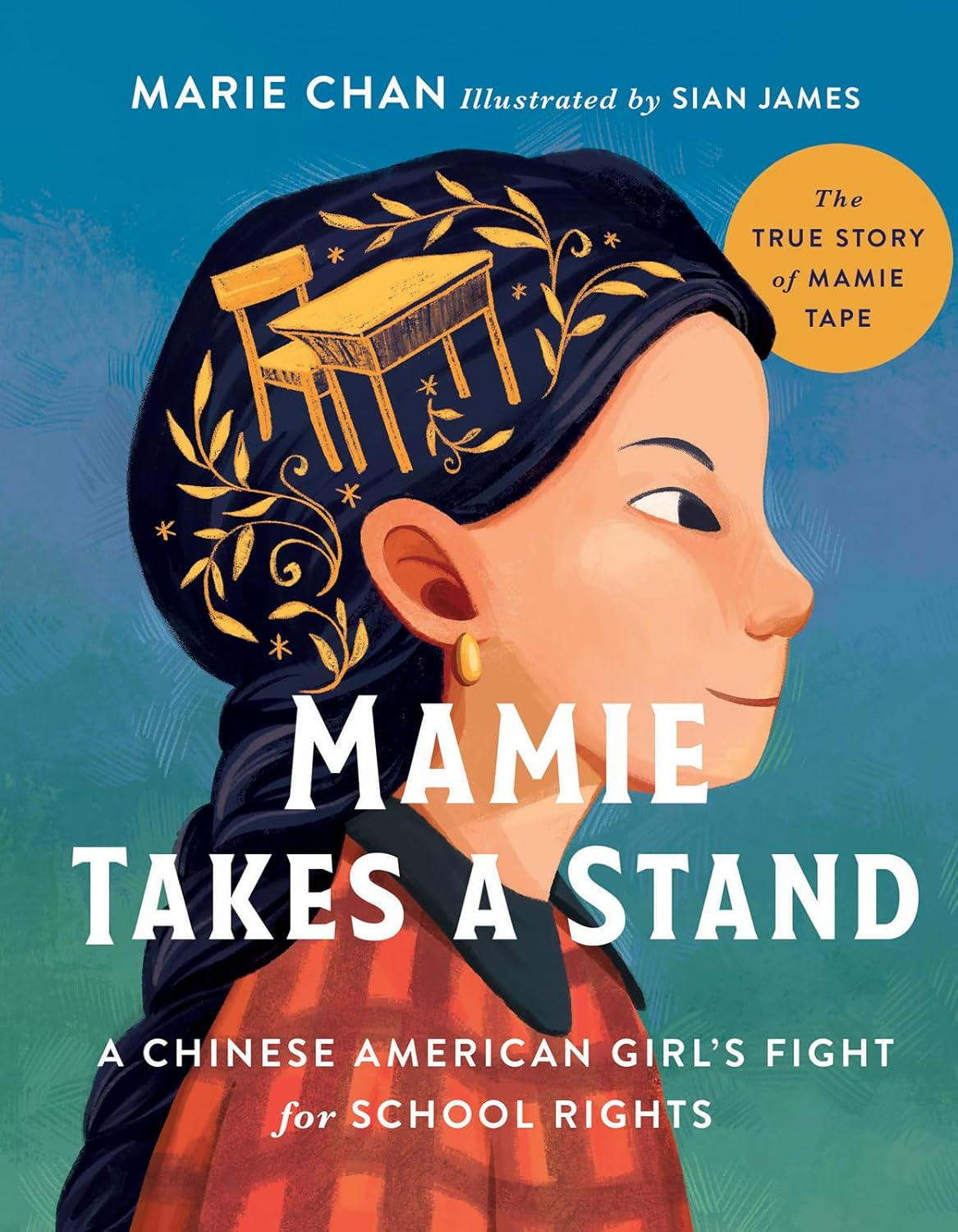
Book: Mamie Takes a Stand: The True Story of Mamie Tape, a Chinese American Girl’s Fight for School Rights

Author: Marie Chan

Illustrator: Sian James

Publisher / Year: Ten Peaks Press, 2024

Topics: Biography, US History, Civil Rights, Chinese American History

Blurb: In the fall of 1884 in San Francisco, California, Mamie excitedly arrived for her first day at an American public school, only to find the principal blocking her way. Why? Because Mamie was Chinese.
 
Thus began the Tape family’s yearlong struggle to secure Mamie’s right to attend public school. In the spring of 1885, Mamie’s case reached the California Supreme Court, who reaffirmed a lower court’s ruling that public schools should be open to children of all races.

What is your manuscript word count? What is your back matter word count? 

Manuscript word count: 1,700 words; plus 182 words for excerpts from Mrs. Mary Tape’s letter; total 1,882 words.

Back matter word count: 1,072 words (not including quotation source notes in the bibliography); 578 words for the timeline; total 1,650 words.

My manuscript word count is higher than a usual picture book, but that is because my acquisitions editor envisioned my biography to be geared more toward middle grade readers, ages 8-12. Having an Asian American editor, who understood my intention behind why I included certain cultural details, such as Chinese words (and decided not to omit them), positively impacted the authenticity of Mamie Takes a Stand. I am grateful that my editor understood the nuances of Chinese culture, the bicultural aspects of being Chinese and American, and also could differentiate between the various dialects of Chinese because of his own lived experience.

At what phase of the drafting/revising/publishing process did you decide your book needed back matter?  

From the beginning, I knew I would need a significant amount of back matter to explain this very complex court case and explain how difficult it was to research this hidden figure. I wanted to include additional facts to explain US and California laws, the Tape v. Hurley court case and other school rights’ cases; provide more background about different key leaders in the case; and share interesting family facts, quotation sources, additional resources, archival photographs, discussion questions, a glossary, and a timeline.

What did the first draft of the back matter look like? Can you show us snippets?

I originally formulated my back matter as “Did you know?” sidebars that were to appear on each page. Later, I took the content and incorporated the information into the timeline, main text, and allowed the illustrations to show the information. I also included some of the sidebar information in my 45-page digital Parent & Educator Guide that I wrote to accompany Mamie Takes a Stand.

Tell us about the back matter revision process. Why did changes occur? What changes and revisions came about after working with the editor/agent?  

My publisher preferred to put everything in the back matter, so it would look more like a narrative picture book than a reference or educational book that reads more like an encyclopedia entry.

Unfortunately, there was only enough space to put my source notes for my quotes and not my full bibliography. My back matter pages were really full, and my editor and I didn’t want the font to be any smaller, which would make the text difficult to read. My actual bibliography is much longer; I probably have enough sources to write a doctoral dissertation! I may post my full bibliography on my website in the future.

I wanted to include more photographs, but there wasn’t enough space for more photos and all my historic notes to fit in 48 pages. I had suggested inserting additional photographs on the end papers, but the art director and designer decided otherwise. Instead, I included some historic Tape family photographs in the Parent & Educator Guide for Mamie Takes a Stand.

I am grateful for the designer, who created a beautiful layout for the interior, and took my comments into consideration when I shared ways to format the text to improve readability and to make the text more accessible to students with dyslexia. I liked how she added spot illustrations to the timeline, which really help students comprehend the content better when they have visuals next to the text. I also liked how the designer framed the archival photographs like they were in a scrapbook and kept some of the original borders on the photos to reflect the time period.

How did you choose the photos that appear in the back matter? Were you involved in getting permission to include the photos?

I chose the photos that were rarer and showed the span of Mamie’s life. I wanted to cite and include at least one photo from the National Archives to encourage students to utilize their library of primary sources. It was important to show the photo of the Chinese Primary School.

I had to obtain photo permission release forms from the Tape family descendants. I also asked UC Berkeley for the correct citations. The National Archives provided a guide to help me evaluate whether a primary source was within copyright or public domain and how they would like me to write the citation.

I wrote to a California historian and a professor who specializes in Asian American history to gather more information and ask questions about different historic photographs.

What was the most challenging part of the back matter publishing process?

Fact checking everything again after the designer created the layout for each page. Sometimes there were typos and other times the mistakes were mine.

I thought I was done researching, but then I would uncover new evidence that made me question whether another source I had used was completely accurate. Discrepancies abound! It was important to dig deep and look at multiple primary sources before deciding on what to print.

I spent weeks researching the difference in one letter in the transliteration of a single Chinese character (word). This involved contacting a professor who specialized in the research of Chinese dialects and asking an elderly friend who spoke Toisanese to gather more insights. Thankfully, my father had an antique Chinese dictionary that confirmed my research that listed the word with an alternative pronunciation.

Also, there was so much propaganda written against the Chinese during the era of the 1882 Chinese Exclusion Act, that even newspaper articles sometimes were biased in their reporting, so I had to search for other reliable primary sources to make sure the facts were accurate.

Is your back matter aimed for kid readers or adults? What do you hope readers will take away after reading your back matter content? 

I wrote the back matter more for adults, but I encourage kids to read the afterword, author’s note, and historic note, analyze the archival photos, and evaluate the primary and secondary sources. I intentionally wrote this biography to read like a story with a narrative arc, but still have robust historical facts so that a child could use my book as a resource for research when writing a biography report for class.

I hope the timeline can be used as a springboard for researching other hidden figures and significant civil rights court cases in US history that involve Asian Americans. Furthermore, I wanted to broaden readers’ perspectives of historic school rights’ cases and show solidarity between different minority groups (e.g., African Americans, Chinese Americans, and Mexican Americans) and how these cases were interconnected and built on one another.

Reflecting on this process, what tips can you offer picture book writers for writing back matter?

If you’re writing a biography, make your own family tree of the person while you are conducting research. Write notes to show how family members are related to each other and where they lived.

Use Google maps to pin key locations in the setting of your story. Take natural disasters into consideration when you do your research. The 1906 San Francisco earthquake resulted in many structures being rebuilt, so I had to check that my reference images of school buildings and other locations pre-dated this earthquake. Some schools moved, were remodeled, or were renamed as well.

Use Zotero to keep track of your sources and to create one version of your manuscript with footnotes for every sentence in your text; this way you will know where the evidence comes from for each fact you write.

Although binders may be cumbersome, one time I needed to fact check something for my manuscript, and the online archive was down for maintenance or inaccessible. I am glad that I had printed out the articles and was able to refer to the hard copy when the electronic version was unavailable. Over the years of research, there have been cases where webpages were no longer existent.

Keep good records of your photo permissions. Copyright can be complicated. Publishers want images that are 300dpi or higher, so make sure photos are scanned at a high resolution for printing.

Also, download the digital educator guides that accompany mentor texts to use as samples when you write a resource guide for your book. Lee & Low Books makes very thorough educator guides that are good examples.

Are there resources or comp titles you can share that would be helpful for writers wanting to learn more about back matter?  

I referred to historic Bloomingdale’s, Sears Roebuck, and Montgomery Ward catalogues when I needed images of historic artifacts from the late 1800s-early 1900s. These catalogues gave me a better glimpse of Mamie’s daily life and what clothing, toys, books, and materials may have been in her classroom and home.

I also utilized city directories and Sanborn Fire Insurance Maps to approximate the locations of different places to describe the setting for Mamie Takes a Stand.

A good reference book and general guide to writing children’s nonfiction books is:

Facklam, Margery, and Peggy Thomas. Anatomy of Nonfiction: Writing True Stories for Children. Writer’s Institute Publications, 2011.

Next, on my “want to read” list is, Nonfiction Writers Dig Deep: 50 Award-Winning Children’s Book Authors Share the Secret of Engaging Writing, edited by Melissa Stewart, National Council of Teachers of English, 2020.

The websites of these authors are helpful as well. When I first began writing Mamie Takes a Stand, I had the opportunity to converse with a few of the authors on this list, who were very generous in sharing their experiences in writing nonfiction for children.

Nonfiction Fest

Beth Anderson

Tina Cho

Lesa Cline-Ransome

Lisa Crayton

Julie Leung

Annette Whipple

Children’s Picture Book Biographies Back Matter Examples

Anderson, Beth. Lizzie Demands a Seat!: Elizabeth Jennings Fights for Streetcar Rights. Illus. E.B Lewis. New York: Calkins Creek, an imprint of Boyds Mills & Kane, 2020.

Brockenbrough, Martha, with Grace Lin. I Am an American: The Wong Kim Ark Story. Illus. Julia Kuo. New York: Little, Brown, and Company, 2021.

Hale, Christy. All Equal: The Ballad of Lemon Grove. New York: Children’s Book Press, an imprint of Lee & Low Books Inc., 2019.

Maclear, Kyo. It Began with a Page: How Gyo Fujikawa Drew the Way. Illus. Julie Morstad. New York: HarperCollins, 2019.

Tonatiuh, Duncan. Separate is Never Equal: Sylvia Mendez and Her Family’s Fight for Desegregation. New York: Abrams Books for Young Readers, an imprint of Abrams, 2014.


Thank you, Marie! You’ve given all of us some great tips and resources for working on our nonfiction picture books and back matter!

Please support Marie!

To order Mamie Takes a Stand: mariechan.com/books

To access digital download of Parent & Educator Guide for Mamie Takes a Stand: mariechan.com/books. This extensive 45-page guide includes engaging, multi-sensory, cross-curricular activities with analysis of archival photographs and primary sources. (I felt like I was writing a second book!)

For upcoming events and to get signed books: mariechan.com/upcoming-events/

I will be teaching Chinese calligraphy and sharing some of the Chinese words in Mamie Takes a Stand at some of my book events. Bring your whole family for art and story time!

Follow Marie on Instagram: @mariechanbooks

Follow Marie on Facebook: @mariechanbooks

Now for a giveaway! Marie and her publisher, Ten Peaks Press, have generously offered to give one lucky person copy of Mamie Takes a Stand! To enter: leave one comment on this blog post by September 17 2024 at 11:59pm Pacific Time. You may earn 1 bonus entry if you leave a comment on the Twitter/X and Instagram posts about this blog to let me know you commented here. (Please remember to check back on this blog post and Twitter/X to see if you are selected as a winner!)

UPDATE: The giveaway is now closed. Congrats to Jamie on winning a copy of Mamie Takes A Stand!

Thank you for reading!

Don’t miss future posts! Subscribe to my blog:

Back Matter Break Down: Impossible Moon

Welcome to the Back Matter Break Down! I stepped away from the blog over the summer, but I’m back at it again and excited to look at the back matter from a lovely, lyrical book. Let’s dive in!

Book: Impossible Moon

Author: Breanna J. McDaniel

Illustrator: Tonya Engel

Publisher / Year: Denene Millner Books/Simon & Schuster Books for Young Readers, 2022

Genre: Fiction

Topics: Stars, Constellations, Black History, Mythology

Blurb: Grana used to tell the best stories, and Mable used to long to soar through the heavens. Nowadays, Grana mostly lies in bed and Mable stays close to home. But one day, Grana asks, “If we can touch the moon, then what is impossible?”

So Mable decides to do just that, embarking on a journey through the stars where The Seven Sistahs, The Big Dipper, and other constellations help her on her quest and teach her about African mythology and African American history. With the support of her new companions, Mable reaches for her biggest dream yet: to make her sick grandma well again.

Book Word Count: about 679

Back Matter Word Count: about 1200

Back Matter Sections

1. Authors Note (about 600 words)

In author Breanna J. McDaniel’s note, she starts off by sharing how her own experience with her ailing grandmother became the initial spark for this story. She continues by detailing how her research led to see how Black characters and history were traditionally overlooked in presentations about stars and constellations. McDaniel notes that the movie Black Panther helped inspire her vision of the constellations as Black characters interacting with a young Black girl who loves astronomy. Finally, she shares her hope that Mable’s story will inspire young readers to love of science and keep dreaming in the impossible.

2. The Impossible Moon Sky (about 650 words)

In this section, McDaniel gives readers more information about astronomy and constellations that are presented in the story. She starts off with an introduction (about 200 words) that explains what constellations are. This section tells how constellations have been used by humans throughout history, including the fact that there are many stories that have been passed down about to constellations.

From there, the author highlights the seven constellations that she depicts in the book (about 450 words). She explains the origins of their names as well as some mythology that has traditionally been associated with the constellation. McDaniel also explains how she approached the depictions in the story as she highlighted the constellations importance to Black people throughout history. It’s extra insightful that she sometimes explains the symbolism behind her depictions that might not be immediately understood in a first reading by some.

Takeaways: Breanna J. McDaniel’s backmatter gives readers insight into her creative process as she was coming up with the themes and deeper meanings into this story. Readers who dive into her author note and explanations about the constellations will see the writer’s mind at work adding layers of meaning to her story. Especially for young readers, they may be surprised to learn of the symbolism and hidden meanings that McDaniel has infused into her story. This likely adds to the pleasure of re-reading the book as kids will be able to appreciate the story on another level while examining how Tonya Engel’s dreamy illustrations draw out these themes.

Tips: Let readers go behind-the-scenes on your creative process. As they understand what inspired your writing, how you pivoted to new ideas, or how research led you into surprising places, it will add to their appreciation of your story’s layers. If your story has symbolism, don’t shy away from explaining their meanings in your back matter. You will be equipping kids to understand how to analyze text at their own level, and I’m sure many educators will love to have such books to use as teaching examples for their students.

Thank you for reading! Leave a comment to keep the conversation going or to suggest a book for future blog posts!

Don’t miss future posts! Subscribe to my blog:

Back Matter Break Down: Interview & Giveaway with Darcie Naslund

Welcome to the Back Matter Break Down! If you are interested in back matter in picture books, you have come to the right place. Today’s interview with Darcie Naslund is full of great behind the scenes info about she put together the back matter for her debut picture book. And don’t forget to read to the end for the giveaway! So much good stuff here, so let’s dive in!

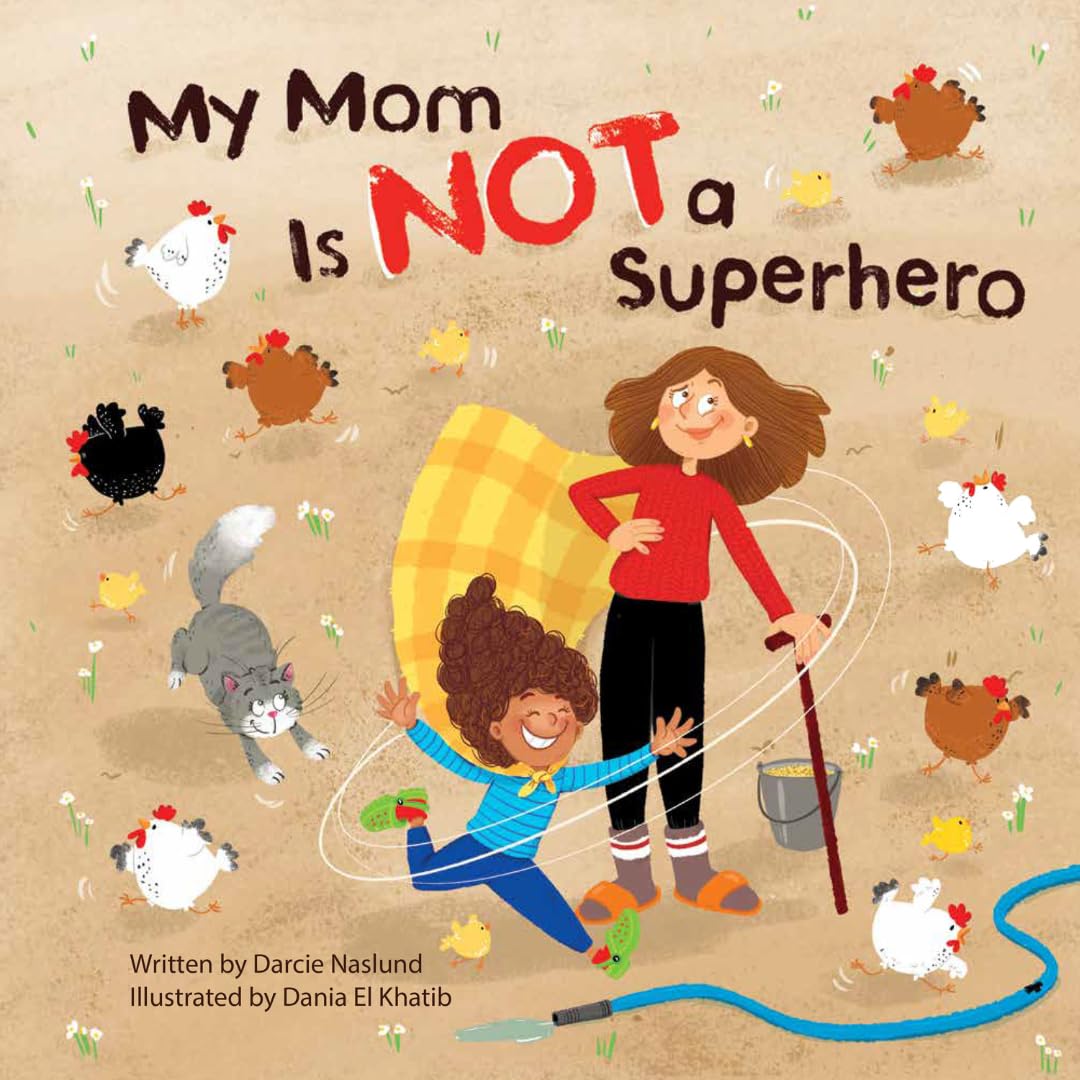
Book: My Mom is NOT a Superhero!

Author: Darcie Naslund

Illustrator: Dania El Khatib

Publisher / Year: DC Canada Education Publishing, 2024

Topics: Multiple Sclerosis, Chronic Illness, Mothers, Superheroes

Blurb: A little girl whose mother has Multiple Sclerosis discovers that some superheroes are fighting invisible battles. With the help of her cat and some X-ray glasses, she learns just how strong her mom is and how she can help her.

What is your manuscript word count? What is your back matter word count?

The manuscript I submitted was about 460 words, not including my illustration notes, which were around 100 words. Looking back now, I realize I didn’t need that many, but at the time, I thought they were necessary to explain the symptoms clearly as villains.

The back matter is about 500 words. It focuses on child readers or creating an adult-child conversation about Multiple Sclerosis and invisible illness.

At what phase of the drafting/revising/publishing process did you decide your book needed back matter? 

My first draft wasn’t a story at all. It was more like a well-written advertisement for MS. It was loaded with descriptions and not exciting for kid readers. The first draft was written on its own without back matter. The author’s note came next, as it was a suggestion from my critique group. They may have suggested back matter, but I can’t remember. What I do remember is that I was very stuck in my way with this manuscript. I would take some pieces of advice on the line level but refused to accept any whole-picture type of advice.

It wasn’t until I received some brutally honest, whole-picture feedback that I realized I needed to make a change. After my daughter’s endless questions about my worsening MS, I had an epiphany. I needed to find a way to make the invisible visible. That’s where the X-ray glasses came in. I rewrote the entire manuscript, cut the descriptions, and turned them into back matter.

Did you need to do any research for the back matter?

Having MS gave me first-hand experience explaining it to children. That being said, I still did a lot of research and connected with the MS Society of Canada. They sent me a few resources for having conversations with children. I also collected resources from other MS organizations around the world.

The organization of the back matter was very important to me. I didn’t want it to be overwhelming for kids if they wanted to learn more. I checked out dozens of picture books with back matter from the library to compare and eventually decided on a plan.

How did you come up with the activities that kids can do to understand MS symptoms?

When I was looking for resources for families, I came across several activity books for kids. Some of them included crossword puzzles, questions and stories. They helped parents explain MS to young children. That’s when I realized the problem— explaining alone doesn’t always lead to understanding. As the old saying goes,

“Tell me and I forget, teach me and I remember, involve me and I understand.”

I needed to put the readers in the shoes of someone with MS to even begin to understand. The analogies that I came up with were things I would say all the time to my family. “I feel like something is pulling my arms down.” Or “My legs feel like they are made of cement.” I have had times when I thought my glasses were dirty or smudged, but it was just my MS. I took all of my experiences and my little descriptions and included them in the backmatter. Even now that the book is published, I want to add or change something about the backmatter. For example, in the back matter, I suggest using ankle weights or socks full of sand to weigh your legs down.  Now, I realize that wearing very big, heavy boots creates a similar effect. Although I can’t make that change now, I will still include it in my activities and book events.

What did the first draft of the back matter look like?

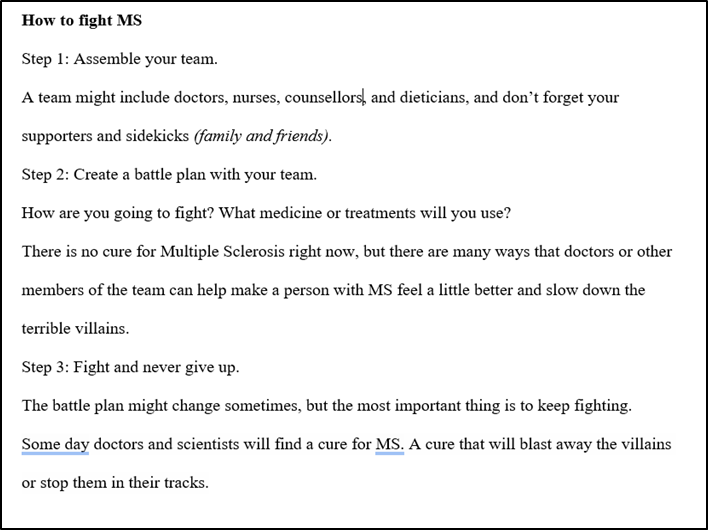
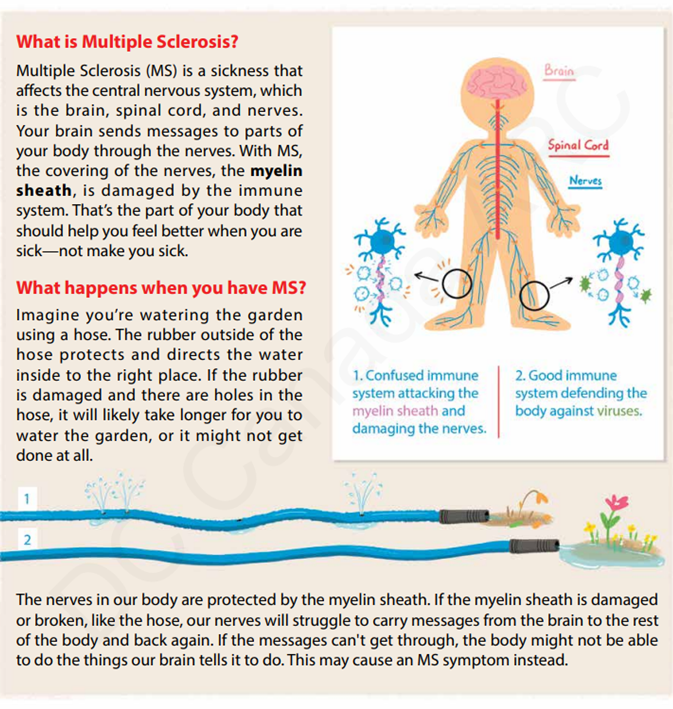
The first draft didn’t look much different in regards to the organization. It had the symptoms list and the “Try This” section. I also had a “How to Fight MS” section that I later took out. It did, however, have a completely different analogy for MS. Finding the right analogy was probably the most difficult part of writing the back matter. I tried many different analogies— a computer and wire, a rough hiking trail, and even mail delivery.  The computer analogy was what I submitted to DC Canada Education Publishing. It was later changed and explained using water flowing through a garden hose. This idea came from the wonderful team at DC Canada Education Publishing.

*Before

Draft of back matter text by Darcie Naslund

*After

Published back matter from My Mom is NOT a Superhero! by Darcie Naslund, Illustrated by Dania El Khatib

Dania El Khatib took my words and created back matter that was not only engaging but accessible. It is everything I dreamed it would be.

Tell us about the back matter revision process. Why did changes occur? What changes and revisions came about after working with the editor/agent? 

The back matter was probably the most difficult part of the revision process with my editor. We went back and forth several times, creating every analogy we could to explain what MS is in a clear, accessible way. I have always described MS as if my brain was a computer and my nerves were wires connecting to the rest of the body. Although this analogy felt most accurate with some MS symptoms, we decided that it was not the safest route to go, as we did not want children thinking that it was okay to play with electrical wires.

I created several more analogies, and so did my editor. When we reviewed them together, we finally concluded that the garden hose analogy would be best. It was clear and did not create a potential risk like the previous version.

My editor mentioned that she was very excited to have received the manuscript with back matter already created. It made her job much easier. She was also the one who thought to include the engaging questions for the readers.

What was the most challenging part of the process of the back matter publishing process?

As I mentioned in the previous question, the most difficult part was creating a clear, concise analogy for what MS is. It was also the beginning of the back matter and set the tone for the rest of the information. This was the most important, difficult and tedious part of the process.

Is your back matter aimed at kid readers or adults? What do you hope readers will take away after reading your back matter content?

I would say the back matter is aimed mostly at kid readers. I also wanted it to create conversations between the children and an adult reader.  My goal for the back matter was not only to explain what Multiple Sclerosis or MS is but to put them in the shoes and help readers understand. I also wanted readers to understand that many challenges and conditions are invisible, but it does not mean that they do not exist. There are superheroes fighting invisible battles all around us. With a little bit of kindness and understanding, even they can be superheroes.

Reflecting on this process, what have you learned? What tips (if any) can you offer picture book writers for writing back matter?

My first piece of advice is to decide what your goal is for your back matter. Once you have your goal, start by studying other picture books (both fiction and nonfiction). I like to use them as a blueprint for organizing my information. I didn’t use one specific book as a guide, but pieces from several books. Studying what was already out there was very helpful to me.

Are there resources or comp titles you can share that would be helpful for writers wanting to learn more about back matter? 

To be honest, I don’t have any resources for this. I studied many different books with back matter, both fiction and non-fiction, as these tended to be very different. The idea of blueprinting came from one of author Ebony Lynn Mudd’s writing courses. I found her courses very useful and would recommend them to all picture book writers.


Thank you, Darcie! You’ve given us some great tips on how to plan for our back matter!

Please support Darcie! Find her website and all of her links on Linktr.ee: Darcie Naslund Linktr.ee

 Purchase My Mom is NOT a Superhero!:

DC Canada Education Publishing

amazon.ca

amazon.com

Now for a giveaway! Update: the giveaway is now closed. Darcie has generously offered to give one lucky person a full manuscript critique that includes backmatter! To enter: leave one comment on this blog post by May 21, 2024 at 11:59pm Pacific Time. You may earn 1 bonus entry if you also comment on the Twitter/X post about this blog to let me know you commented here. (Please remember to check back on this blog post and Twitter/X to see if you are selected as a winner!)

Thank you for reading!

Don’t miss future posts! Subscribe to my blog:

Back Matter Break Down: Interview with Andrew Hacket

Welcome to the Back Matter Break Down! Today we will be looking at a lovely new book and hearing from the author about how back matter came together. Debut author Andrew Hacket will be joining us today on his blog tour and I’m so excited for you all to learn more about his book and his back matter journey! Let’s dive in!

Book: Ollie, the Acorn, and the Mighty Idea

Author: Andrew Hacket

Illustrator: Kaz Windness

Publishers / Year: Page Street Kids, 2024

Topics: Bullying, Social-Emotional Learning

Blurb: Ollie Alexander Kandersteen, successful amateur gardener, longs to be a tree: Strong. Tall. And mighty enough to stand up to Everett, the bully next door. Ollie is rather short for his age, and when things are too heavy or too high to reach, Everett is sure to point it out. Ollie wilts, he withers. Inside and out, he feels small. But when Everett, feeling jealous of Ollie’s gardening skills, steals Ollie’s sapling, an idea takes root…
“I couldn’t. I shouldn’t.”
But he does! Ollie SWALLOWS an acorn. He waits, wonders, and rumbles … Burp! With a little care and cultivation, a tree-mendous transformation begins! Ollie’s feet root, his arms branch, his locks leaf, and his limbs stretch to the clouds. He’s finally strong and tall enough to confront Everett. But when he does, he finds out that being the biggest doesn’t always mean you’re the mightiest and getting even with a bully might just make you feel smaller than ever.

Word Count: about 600 words

Back Matter Word Count: about 350 words

At what phase of the drafting/revising/publishing process did you decide your book needed back matter? 

I began drafting what would become Ollie in October of 2020. It wasn’t until May of 2021, after receiving a critique from Jolene Guiterrez, that she suggested back matter as an option. Up until this point I had received some concerned feedback that Ollie’s ingesting of non-food items could present a problem for some families. Jolene’s suggestion was the perfect suggestion to allow me to address this concern while keeping the story intact.

What kind of research did you do for the back matter?

My back matter serves as a big PSA encouraging readers not to copy Ollie’s action. I knew that just saying “Hey, don’t eat acorns!” wasn’t substantial enough to need back matter. What I had to do was consider what facts related to Ollie’s actions would be interesting and informative to the reader. For some parts, such as not eating acorns, I knew I wanted to give the why as well as share some information about who can eat them. For other aspects, such as drinking water, I needed to get a little more creative. This began in the form of brainstorming all of the possible related concepts I could explore. After that I began eliminating options based on whether or not I thought kids would find them interesting. With a smaller list in hand, I then began doing internet searches to find the specific facts from reputable sources that would complete the back matter.

What did the first draft of the back matter look like?

Surprisingly, the first draft to final copy of the back matter is almost exactly the same. We included a few additional sentences, but for the most part that first attempt was spot on. 

Your back matter uses 2nd person/direct address and continues the alliteration and wordplay found in the book’s main text. How did you arrive at this voice for the back matter? 

The voice came very naturally to me. I had spent so much time drafting and revising the main text, agonizing over each and every word, that by the time I got to the back matter I was ready to have some fun. I was so well-acquainted with the voice and tone from the picture book manuscript that writing similarly in the back matter just felt natural. The use of 2nd person was intentional as well. I wanted the child listener to feel these words/warnings were being spoken directly to them. I mostly wanted this because it welcomes the reader into feeling part of the story, but I also wanted the DO NOT EAT disclaimer to also feel like it was being spoken directly to them. 

Tell us about the back matter revision process. Why did changes occur? What changes and revisions came about after working with the editor/agent?

Funnily enough, after several back and forths with an R&R to get Ollie acquired, the back matter was barely touched. My incredible editor, Kayla Tostevin, had a few suggestions for clarity that we added in, but overall the revision process was quick and easy for this part.

What was the most challenging part of process of the back matter publishing process?

I am fortunate to say that the publishing part of the back matter was smooth sailing. 

What do you hope readers will take away after reading your back matter content? 

Ollie is a pretty weird book with loads of actions we did not want our readers to emulate. So my biggest hope is for kids to not start eating acorns and dirt because of me. Additionally, I wanted to give some fun related facts that piggybacked on the small underlying science content embedded within Ollie’s actions.

Reflecting on this process and what you learned, what tips (if any) can you offer picture book writers for writing back matter?

There are so many types of back matter for authors to investigate and study prior to jumping into writing their own. I recommend that authors explore these options and see what works for them and best compliments their story. 


Thank you, Andrew! I love that you took the concerns of your early readers and found a way to problem-solve with some clever and fun back matter!

Please support Andrew! Purchase signed copies of his books from Tidepool Bookshop:

Ollie, the Acorn, and the Mighty Idea https://www.tidepoolbookshop.com/book/9781645677888

Curlilocks & the Three Hares -https://www.tidepoolbookshop.com/book/9781956378184

Hope and the Sea -https://www.tidepoolbookshop.com/book/9781546005384

Follow Andrew on social media:

Website – https://www.andrewhacket.com/

X/Twitter – https://twitter.com/AndrewCHacket

Instagram – https://www.instagram.com/andrewchacket/

Facebook – https://www.facebook.com/AndrewCHacket

Now for a giveaway! Andrew has generously offered to give one lucky person a 30-minute AMA! To enter: Leave one comment on this blog post by April 16, 2024 at 11:59pm Pacific Time. A winner will be chosen at random and notified on April 17, 2024. One entry per person.

UPDATE: The giveaway is now closed. Congrats, brilawyer! You are the winner!

Thank you for reading!

Don’t miss future posts! Subscribe to my blog:

Back Matter Break Down: Interview with Annette Whipple

Welcome to the Back Matter Break Down! Today we get to enjoy this interview with author Annette Whipple! She has so much great information to share with us as she has tackled back matter in so many of her non-fiction books. We are in for a treat because she’s going to share about several of her books today. Let’s dive in!

How do you decide what information will end up in the back matter versus in the main text of your non-fiction picture books?

As I’m writing, I can’t include all the wonderful facts I find in the main text. I use the interesting facts that don’t fit and consider if they’d work as back matter. I also want to include a way for the reader to interact with the topic more, so I often include hands-on activities as well as additional resources to learn more.

Tell us about the back matter revision process. Why do changes occur? What contributions and changes come as a result of working with editors?

I love back matter, so the revision process often includes me writing lots and letting my editor know that it doesn’t all need to be included. In a picture book, it’s important to leave room in the page count for it. I try to envision what it might look like (with photographs and/or illustrations), but sometimes something needs to be removed.

In The Truth About series, there are a lot of photos used alongside the text with some illustrated and graphic elements. How does your back matter text look when you are ready to submit? Do you use illustration notes?

This series is beautifully designed. My illustration notes are fairly limited throughout the book, including the back matter. In the book Ribbit! The Truth About Frogs, I wanted to highlight cool frog species. I titled it “Freaky, Funky Frogs.” After a brief introduction, I wrote a sentence about each frog and what set it apart from others. At the end of this section of back matter, I included an illustration note. (My illustration notes are in gray text and brackets.)

The 228 words I wrote became a two-page spread seen here.

Ribbit! The Truth About Frogs actually had eight pages of back matter (plus another page with my author bio and photo on it). That’s a lot for a picture book.

Is your back matter aimed for kid readers or adults? What do you hope readers will take away after reading your back matter content?

At this point, my back matter has always been aimed at the kid reader instead of the adult. I write it with the purpose of helping the reader immerse themselves in the topic even more.

How do you come up with the projects that appear in the back matter for The Truth About Series? 

I was once a teacher, so I love coming up with hands-on ideas. I had a lot of trouble brainstorming a science-focused craft or activity for Meow! The Truth About Cats so I turned to Pinterest. There I found a great idea and made it my own. You wouldn’t believe how much fun it is learning if your cat is right-pawed or left-pawed!

What tips can you offer picture book writers for writing back matter?

Go beyond the bibliography/resources and glossary. Make the back matter something the reader will engage with. I have a whole blog post about back matter. https://www.annettewhipple.com/2022/01/writers-questions-about-back-matter.html

Are there resources or comp titles you can share that would be helpful for writer’s wanting to learn more about back matter? 

I’ve heard some authors use my series, The Truth About, for inspiration. However, I think borrowing 25 recently published books from your local library is a great place to start.  


Thank you, Annette! There’s so much good information here for anyone interested in back matter!

Please support Annette!

https://www.annettewhipple.com/ is full of resources for writers, both published and unpublished.

Follow Annette:

@AnnetteWhippleBooks on Instagram and Facebook

@AnnetteWhipple Twitter/X and Blusky

Thank you for reading!

Don’t miss future posts! Subscribe to my blog:

Back Matter Break Down: Interview with Lindsay Farley

Welcome to the Back Matter Break Down! Today, I am happy to bring an interview with Lindsay Farley! Her book is unique in so many ways as it brings together sports and social-emotional learning, plus math in the back matter! I’m excited for you all to learn more about her journey, so let’s go!

Book: An Above Par Day

Author: Lindsay Farley

Illustrator: Anglika Dewi

Publisher / Year: Kiddywink Crew, 2023

Topics: Golf, Sports, Social-Emotional

Blurb: Does practice really make perfect? And is perfect really what it’s all about? An Above Par Day is an engaging and relatable story about a boy, Liam, who thinks he will be as good as the pros when he goes out on a real golf course. Liam’s frustration gets in the way of enjoying his family golf outing. Will he be able to turn his attitude around and make some memories with his sister and parents?

Word Count: 762

Back matter word count: 309

At what phase of the drafting/revising/publishing process did you decide to add back matter in your book? 

I think I always knew I would add some type of back matter. But I was all over the place with what I wanted it to be for a while! In the very beginning stages I wanted to include a “board game” in the back. Then I went back and forth about adding in more information about the actual game of golf (i.e. explain par, bogie, etc). I also thought about having readers figure out the scores throughout the book, but I felt that took away from the storyline.  

I ended up adding in the back matter right at the end, right before it was published. After what I thought was the final read through, I felt like it didn’t showcase the math in golf as much as I wanted it to. I didn’t want to interrupt the actual story with too much math, so back matter felt like the perfect place for it.  

What did the first draft of the back matter look like? Can you show us snippets?

The very first draft of the back matter was a board game. Here are pictures of what I had initially envisioned. I had the thought that you would go to my website to download and print the cards (a few of the cards are pictured here), but then I thought maybe it would be better to bring this game and activities to visits instead of having them in the book.

Tell us about the back matter revision process. Why did changes occur? 

Initially I was publishing this book on my own. And then, in a twist of fate, I met my now business partner, Julianna Bria. We created Kiddywink Crew together, and this book was published as part of our kids entertainment company.  

A big part of what we do with Kiddywink Crew is promote the importance of conversations between kids and adults. That helped me think about the back matter differently. That’s a big part of why I changed it to questions for kids and adults to talk about from the book.

Is your back matter aimed for kid readers or adults? What do you hope readers will take away after reading your back matter content?

It’s aimed at parents and kids so they can talk about the math in the book.  I hope kids and adults see the math throughout the story, and use some of the questions to inspire questions they can ask their children the next time they play golf!

Have you heard back from any readers about how they are using the Math Connections? 

I’ve heard from a few teacher friends that they’ve used it with their classes! As a parent, I totally get why it might be hard to use with your kids, especially when you are reading at night and are ready for it to be bedtime! But I do hope that more people refer back to the questions as they reread the book!

Reflecting on this process and what you learned, what tips (if any) can you offer picture book writers for writing back matter? 

I think my biggest tip would be to wait until you’ve finished the manuscript.  It might even be best to wait until it’s illustrated too. I think you figure out the best back matter for your book once it’s as final as possible.  


Thank you, Lindsay! It’s so interesting to see your thought process! Hopefully it will help other authors as they are problem-solving their own back matter.

Please support Lindsay!

You can purchase copies of An Above Par Day here: https://www.kiddywinkcrew.com/shop

Find Kiddywink Crew on Instagram and Pinterest

Listen to Kiddywink Crew podcast on any podcast platform! https://podcasts.apple.com/au/podcast/kiddywink-crew-podcast/id1691379364

Now for the giveaway! Here is Lindsay’s generous offer: We have kids as guests on our Kiddywink Crew podcast. I would like to offer up a kid spot on our podcast for a lucky winner! Best for kids ages 4 – 10. To enter: Leave one comment on this blog post by February 26, 2024 at 11:59pm PT. A winner will be chosen at random and notified on February 27, 2024. One entry per person!

UPDATE: The giveaway is now closed.

Thank you for reading!

Don’t miss future posts! Subscribe to my blog!